As I went out ae May morning
Behind the song
A May-morning encounter begins with the familiar brightness of a pastoral song and becomes a story of refusal, injury and an uncertain promise. The young woman says that she is too young to marry and will not accept a dishonourable relationship. The man who tells the story overrides her refusal, then dismisses her distress. His final offer of comfort arrives after words that have already made his reliability doubtful.[1]
Read the fuller story
The opening lets us see her through his admiring eyes. A “weel-far’d” maid is good-looking; she comes “linkin”, moving lightly, across the grass. He “spier’d”, or asked, whether she could favour him. Her reply is direct. She tells him to go away and says that he will never win her favour. The sweetness of birches, hawthorn, roses and woodbine in the following stanza makes a disturbing setting for his boast that he has proved her objections groundless.[1]
Her own words change the emotional balance. Blushing, sighing and crying, she says that he has wronged her and asks when he will marry her. He answers that she will never see that day and insists that she shared equally in what happened. Read against her earlier refusal and present distress, his claim sounds like an attempt to evade responsibility. The narrative gives us his version of the encounter, but preserves enough of her voice to expose the hurt within it.[1]
The eighth stanza, on the following printed page, is essential to the ending. He begins with a brewing proverb: as she malts, so she must brew and put the result into a cask. The implication is that she must bear the consequences. He then invites her into his arms and promises that she will never regret what has happened. That sudden reassurance leaves the relationship unresolved. It does not explicitly withdraw his refusal to marry, and the song supplies no further response from her.[1]
James C. Dick calls the verses largely Burns’s work within an older ballad tradition. He reports their publication in the Scots Musical Museum in 1792, from Burns’s manuscript, and quotes Stenhouse’s account that Burns supplied both words and music in his own handwriting. Dick also points to shorter Herd versions with only a slight resemblance to this reading. The selected text therefore presents a particular eight-stanza development of inherited material, rather than the whole range of the ballad.[2]
The score is marked “Lively” and takes its tune-title from the opening words. Dick describes its movement chiefly in the major mode, closing in the relative minor. The brightness of that heading sits alongside a story whose apparent invitation to romance gives way to humiliation and doubt. Following all eight stanzas allows that uncomfortable change to remain audible.[1][2]
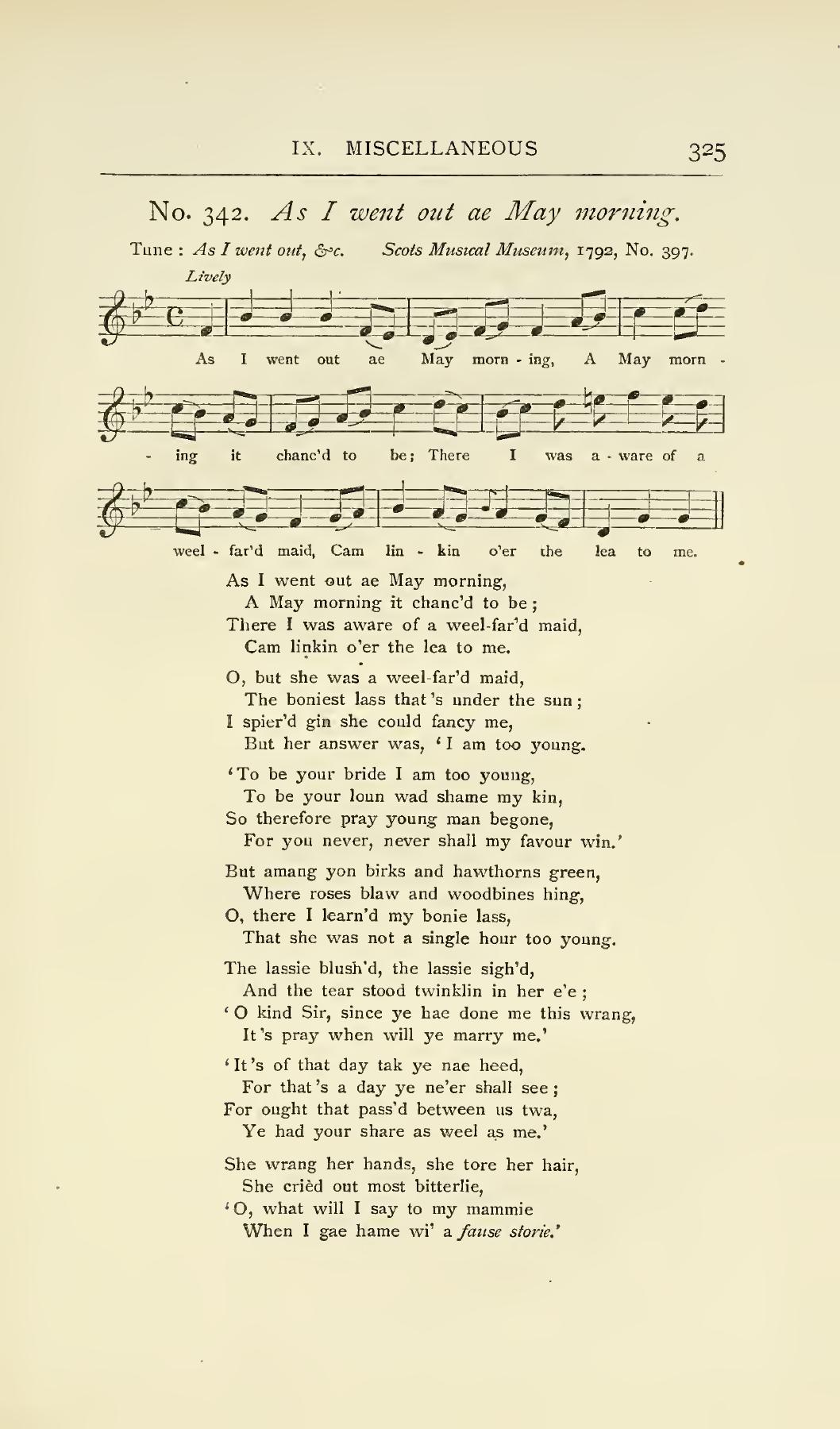 View score Dick’s Songs of Robert Burns (1903)
Lyrics
Choose an edition
Version notes
| Dick (1903) · no. 342 | Scots Musical Museum, vol. IV (1792) · no. 397 |
|---|---|
| When I gae hame wi’ a fause storie. | When I gae hame wi’ my big bellie! |
Dick (1903) · no. 342
As I went out ae May morning.
As I went out ae May morning,
A May morning it chanc'd to be;
There I was aware of a weel-far'd maid,
Cam linkin o'er the lea to me.

O, but she was a weel-far'd maid,
The boniest lass that 's under the sun;
I spier'd gin she could fancy me,
But her answer was, 'I am too young.

'To be your bride I am too young,
To be your loun wad shame my kin,
So therefore pray young man begone,
For you never, never shall my favour win.'

But amang yon birks and hawthorns green,
Where roses blaw and woodbines hing,
O, there I learn'd my bonie lass,
That she was not a single hour too young.

The lassie blush'd, the lassie sigh'd,
And the tear stood twinklin in her e'e;
'O kind Sir, since ye hae done me this wrang,
It's pray when will ye marry me.'

'It's of that day tak ye nae heed,
For that 's a day ye ne'er shall see;
For ought that pass'd between us twa,
Ye had your share as weel as me.'

She wrang her hands, she tore her hair,
She cried out most bitterlie,
'O, what will I say to my mammie
When I gae hame wi' a fause storie.'

'O, as ye maut, so maun ye brew,
And as ye brew, so maun ye tun:
But come to my arms, my ae bonie lass,
For ye never shall rue what ye now hae done.'
View the source edition · As I went out ae May morning.
Scots Musical Museum, vol. IV (1792) · no. 397
View the source edition · Volume 4, no. 397; p. 410
Music
View historical scores
Dick’s Songs of Robert Burns (1903)
As I went out ae May morning.