O, where hae ye been Lord Ronald, my son?
Behind the song
Lord Ronald comes home weary and asks his mother to make his bed. She hears he has been with his sweetheart and asks what he had to eat. Poison, he answers. It takes a mother’s ordinary question to uncover what has happened to her son. [1]
Read the fuller story
Each question occupies two lines, repeating the son’s name and his relationship to the questioner. The mother’s voice holds him close while asking for an explanation. His replies move towards rest: he would gladly lie down, then says that life has become a burden which he will soon lay down. That change gives the repeated request for a bed a terrible new meaning. The homecoming has brought him back to his mother at the moment when she can no longer offer the comfort he needs. [1]
The Scots keeps the dialogue direct. “Hae” means have, “frae” means from, and “fain wad” expresses how gladly he would lie down. Familiar words carry the movement from fatigue to mortal danger. The lover remains offstage, known through Ronald’s answers. The fragment supplies the poison and the relationship, while leaving the circumstances of the betrayal unstated. Its brevity concentrates attention on the mother hearing what has happened. [1]
Dick prints these two quatrains with a row of asterisks beneath them. His note identifies the fragment in the Scots Musical Museum of 1792, no. 327, and quotes Stenhouse’s account that Burns recovered both the ancient ballad fragment and its air. Burns’s role here is the communication of traditional material. Dick points to fuller and different versions in Scott, Kinloch and Child, including a version called Lord Donald and a group headed Lord Randal. Those references show the wider ballad tradition surrounding the small portion preserved here. [2]
The setting is marked “Very slow”. That direction allows the doubled questions and the son’s requests to unfold with painful deliberation. Dick also quotes Burns describing the air as a favourite in Ayrshire and connecting it with Lochaber. His subsequent discussion weighs competing evidence about the priority of related melodies. The tune’s ancestry remains a historical question; its slow pacing gives the short dialogue its expressive space. [1][2]
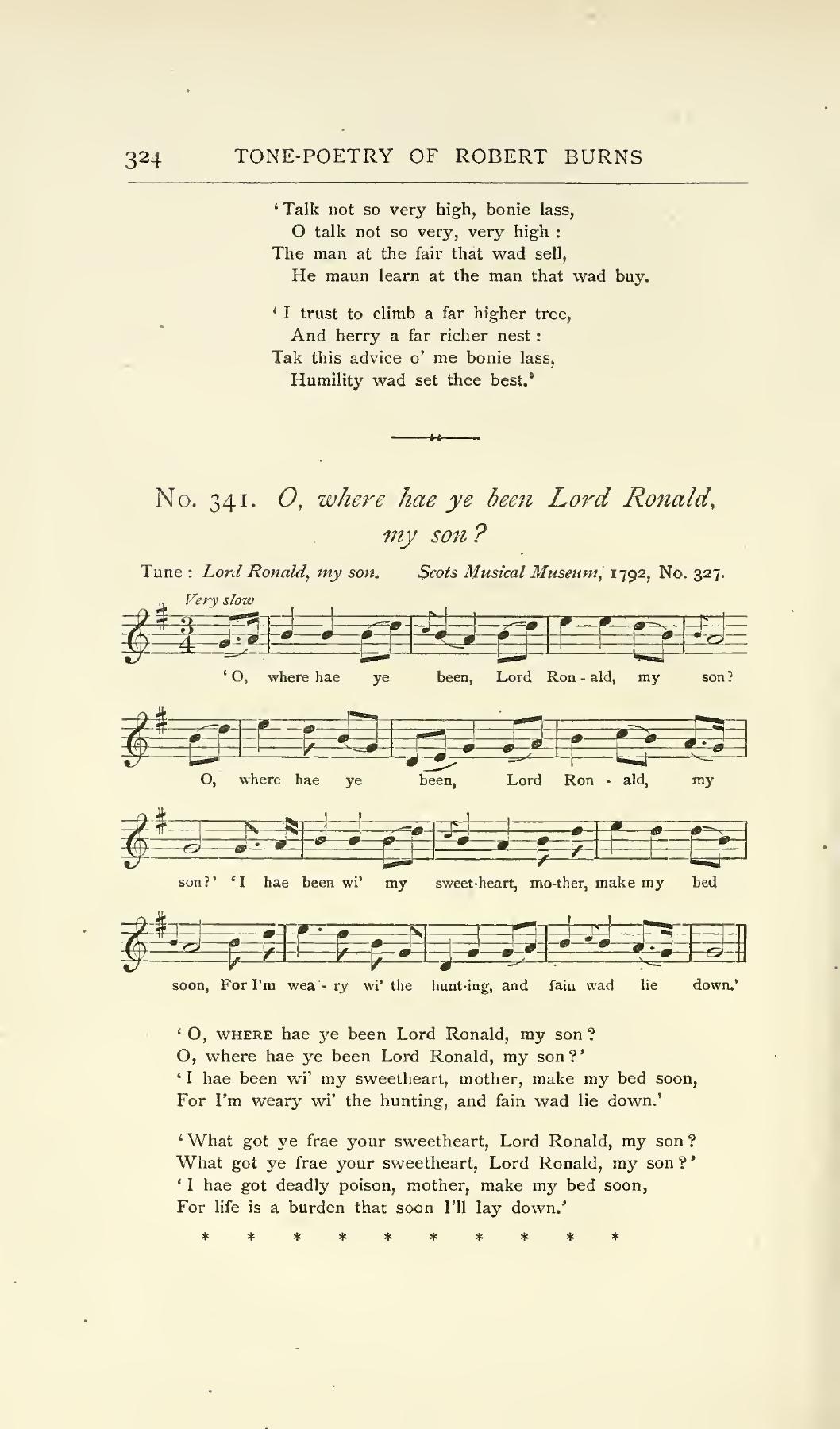 View score Dick’s Songs of Robert Burns (1903)
Lyrics
Choose an edition
Version notes
| Dick (1903) · no. 341 | Scots Musical Museum, vol. IV (1792) · no. 327 |
|---|---|
| Terminal asterisks | Terminal crosses/asterisk-like markers |
Dick (1903) · no. 341
O, where hae ye been Lord Ronald, my son?
'O, where hae ye been Lord Ronald, my son?
O, where hae ye been Lord Ronald, my son?'
'I hae been wi' my sweetheart, mother, make my bed soon,
For I'm weary wi' the hunting, and fain wad lie down.'

'What got ye frae your sweetheart, Lord Ronald, my son?
What got ye frae your sweetheart, Lord Ronald, my son?'
'I hae got deadly poison, mother, make my bed soon,
For life is a burden that soon I'll lay down.'
Fragment from Dick’s 1903 edition.
View the source edition · O, where hae ye been Lord Ronald, my son?
About this edition
Complete printed fragment from Dick’s 1903 edition.
Scots Musical Museum, vol. IV (1792) · no. 327
View the source edition · Volume 4, no. 327; p. 337
Music
View historical scores
Dick’s Songs of Robert Burns (1903)
O, where hae ye been Lord Ronald, my son?