As I cam down by yon Castle wa’
Behind the song
A young man sees a beautiful woman across the flower-borders of a garden and offers five hundred pounds to have such a bride. She answers that even the King of Scotland would find her unwilling to be his queen. The exchange begins as courtship and quickly becomes a contest in pride, with each speaker trying to leave the other at a disadvantage. [1]
Read the fuller story
The flower-borders make a small but effective division in the opening scene. The narrator can see and praise the woman, yet there is already something between them. His offer translates admiration into a price. Her answer raises the stakes extravagantly: she dismisses his money and even the imagined offer of a crown. The song gives her refusal a scale large enough to answer his confidence. [1]
He responds with the language of the fair. Someone who wants to sell, he says, must learn from the person who would buy. That comparison tries to turn her refusal into bad bargaining. In the last stanza he announces that he expects to climb a higher tree and raid a richer nest, before recommending humility to her. His advice is comic because the boast immediately preceding it has displayed his own ambition. [1]
The Scots carries the sharpness of the exchange. “Sairly mistaen” means badly mistaken, “maun” means must, and “herry” means rob or plunder, as in taking a nest’s contents. That final verb gives his imagined search for a better match a predatory edge. The five quatrains end with his speech; the woman’s refusal remains the last answer she gives. The song leaves the disagreement unresolved. [1]
Dick identifies the piece in the Museum of 1792, no. 326. He quotes Burns calling it a very popular Ayrshire song and cites Stenhouse’s account that Burns transmitted both words and music to Johnson. His note also relates it to a short Herd fragment and to the longer Laird of Drumme ballad, where courtship across differences of rank develops into a fuller story. Those relationships are Dick’s account of a song tradition; the selected five stanzas retain their own compact encounter. [2]
The setting is marked “Slow”, with the tune named from the opening line. Its measured pace gives the successive offers, refusals and retorts room to register. The exchange can be sung as a sequence of distinct voices, moving from admiration to outrage and then to a wounded suitor’s attempt to recover his standing. [1]
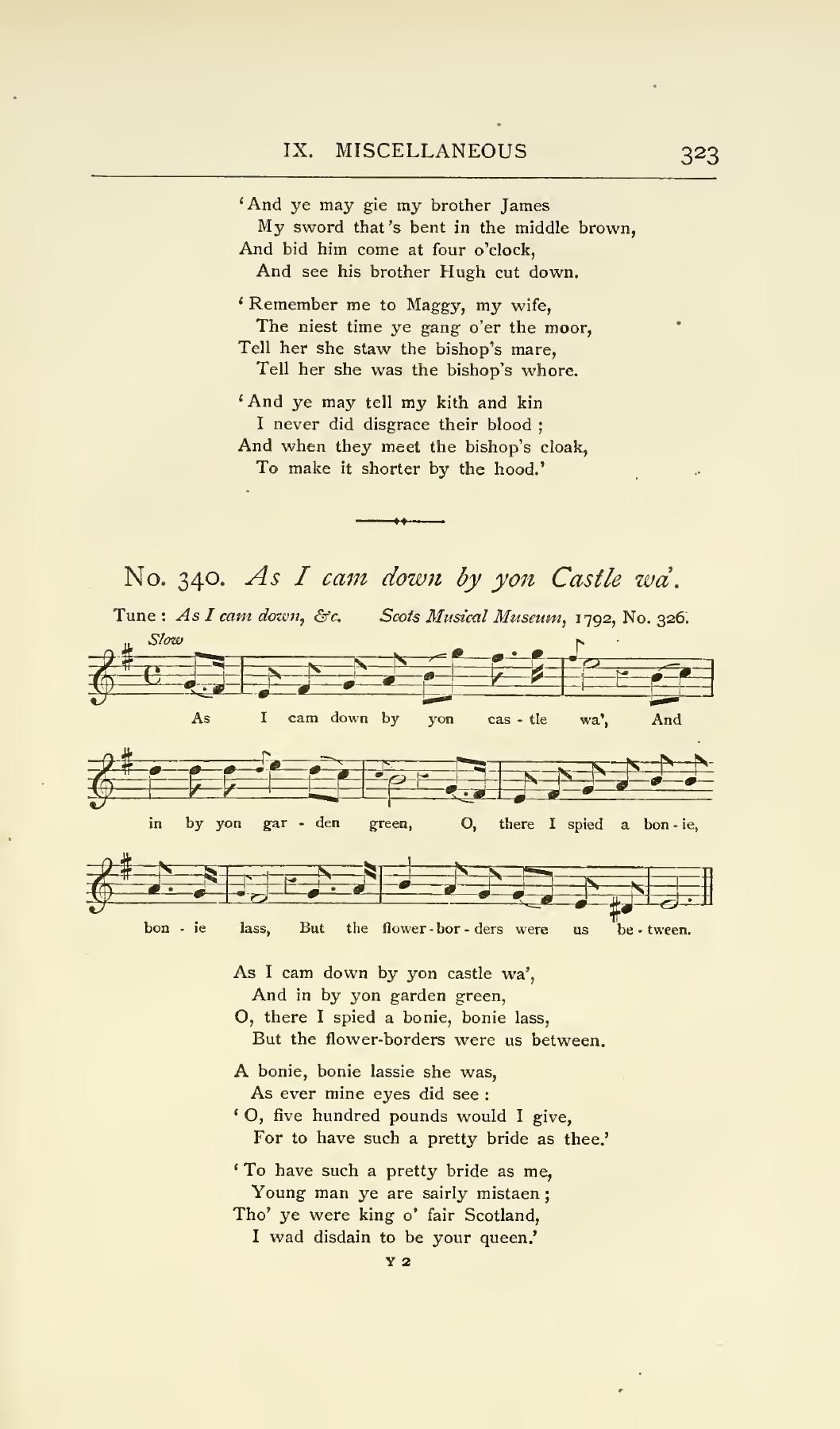 View score Dick’s Songs of Robert Burns (1903)
Lyrics
Choose an edition
Version notes
| Dick (1903) · no. 340 | Scots Musical Museum, vol. IV (1792) · no. 326 |
|---|---|
| bonie | bony |
Dick (1903) · no. 340
As I cam down by yon Castle wa'.
As I cam down by yon castle wa',
And in by yon garden green,
O, there I spied a bonie, bonie lass,
But the flower-borders were us between.

A bonie, bonie lassie she was,
As ever mine eyes did see:
'O, five hundred pounds would I give,
For to have such a pretty bride as thee.'

'To have such a pretty bride as me,
Young man ye are sairly mistaen;
Tho' ye were king o' fair Scotland,
I wad disdain to be your queen.'

'Talk not so very high, bonie lass,
O talk not so very, very high:
The man at the fair that wad sell,
He maun learn at the man that wad buy.

'I trust to climb a far higher tree,
And herry a far richer nest:
Tak this advice o' me bonie lass,
Humility wad set thee best.'
View the source edition · As I cam down by yon Castle wa'.
Scots Musical Museum, vol. IV (1792) · no. 326
View the source edition · Volume 4, no. 326; pp. 336–337
Music
View historical scores
Dick’s Songs of Robert Burns (1903)
As I cam down by yon Castle wa'.