It’s up wi’ the Souters o’ Selkirk
Behind the song
The souters are Selkirk’s shoemakers. Up with them and the lads of the Forest, the singer cries, and down with the Earl of Hume and the Merse. James C. Dick says Burns passed these eight lines to the Scots Musical Museum. How many of the lines he wrote is uncertain. [1][3]
Read the fuller story
“Souters” are shoemakers, and “shoon” means shoes. The lads’ single-soled shoes identify the craft the song celebrates. They are called “trusty and leal”: dependable and loyal. Those qualities receive a much louder endorsement than any individual achievement. The song assumes that declaring the group’s name will be enough to summon fellow feeling. [1][2]
Burns’s connection is with a transmitted fragment. Dick describes the eight lines as material communicated by Burns to the Scots Musical Museum, where he dates their publication to 1796 as no. 438. He reports a manuscript carrying Burns’s remark that the tune could be found anywhere and suggests that the first four lines probably came from Herd. The extent of Burns’s own writing remains uncertain; his role in bringing the fragment into the collection is the clearer part of Dick’s narrative. [3]
The song gathered an argument about the past. Dick recounts a story, associated with William Tytler, in which the town clerk led eighty Selkirk shoemakers to fight for the king at Flodden. He then gives the objections: Joseph Ritson mocked the number, and Walter Scott defended the antiquity of the shoemakers’ fraternity while judging the song’s connection with Flodden highly improbable. These competing explanations matter because the lyric’s confident loyalties can sound as if they refer to a familiar historical episode. The later commentators themselves disagreed about that episode. [3]
There were also more words in circulation than the eight lines Burns transmitted. Dick quotes a middle stanza from Scott’s Minstrelsy and reports that Stenhouse had heard another form in his younger days. Those versions show a song capable of receiving different local expressions of allegiance. The short reading here preserves the particular fragment Dick prints, with its praise of the Souters and its closing dismissal of their rivals. [3]
Dick heads his setting with a reference to Craig’s Scots Tunes of 1730 and marks it “Briskly”. His note traces other early appearances of the melody, making a distinction between the tune’s circulation and the later publication of the Burns-associated words. The brisk direction suits the eight-line sequence of cheers and taunts. The quick alternation between “up” and “down” invites the company to cheer the Souters and dismiss their rivals. [1][3]
Story references
- James C. Dick, The Songs of Robert Burns (1903), no. 338, p. 321, eight-line fragment and setting.
- Allan Cunningham, ed., The Complete Works of Robert Burns (1855), glossary, “Leal”, “Shoon” and “Souter”; Project Gutenberg transcription.
- James C. Dick, The Songs of Robert Burns (1903), note 338, p. 490.
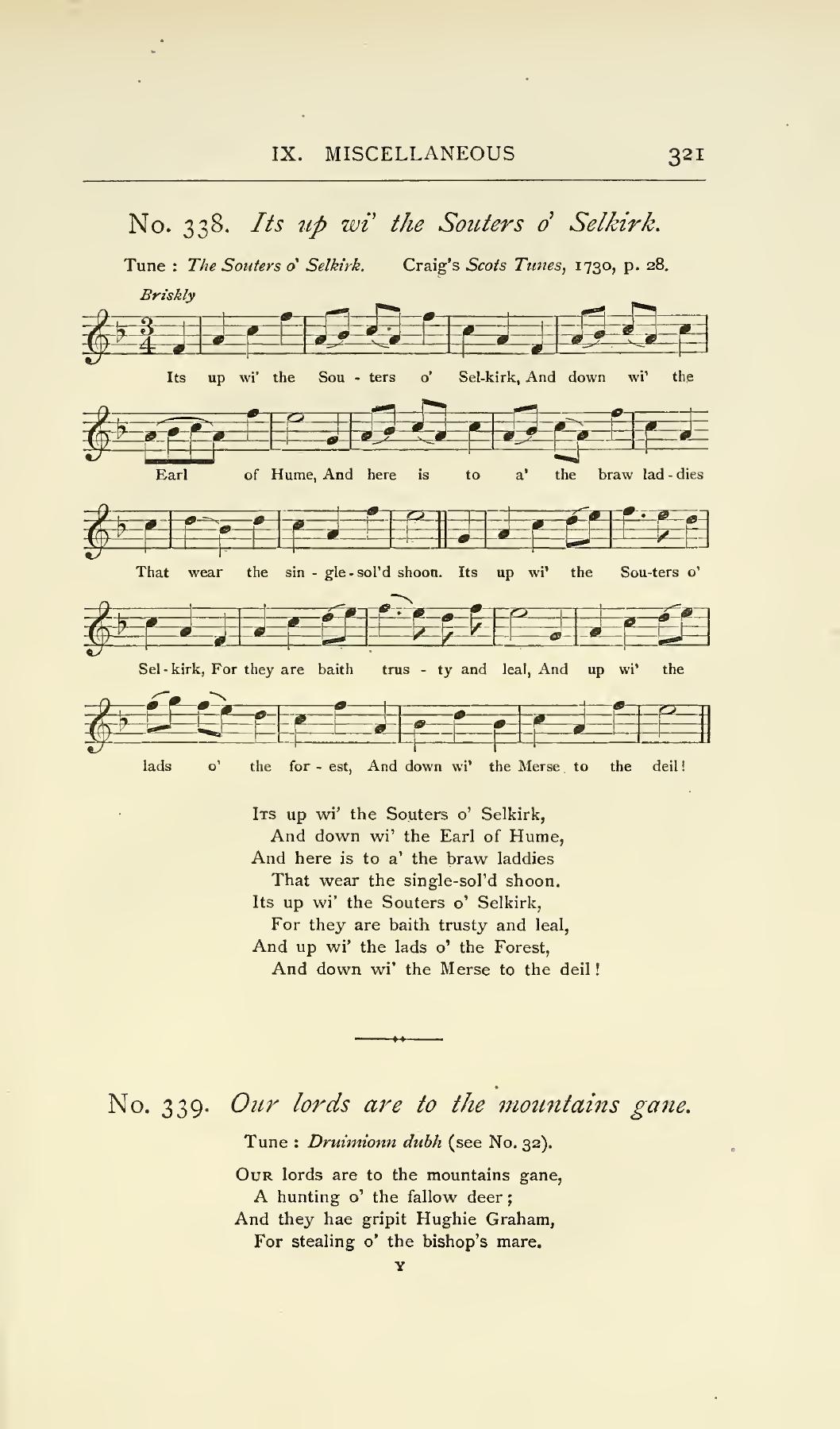 View score Dick’s Songs of Robert Burns (1903)
Lyrics
Version notes
| Dick (1903) · no. 338 | Scots Musical Museum, vol. V (catalogued 1796) · no. 438 |
|---|---|
| single-sol’d shoon | single soal’d shoon |
Dick (1903) · no. 338
Its up wi' the Souters o' Selkirk.
Its up wi' the Souters o' Selkirk,
And down wi' the Earl of Hume,
And here is to a' the braw laddies
That wear the single-sol'd shoon.
Its up wi' the Souters o' Selkirk,
For they are baith trusty and leal,
And up wi' the lads o' the Forest,
And down wi' the Merse to the deil!
Fragment from Dick’s 1903 edition.
View the source edition · Its up wi' the Souters o' Selkirk.
About this edition
Complete printed fragment from Dick’s 1903 edition.
Scots Musical Museum, vol. V (catalogued 1796) · no. 438
View the source edition · Volume 5, no. 438; p. 450
Music
View historical scores
Dick’s Songs of Robert Burns (1903)
Its up wi' the Souters o' Selkirk.