There liv’d a man in yonder glen!
Behind the song
John Blunt and his wife agree that the first to speak must get up and bar the door. It stands open while strangers enter. Each new indignity puts a higher price on the pleasure of making the other one get up. [1]
Read the fuller story
John begins with a good reputation: he makes malt and brews fine ale. A sharp wind blowing through the house prompts him to tell his wife to shut the door. Their ‘paction’, or agreement, transfers the task to the first speaker. The repeated reference to barring the door makes that trivial duty the measure against which every later danger is absurdly weighed.[1]
Three travellers who have lost their way follow the light to the house. They pull the wife from her bed and lay her on the floor, yet she stays silent. John finally protests that they have eaten his bread, drunk his ale and are about to sexually dishonour his wife. Her immediate reply announces his defeat: he has spoken first and must now bar the door. The comic reversal depends on her treating the broken agreement as the decisive event, even amid the threat of assault.[1]
James C. Dick identifies a Museum printing of 1792, no. 365, and reports two manuscript versions in Burns’s handwriting. He presents the song as Burns’s treatment of a much older, widely travelled tale. His note compares an Italian version and the familiar Scottish ‘The barrin o’ the door’, printed in Herd’s collection, where a different set of intrusions also provokes the husband into speech.[2]
Dick further accepts Stenhouse’s statement that Burns communicated the tune ‘Johnie Blunt’. The printed setting is marked ‘Gaily’ and carries the first quatrain beneath the score. Six quatrains tell the story economically, allowing the final command to shut the door to return as the punchline to the quarrel that began it.[1][2]
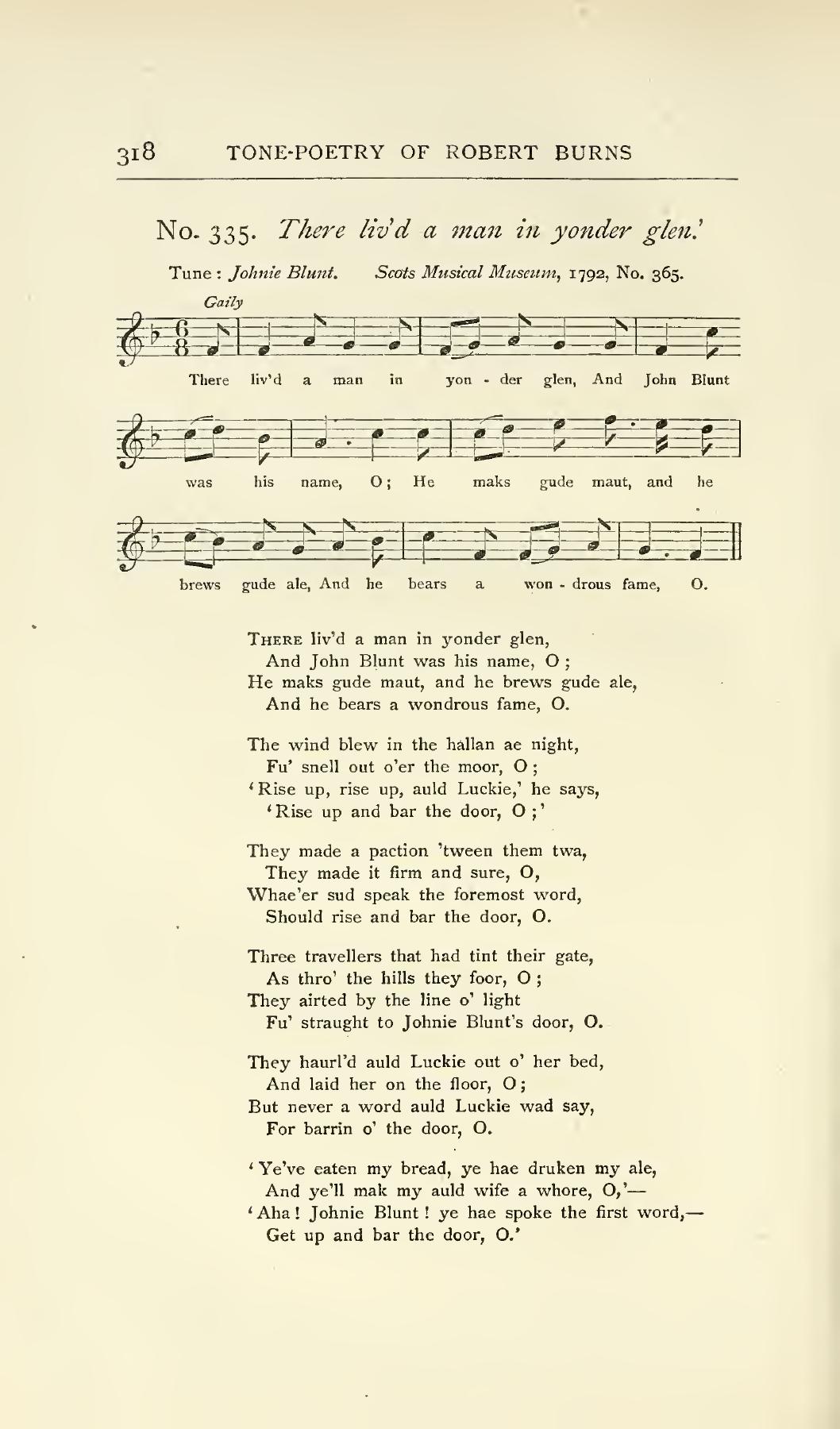 View score Dick’s Songs of Robert Burns (1903)
Lyrics
Choose an edition
Version notes
| Dick (1903) · no. 335 | Scots Musical Museum, vol. IV (1792) · no. 365 |
|---|---|
| drunken | druken |
Dick (1903) · no. 335
There liv'd a man in yonder glen.
There liv'd a man in yonder glen,
And John Blunt was his name, O;
He maks gude maut, and he brews gude ale,
And he bears a wondrous fame, O.

The wind blew in the hallan ae night,
Fu' snell out o'er the moor, O;
'Rise up, rise up, auld Luckie,' he says,
'Rise up and bar the door, O;'

They made a paction 'tween them twa,
They made it firm and sure, O,
Whae'er sud speak the foremost word,
Should rise and bar the door, O.

Three travellers that had tint their gate,
As thro' the hills they foor, O;
They airted by the line o' light
Fu' straught to Johnie Blunt's door, O.

They haurl'd auld Luckie out o' her bed,
And laid her on the floor, O;
But never a word auld Luckie wad say,
For barrin o' the door, O.

'Ye've eaten my bread, ye hae drunken my ale,
And ye'll mak my auld wife a whore, O,'—
'Aha! Johnie Blunt! ye hae spoke the first word,—
Get up and bar the door, O.'
View the source edition · There liv'd a man in yonder glen.
Scots Musical Museum, vol. IV (1792) · no. 365
View the source edition · Volume 4, no. 365; p. 376
Music
View historical scores
Dick’s Songs of Robert Burns (1903)
There liv'd a man in yonder glen.