It was in sweet Senegal
Behind the song
Taken from Senegal and enslaved in Virginia, the singer remembers the shore from which he was carried away. In Virginia he must shoulder a burden and live in fear of the scourge. Every stanza brings him back to the same cry of weariness. [1]
Published as The Slave’s Lament in the Scots Musical Museum in 1792, the song reached the collection through Burns, according to William Stenhouse. He credits Burns with sending both words and air. How much Burns composed remains uncertain. [2]
Read the fuller story
The first stanza compresses capture and removal into four lines. The speaker was taken by enemies, torn from a beloved shore and carried to Virginia, with no expectation of seeing home again. The song creates a first-person voice through which a listener encounters the pain of enslavement. Its emotional force rests on that immediate appeal. [1]
The middle stanza dwells on the remembered landscape. Senegal has flowing streams, continuing flowers and freedom from bitter snow and frost. These are the singer’s consoling images of home. Their abundance makes the loss sharper: the word “sweet” in the opening has prepared a place that memory can keep returning to. The final stanza brings the song back to coercion. Alongside the physical burden and threatened punishment come thoughts of dear friends and bitter tears. Separation from other people gives the contrast between the two places its deepest human meaning. [1]
Dick prints the piece as “The slave’s lament”, with its tune, and identifies its appearance in the Scots Musical Museum in 1792 as no. 384. His note cites Stenhouse’s account that Burns communicated both the verses and the air. That account supports Burns’s part in transmitting the song; it leaves the extent of his composition uncertain. Dick also reports Sharpe’s belief that the words were made from an older street ballad about a young woman betrayed and sent to Virginia. The proposed connection remains uncertain. [2]
The printed music gives the lament room to linger. Each of the three quatrains has a direction to repeat its final two lines, and the broken repetition of Virginia’s name keeps the place audible inside the refrain. The repeated weariness gathers the three experiences together: removal, remembered home and life under compulsion. A singer can make that return feel heavier each time without adding anything to the words. [1]
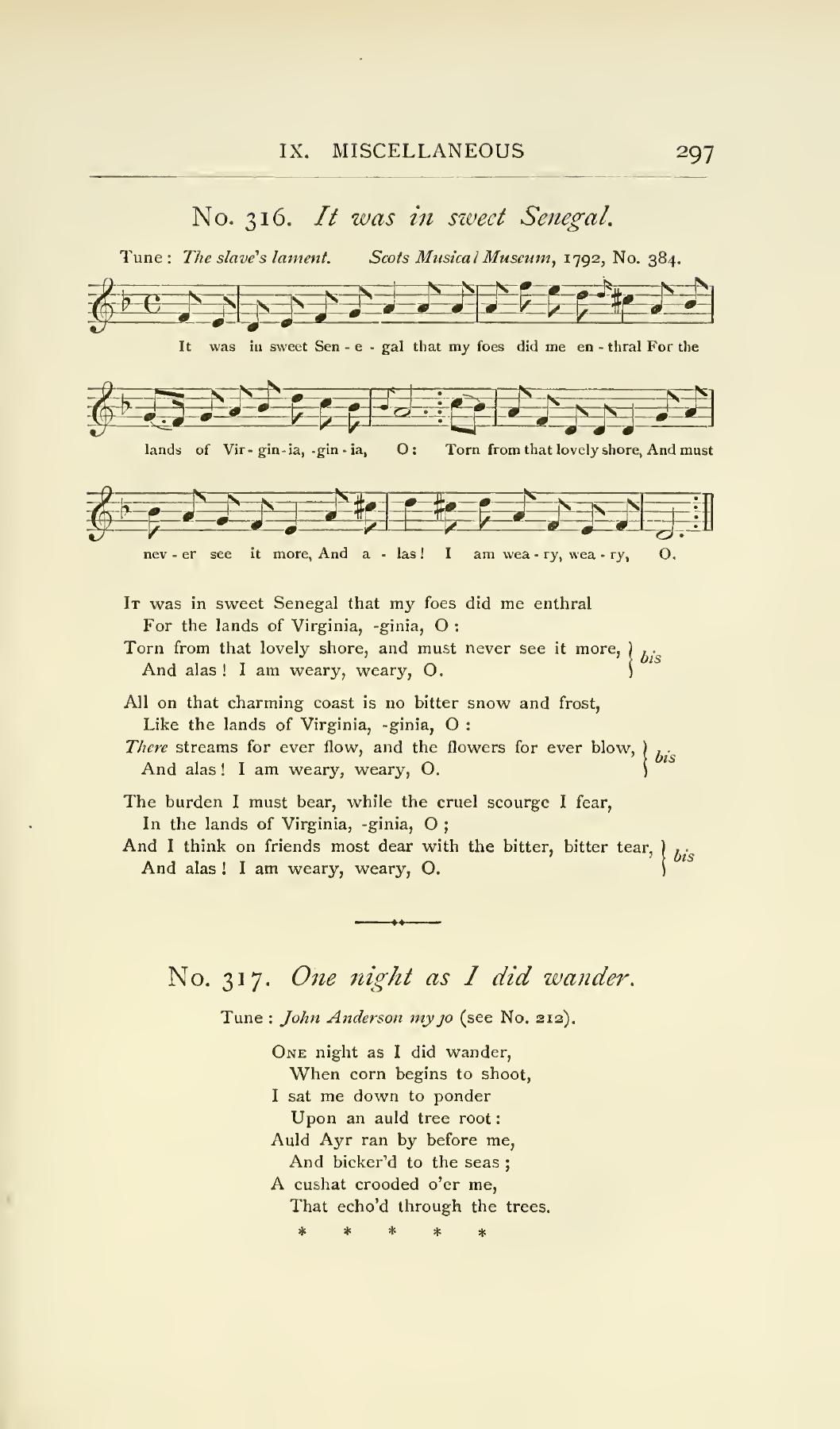 View score Dick’s Songs of Robert Burns (1903)
Lyrics
Choose an edition
Version notes
| Dick (1903) · no. 316 | Scots Musical Museum, vol. IV (1792) · no. 384 |
|---|---|
| bis for final two lines in each stanza | First-stanza ending repeated in underlay; There streams &c. and And I think &c. later |
| for ever flow | forever flow |
| and the flowers | and there flowers |
Dick (1903) · no. 316
It was in sweet Senegal.
It was in sweet Senegal that my foes did me enthral
For the lands of Virginia, -ginia, O:
Torn from that lovely shore, and must never see it more,
And alas! I am weary, weary, O.

All on that charming coast is no bitter snow and frost,
Like the lands of Virginia, -ginia, O:
There streams for ever flow, and the flowers for ever blow,
And alas! I am weary, weary, O.

The burden I must bear, while the cruel scourge I fear,
In the lands of Virginia, -ginia, O;
And I think on friends most dear with the bitter, bitter tear,
And alas! I am weary, weary, O.
View the source edition · It was in sweet Senegal.
Scots Musical Museum, vol. IV (1792) · no. 384
View the source edition · Volume 4, no. 384; p. 398
Music
View historical scores
Dick’s Songs of Robert Burns (1903)
It was in sweet Senegal.