’Twas on a Monday morning
Behind the song
Charlie’s arrival turns a town visit into a flirtation. The song introduces the young Chevalier through the excitement he causes: he notices a young woman at a window, runs upstairs and is readily admitted. The chorus’s repeated ‘my darling’ makes his public identity sound intimate and affectionate.[1]
Read the fuller story
The action moves quickly from street to doorway. Charlie ‘tirl’d at the pin’, rattling the door’s latch, and the woman herself lets him in. Soon Jenny is sitting on his knee while he wears his Highland dress. The narrator credits him with knowing how to please a lass, making personal charm the centre of this miniature portrait.[1]
The final stanza moves away from Jenny’s room to the heathery mountain and scrubby glen. There, the speakers say they dare not go milking because of Charlie and his men. The change of setting gives the admiration a more uneasy edge: the men’s presence affects ordinary work as well as courtship. The lyric leaves that closing apprehension beside the chorus’s delight.[1]
James C. Dick places the song in the Scots Musical Museum of 1796, no. 428, under ‘Charlie he’s my darling’. He reports a manuscript in Burns’s handwriting and quotes Stenhouse’s statement that Burns communicated the song to the Museum. Dick argues that it is probably wholly original because he found no trace of an earlier song. That argument is an inference from his search, while the manuscript and transmission statements are his reported evidence.[2]
Dick also disputes the account of the tune’s modernisation given by Stenhouse, describing differences between the air he prints and a later form. The score here carries the opening stanza and the affectionate chorus as separate musical sections. Its movement from the announcement of Charlie’s arrival into the repeated endearment mirrors the way the verses turn a political figure into a charming visitor.[1][2]
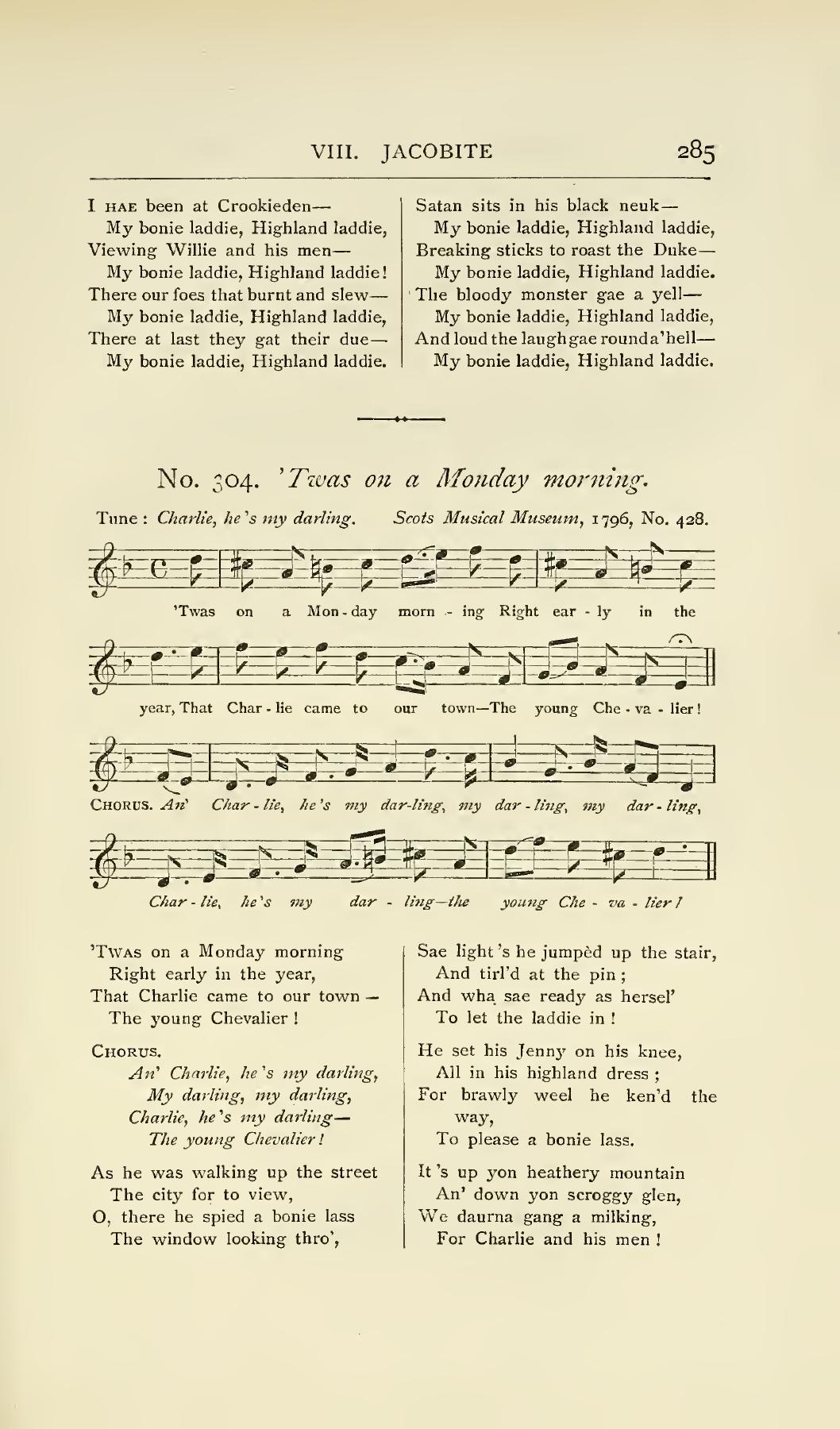 View score Dick’s Songs of Robert Burns (1903)
Lyrics
Version notes
| Dick (1903) · no. 304 | Scots Musical Museum, vol. V (catalogued 1796) · no. 428 |
|---|---|
| jumpèd / tirl’d | jimped / tirled |
| daurna | daur na |
| One separately printed chorus block | An’ Charlie &c. after each later stanza |
| brawly weel | brawlie weel |
More differences between these editions
| Dick (1903) · no. 304 | Scots Musical Museum, vol. V (catalogued 1796) · no. 428 |
|---|---|
| heathery mountain | hethery mountain |
| An’ down yon scroggy glen | And down yon scroggy glen |
Dick (1903) · no. 304
'Twas on a Monday morning.
'Twas on a Monday morning
Right early in the year,
That Charlie came to our town—
The young Chevalier!
CHORUS
An' Charlie, he's my darling,
My darling, my darling,
Charlie, he's my darling—
The young Chevalier!

As he was walking up the street
The city for to view,
O, there he spied a bonie lass
The window looking thro',

Sae light's he jumpèd up the stair,
And tirl'd at the pin;
And wha sae ready as hersel'
To let the laddie in!

He set his Jenny on his knee,
All in his highland dress;
For brawly weel he ken'd the way
To please a bonie lass.

It's up yon heathery mountain
An' down yon scroggy glen,
We daurna gang a milking,
For Charlie and his men!
View the source edition · 'Twas on a Monday morning.
Scots Musical Museum, vol. V (catalogued 1796) · no. 428
View the source edition · Volume 5, no. 428; p. 440
Music
View historical scores
Dick’s Songs of Robert Burns (1903)
'Twas on a Monday morning.