There grows a bonie brier-bush in our kail-yard
Behind the song
A lass and a lad are busy courting beneath a brier-bush in the kail-yard, the household’s vegetable garden. The opening repeats the place before revealing what is happening there. In the next stanza the lovers decide to move to Athole’s green, where trees and branches will shelter them from view. A familiar domestic corner gives way to the promise of greater privacy. [1]
Read the fuller story
The song then changes direction through a series of invitations and decisions. Someone is asked to dance in Carlyle’s hall, where Sandy and Nancy are expected to outdo everyone, and the answer is a refusal. Another question follows: what will the singer do for a lad when Sandy goes away? Edinburgh offers the prospect of earning a little money and attracting somebody new. The verses keep love in motion, through places to meet, invitations to accept or reject, departure and the possibility of another attachment. [1]
The final stanza answers that possibility with an approaching figure. He comes from the North, with a feather in his bonnet and a ribbon at his knee, and the repeated expectation that he will fancy the singer becomes a delighted announcement: there he is. The lad’s arrival gives the sequence a visible endpoint after its shifting plans. Repeated opening lines in each stanza let the singer dwell on one prospect before moving to the next. [1]
James C. Dick places the song among his Jacobite material and identifies its Museum appearance in 1796. His note reports a manuscript in Burns’s handwriting and considers the suggestion that Burns altered an older song. He finds that earlier history uncertain, while quoting William Stenhouse’s claim that Burns wrote the song apart from a few old lines and supplied its air. The precise division between inherited words and new writing therefore remains open in his account. [2]
Dick also describes a later imitation by Baroness Nairne and a version in the Scottish Minstrel of 1821 combining Burns and Nairne. That later combination is a separate stage in the song’s life. The five stanzas printed here preserve Dick’s selected form, moving from the garden lovers through dancing and departure to the northern lad’s arrival. [2]
The tune is headed The bonie brier-bush and the setting is marked “Briskly”. The repeated lines give the melody room to establish each new situation, while the longer third line introduces its particular detail. In the final stanza, bonnet feather and knee ribbon lead into the short, immediate recognition of the lad himself. [1]
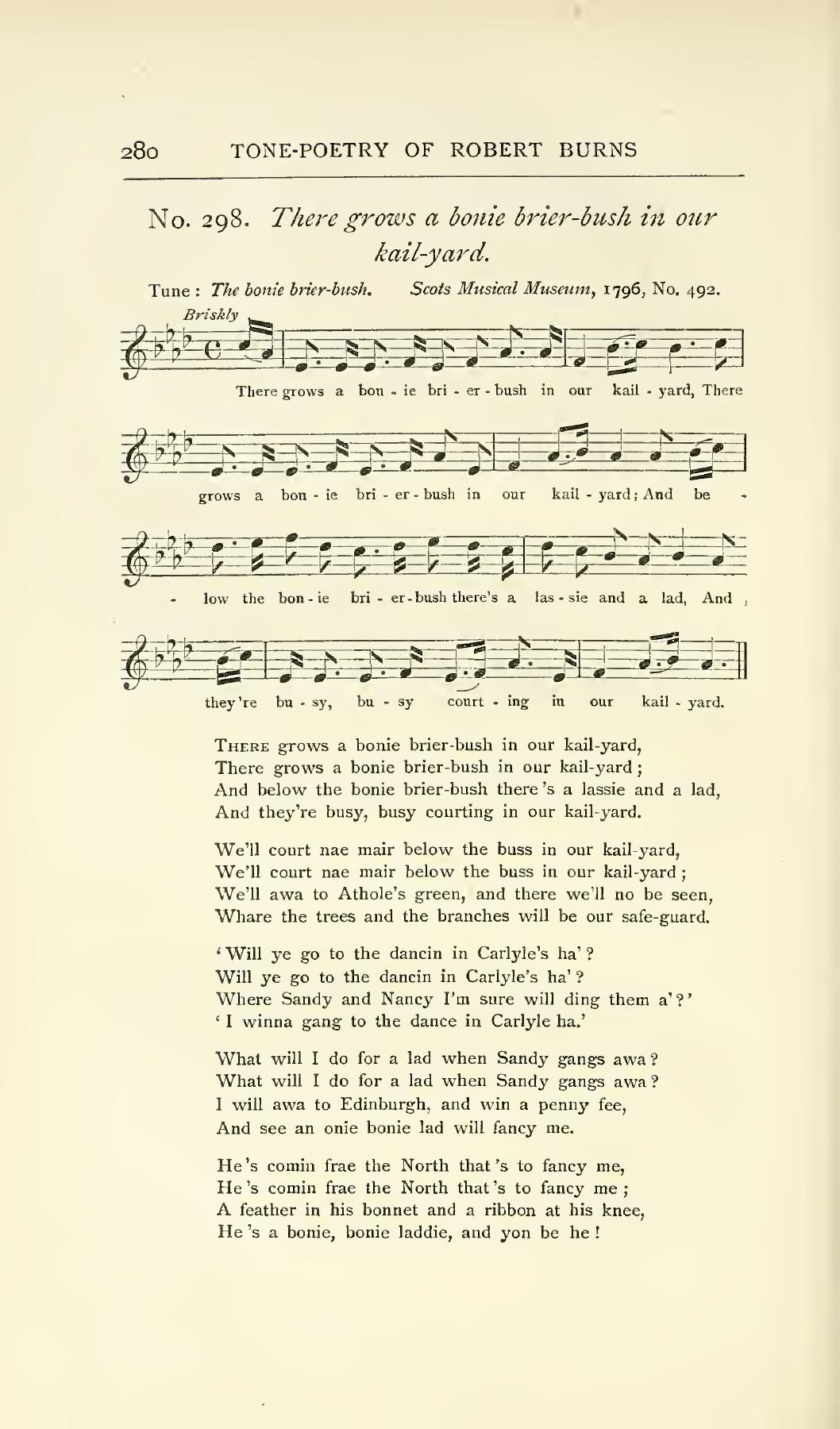 View score Dick’s Songs of Robert Burns (1903)
Lyrics
Version notes
| Dick (1903) · no. 298 | Scots Musical Museum, vol. V (catalogued 1796) · no. 492 |
|---|---|
| Where Sandy and Nancy | Whare Sandy and Nancy |
| penny fee | pennie fee |
| Carlyle ha. | Carlyle-ha. |
| yon be he! | yon be he. |
Dick (1903) · no. 298
There grows a bonie brier-bush in our kail-yard.
There grows a bonie brier-bush in our kail-yard,
There grows a bonie brier-bush in our kail-yard;
And below the bonie brier-bush there's a lassie and a lad,
And they're busy, busy courting in our kail-yard.

We'll court nae mair below the buss in our kail-yard,
We'll court nae mair below the buss in our kail-yard;
We'll awa to Athole's green, and there we'll no be seen,
Whare the trees and the branches will be our safe-guard.

'Will ye go to the dancin in Carlyle's ha'?
Will ye go to the dancin in Carlyle's ha'?
Where Sandy and Nancy I'm sure will ding them a'?'
'I winna gang to the dance in Carlyle ha.'

What will I do for a lad when Sandy gangs awa?
What will I do for a lad when Sandy gangs awa?
I will awa to Edinburgh, and win a penny fee,
And see an onie bonie lad will fancy me.

He's comin frae the North that's to fancy me,
He's comin frae the North that's to fancy me;
A feather in his bonnet and a ribbon at his knee,
He's a bonie, bonie laddie, and yon be he!
View the source edition · There grows a bonie brier-bush in our kail-yard.
Scots Musical Museum, vol. V (catalogued 1796) · no. 492
View the source edition · Volume 5, no. 492; p. 508
Music
View historical scores
Dick’s Songs of Robert Burns (1903)
There grows a bonie brier-bush in our kail-yard.