My heart is wae, and unco wae
Behind the song
A raging sea separates the singer from the bonnie Lass of Albanie. Soon we hear what else she has lost, the towers and lands the singer claims for her by royal right. James C. Dick identifies the Lass as Prince Charles Stuart’s daughter. He offers only a possible occasion for the song. [1][2]
The singer longs to welcome her back with pipes and drums. Grief for an absent woman has become a Jacobite hope of restoring a royal family. [1]
Read the fuller story
“Wae” means sorrowful; “unco wae” intensifies it into very great grief. The repetition makes the first line almost a spoken lament. The sea roars between the woman and the green gardens that the speaker regards as hers. Later, towers and lands are claimed as her royal right. Affection and ownership run together: the landscape is presented as a home from which its proper possessor has been kept away.[1]
The six stanzas sharpen that grievance by stages. Royal descent is asserted, then a princely place on the Clyde is imagined as hers. A “witless youth” occupies the place where she ought to be, and a “false usurper” has won supremacy. “Wan the gree” means gained the victory or first place. These are the partisan judgements of the song’s voice. Its strongest emotional move comes at the end, when solitary sorrow opens into a collective “we”, praying daily and nightly for the homecoming.[1]
James C. Dick connects the Lass with Prince Charles Stuart’s daughter and the disputed expectations surrounding her status. He says the song is supposed to have followed news of a supposed marriage between Charles and Miss Walkinshaw. His repeated qualifications matter: this is a proposed occasion, not a securely dated account of composition. He also reports a formal declaration legitimating the daughter, registered in France in December 1787, and an assumption after Charles’s death that she was his sole heir. Those statements describe the historical explanation offered by Dick; they do not establish the song’s claims to property or succession.[2]
Dick cites Chambers’s 1852 edition and a later facsimile, and prints the words to “Mary’s dream”, marked “Slow”. He attributes that melody to John Lowe and identifies his musical source as the Perth Musical Miscellany of 1786. The slow setting suits the recurring grief, while the final pipe-and-drum welcome remains an imagined future within the words. The song’s force lies in that movement from loss to expectation: political allegiance is made audible as longing for someone to come home.[1][2]
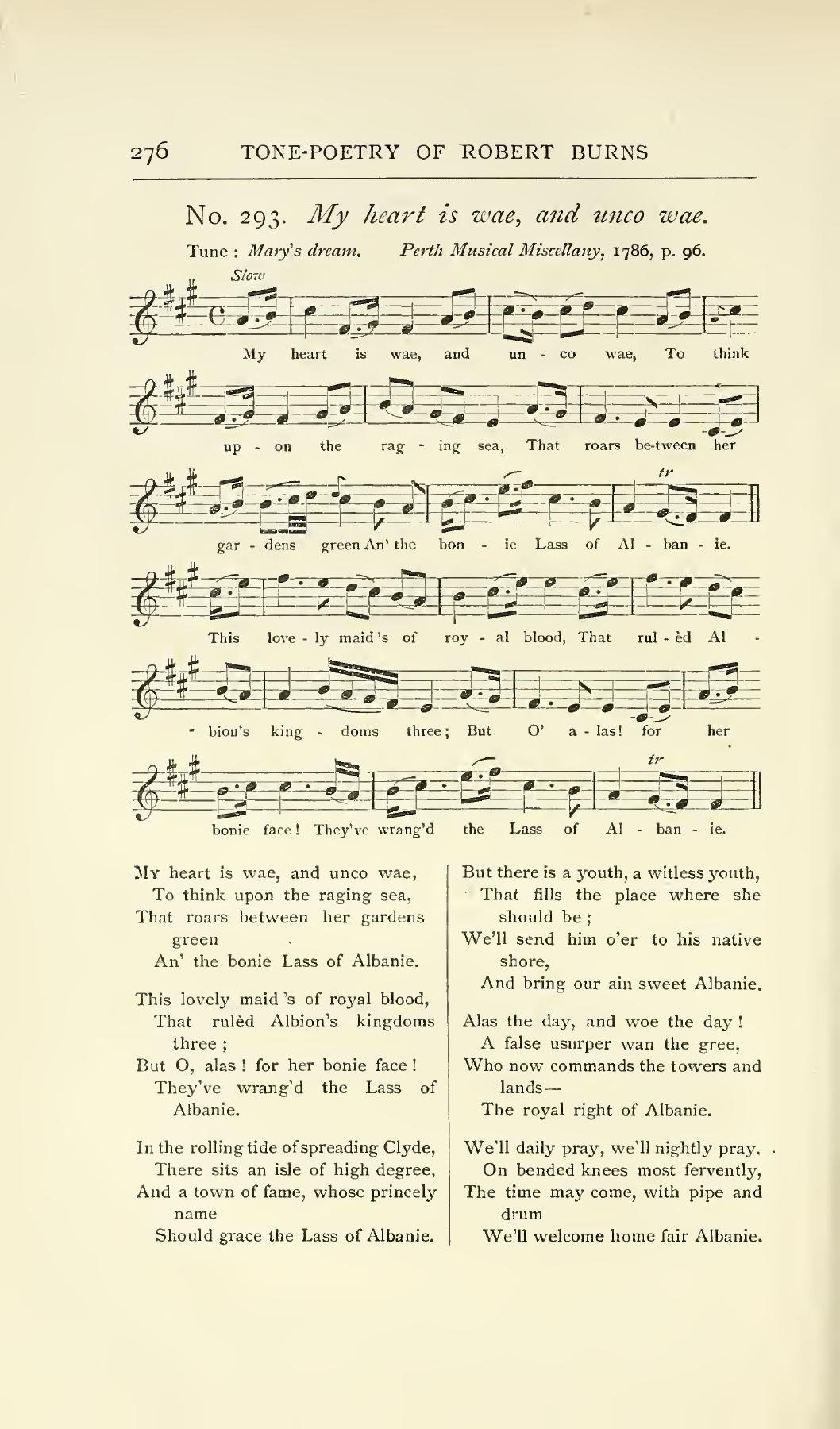 View score Dick’s Songs of Robert Burns (1903)
Lyrics
Dick (1903) · no. 293
My heart is wae, and unco wae.
My heart is wae, and unco wae,
To think upon the raging sea,
That roars between her gardens green
An' the bonie Lass of Albanie.

This lovely maid's of royal blood,
That rulèd Albion's kingdoms three;
But O, alas! for her bonie face!
They've wrang'd the Lass of Albanie.

In the rolling tide of spreading Clyde,
There sits an isle of high degree,
And a town of fame, whose princely name
Should grace the Lass of Albanie.

But there is a youth, a witless youth,
That fills the place where she should be;
We'll send him o'er to his native shore,
And bring our ain sweet Albanie.

Alas the day, and woe the day!
A false usurper wan the gree,
Who now commands the towers and lands—
The royal right of Albanie.

We'll daily pray, we'll nightly pray,
On bended knees most fervently,
The time may come, with pipe and drum
We'll welcome home fair Albanie.
View the source edition · My heart is wae, and unco wae.
Music
View historical scores
Dick’s Songs of Robert Burns (1903)
My heart is wae, and unco wae.