Sir John Cope trode the north right far
Behind the song
In the song Sir John Cope sends Charlie a challenge from Dunbar. By the time anyone asks him where his soldiers are, Cope has fled to Berwick and has to admit he left them behind. The chorus keeps offering the same morning greeting. Are you awake yet, Johnnie Cope? [1]
Read the fuller story
The opening follows Cope through the north to Dunbar, where he sends Charlie a challenge. Charlie draws his sword and answers readily. Cope’s subsequent language is fierce, but the narrator repeatedly imagines him taking wing like a frightened bird. The Highland men appear with tartan clothing, white cockades and weapons; their arrival gives the song its opportunity to turn martial display into Cope’s humiliation. [1]
The later stanzas carry the ridicule through flight and arrival elsewhere. Cope seeks a warship at Dunbar and hopes to pass as a sailor, then rides into Berwick. Asked what has become of his men, he says he does not know and has left them behind. Lord Mark Car’s final dismissal completes the disgrace. The satire makes the commander supply the words that condemn him. [1]
The repeated morning ending binds the episodes together even as the narrative moves between places. In the chorus, “wauking” means waking and “wit” means know. The questions pretend that Cope merely needs rousing, while the verses insist on his fear and flight. The audience can join that questioning voice: the printed score gives the chorus its own marked place after the opening stanza. [1]
Dick’s note connects the satire with Cope’s defeat at Prestonpans in 1745 and quotes Robert Riddell’s account of its commemorative purpose. His discussion also explains why the song appears in a Burns collection. He cites Law’s manuscript list, where it is marked as Burns’s old words, as evidence that Burns supplied it to Johnson’s Museum. The note distinguishes this act of transmission from secure original authorship. Dick disputes Stenhouse’s attribution to Adam Skirving and discusses several different Johnnie Cope ballads. The author of the present version remains uncertain in that account. [2]
The tune is headed “Johnie Cope” and marked “In moderate time”. Dick reports Burns remembering it as the air of an older song whose title asked about going to the coals in the morning. That remembered title offers another morning refrain in the tune’s history. In the selected eleven stanzas and chorus, the repeated summons has become a way of keeping a defeated commander permanently answerable to the singers. [1][2]
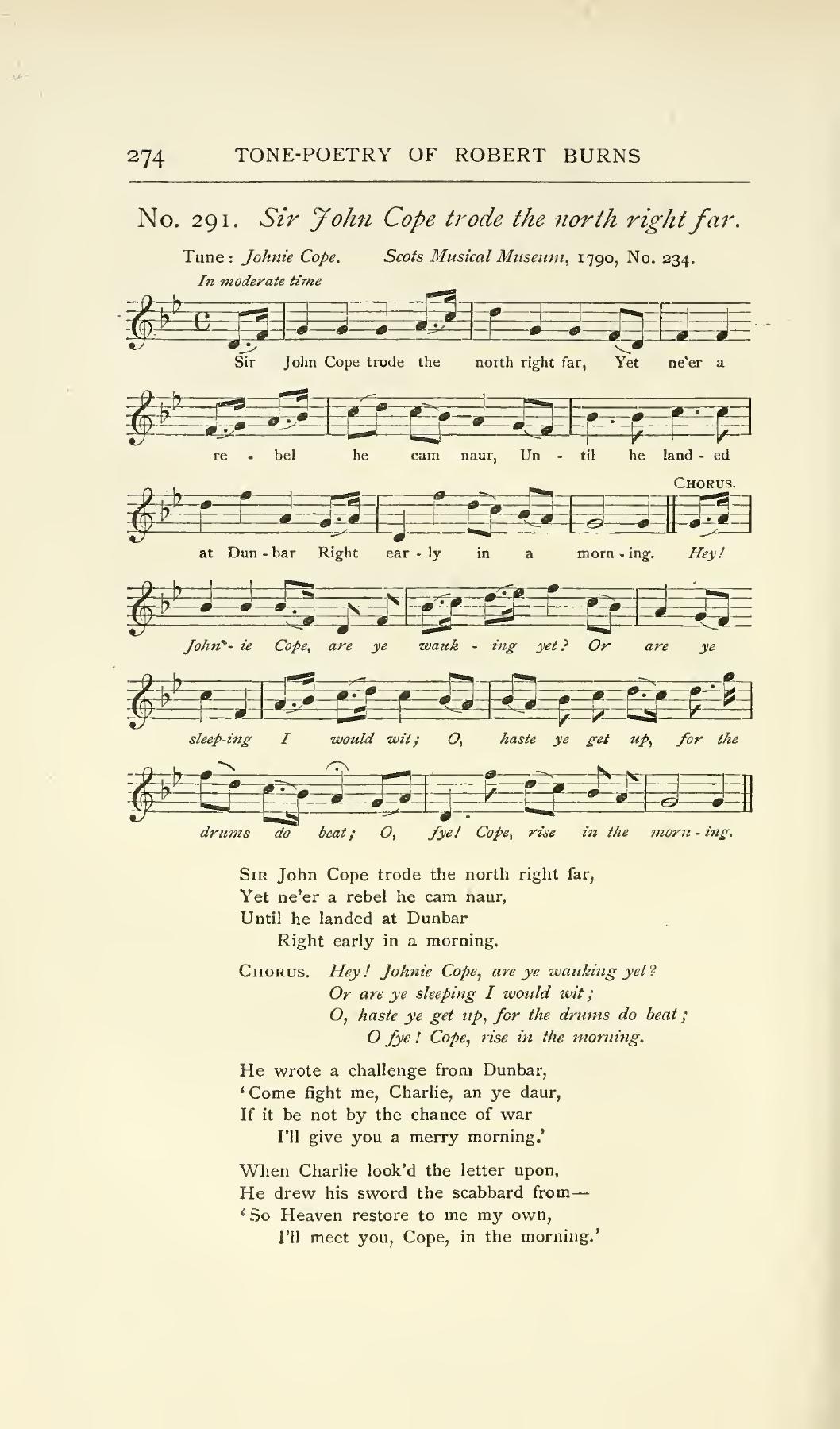 View score Dick’s Songs of Robert Burns (1903)
Lyrics
Choose an edition
Dick (1903) · no. 291
Sir John Cope trode the north right far.
Sir John Cope trode the north right far,
Yet ne'er a rebel he cam naur,
Until he landed at Dunbar
Right early in a morning.
CHORUS
Hey! Johnie Cope, are ye wauking yet?
Or are ye sleeping I would wit;
O, haste ye get up, for the drums do beat;
O fye! Cope, rise in the morning.

He wrote a challenge from Dunbar,
'Come fight me, Charlie, an ye daur,
If it be not by the chance of war
I'll give you a merry morning.'

When Charlie look'd the letter upon,
He drew his sword the scabbard from—
'So Heaven restore to me my own,
I'll meet you, Cope, in the morning.'

Cope swore, with many a bloody word,
That he would fight them gun and sword,
But he fled frae his nest like an ill-scar'd bird,
And Johnie took wing in the morning.

It was upon an afternoon,
Sir Johnie march'd to Preston town,
He says, 'My lads come lean you down,
And we'll fight the boys in the morning.'

But when he saw the Highland lads,
Wi' tartan trews and white cockauds,
Wi' swords, and guns, and rungs, and gauds—
O Johnie, he took wing in the morning.

On the morrow when he did rise,
He looked between him and the skies;
He saw them wi' their naked thighs,
Which fear'd him in the morning.

O, then he flew into Dunbar,
Crying for a man of war;
He thought to have passed for a rustic tar,
And gotten awa in the morning.

Sir Johnie into Berwick rade,
Just as the devil had been his guide;
Gien him the warld he would na stay'd
To foughten the boys in the morning.

Says the Berwickers unto Sir John:—
'O what's become of all your men?'
'In faith,' says he, 'I dinna ken—
I left them a' this morning.'

Says Lord Mark Car—'Ye are na blate
To bring us the news o' your ain defeat,
I think you deserve the back o' the gate!
Get out o' my sight this morning.'
View the source edition · Sir John Cope trode the north right far.
Scots Musical Museum, vol. III (1790) · no. 234
View the source edition · Volume 3, no. 234; pp. 242–243
Music
View historical scores
Dick’s Songs of Robert Burns (1903)
Sir John Cope trode the north right far.