My love was born in Aberdeen
Behind the song
A woman answers her lover’s departure for war by deciding to follow him. In ‘My love was born in Aberdeen’, grief at his going gives way to a practical resolve: she will marry him, sell her possessions and buy a tartan plaid. The white cockade he wears becomes the repeated sign of both his cause and her attachment.[1]
Read the fuller story
The opening begins as a lover’s compliment, calling him the bonniest lad ever seen. Taking the field changes that admiration into sadness. The chorus responds with energy, describing him as ‘ranting’ and ‘roving’, brisk and handsome. Its declaration that she will be wed whatever happens makes affection an active choice in the face of uncertainty.[1]
The last stanza lists what that choice will cost. Her ‘rock’, reel and tow are the distaff, winding tool and fibre she uses in spinning. She will sell these along with her grey mare and cow to buy the plaid. Household work, animals and clothing make her proposed departure tangible. The final repetition of the white cockade joins the list of sacrifices back to the man she intends to follow.[1]
James C. Dick identifies the song in the Scots Musical Museum of 1790, no. 272, as ‘The white cockade’. He says Burns turned an older song into a clearly Jacobite one through a few changes. The stanza he quotes from Herd’s collection describes a lover forced away over the hills; in the printed Burns version, taking the field with the white cockade makes the separation explicitly political.[2]
Dick associates the older text with broadside singers and records Law’s description of it as Burns’s old words. His account places the song within a tradition Burns adapted. The score is marked ‘Merrily’ and sets the opening verse followed by the chorus. That buoyant direction suits the determined answer which the chorus gives to the sadness of parting.[1][2]
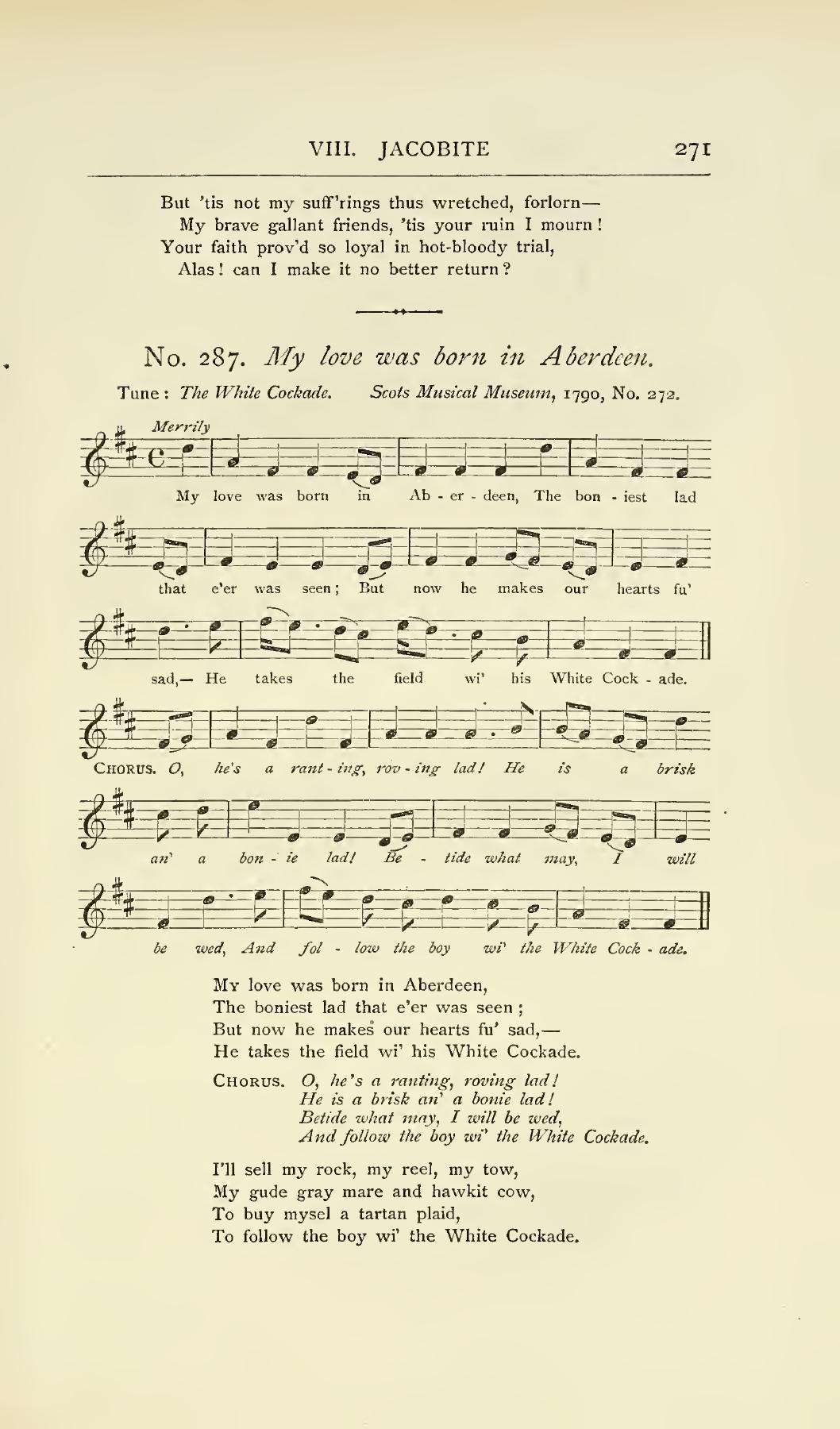 View score Dick’s Songs of Robert Burns (1903)
Lyrics
Choose an edition
Dick (1903) · no. 287
My love was born in Aberdeen.
My love was born in Aberdeen,
The boniest lad that e'er was seen;
But now he makes our hearts fu' sad,—
He takes the field wi' his White Cockade.
CHORUS
O, he's a ranting, roving lad!
He is a brisk an' a bonie lad!
Betide what may, I will be wed,
And follow the boy wi' the White Cockade.

I'll sell my rock, my reel, my tow,
My gude gray mare and hawkit cow,
To buy mysel a tartan plaid,
To follow the boy wi' the White Cockade.
View the source edition · My love was born in Aberdeen.
Scots Musical Museum, vol. III (1790) · no. 272
View the source edition · Volume 3, no. 272; p. 281
Music
View historical scores
Dick’s Songs of Robert Burns (1903)
My love was born in Aberdeen.