’Twas in the seventeen hunder year
Behind the song
This election ballad gives the defeated side the speaking part. Its narrator remembers 23 March 1795 as a day that began brightly and ended in misery. He had served Earl Galloway’s interest and led Broughton’s men; now their authority is broken, and his lament turns into a parade of complaints about the allies who failed him.[1]
Read the fuller story
James C. Dick identifies the piece as an election song celebrating the victory of the Whig candidate Heron of Kerroughtrees. He cites its publication in Hogg and Motherwell’s edition of 1834 as ‘John Busby’s lamentation’, with three stanzas omitted there. Dick describes Busby as a solicitor and bank agent whom Burns disliked. That account gives the first-person misery its satirical purpose: Burns makes an opponent describe the collapse of his own cause.[2]
The opening claim to be the saddest man alive leads into the loss of Earl Galloway’s ‘sceptre’. Political influence becomes royal power in miniature. The narrator’s fidelity is compared to two blind beggars tied together and a faithful dog, images that make his loyalty look dependent and unthinking. His announcement that honesty has gone sounds especially hollow beside the later catalogue of selfishness.[1]
The meeting takes place by the Dee near Kirkcudbright, where Stewart and Murray gather their forces. Their supporters receive a succession of comic portraits. Garlies has gone to London, leaving the cattle free to stray. Balmaghie would have done better drinking Madeira. Cardoness watches like an owl sitting in its tower at noon. The accumulation turns a political alliance into a company of absent, ineffective or ridiculous figures.[1]
The closing portraits sharpen the moral attack. Redcastle’s supposedly bloodless sword has been used against a wandering man who is lame and blind, driving him from the door. Collieston’s overriding concern is to keep one knave safe: himself. The last word of the ballad is ‘scaith’, harm, and the retreat into self-protection completes the collapse announced at the beginning.[1]
Dick’s text runs through seventeen quatrains. The score sets the opening stanza to ‘The children in the wood’, while his note gives the familiar title ‘Babes in the wood’. The steady stanza pattern lets the singer add one damaging portrait after another.[1][2]
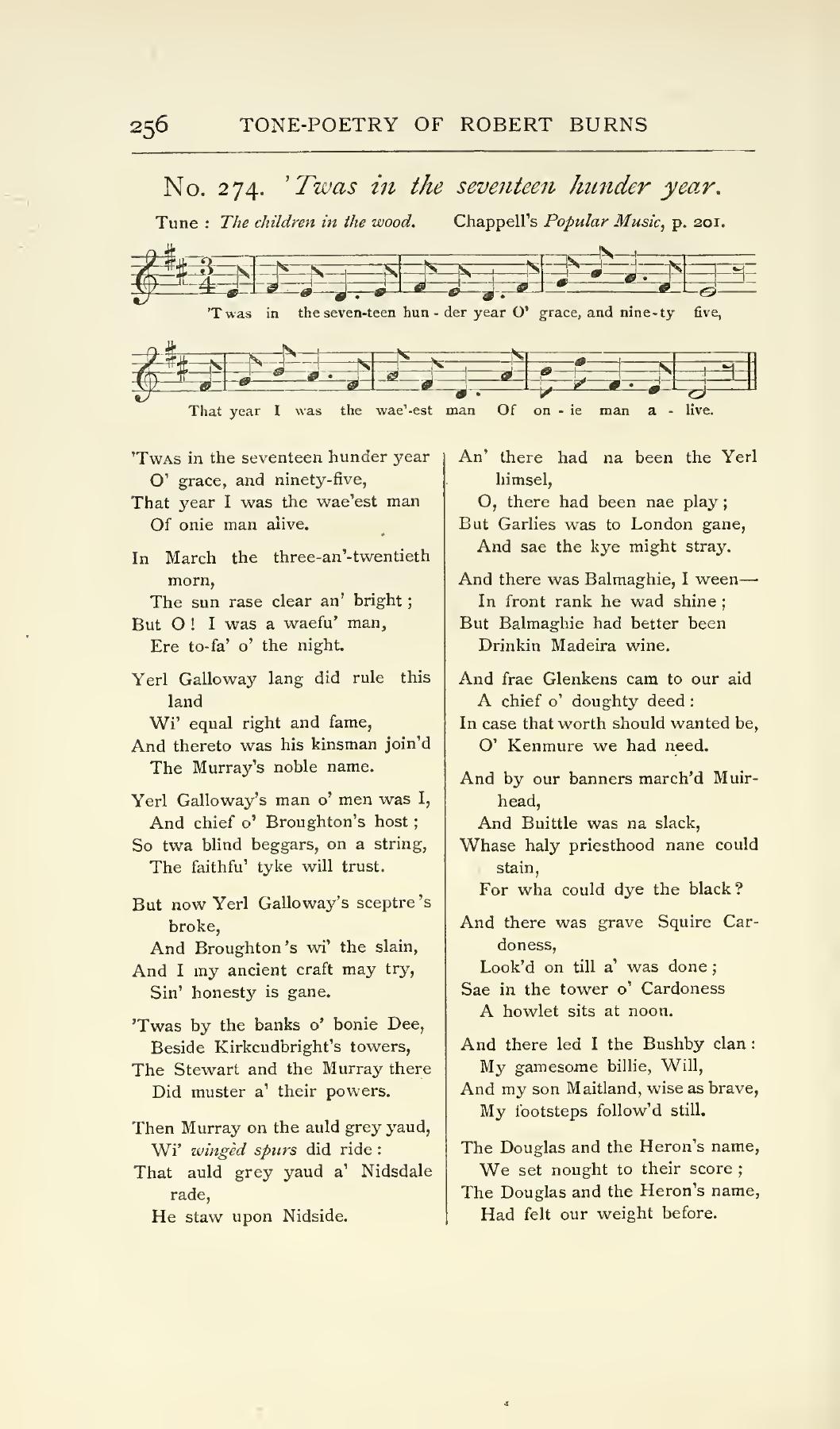 View score Dick’s Songs of Robert Burns (1903)
Lyrics
Dick (1903) · no. 274
'Twas in the seventeen hunder year.
'Twas in the seventeen hunder year
O' grace, and ninety-five,
That year I was the wae'est man
Of onie man alive.

In March the three-an'-twentieth morn,
The sun rase clear an' bright;
But O! I was a waefu' man,
Ere to-fa' o' the night.

Yerl Galloway lang did rule this land
Wi' equal right and fame,
And thereto was his kinsman join'd
The Murray's noble name.

Yerl Galloway's man o' men was I,
And chief o' Broughton's host;
So twa blind beggars, on a string,
The faithfu' tyke will trust.

But now Yerl Galloway's sceptre's broke,
And Broughton's wi' the slain,
And I my ancient craft may try,
Sin' honesty is gane.

'Twas by the banks o' bonie Dee,
Beside Kirkcudbright's towers,
The Stewart and the Murray there
Did muster a' their powers.

Then Murray on the auld gray yaud,
Wi' winged spurs did ride:
That auld grey yaud a' Nidsdale rade,
He staw upon Nidside.

An' there had na been the Yerl himsel,
O, there had been nae play;
But Garlies was to London gane,
And sae the kye might stray.

And there was Balmaghie, I ween—
In front rank he wad shine;
But Balmaghie had better been
Drinking Madeira wine.

And frae Glenkens cam to our aid
A chief o' doughty deed:
In case that worth should wanted be,
O' Kenmure we had need.

And by our banners march'd Muirhead,
And Buittle was na slack,
Whase haly priesthood nane could stain,
For wha could dye the black?

And there was grave Squire Cardoness,
Look'd on till a' was done;
Sae in the tower o' Cardoness
A howlet sits at noon.

And there led I the Bushby clan:
My gamesome billie, Will,
And my son Maitland, wise as brave,
My footsteps follow'd still.

The Douglas and the Heron's name,
We set nought to their score;
The Douglas and the Heron's name,
Had felt our weight before.

But Douglasses o' weight had we:
The pair o' lusty lairds,
For building cot-houses sae fam'd,
And christenin kail-yards.

And then Redcastle drew his sword
That ne'er was stain'd wi' gore—
Save on a wand'rer lame and blind,
To drive him frae his door.

And last cam creepin Collieston,
Was mair in fear than wrath;
Ae knave was constant in his mind—
To keep that knave frae scaith.
View the source edition · 'Twas in the seventeen hunder year.
Music
View historical scores
Dick’s Songs of Robert Burns (1903)
'Twas in the seventeen hunder year.