The Robin cam to the Wren’s nest
Behind the song
A robin peeps into a wren’s nest. Come inside, says the wren. The shelter is small, but the visitor can have a share of it and whatever cloth the host can find to wrap around them. [1]
Read the fuller story
‘Keekit’ means peeped, while ‘pow’ is a head. The greeting to the robin’s old head makes the visitor seem familiar, and the repeated question asks whether he would like to come in. The voice then promises that he will never be left outside while the speaker is within. An ‘auld clout’ is an old cloth, and ‘rowe’ means wrap: welcome is expressed through an ordinary household action.[1]
Each even-numbered line repeats a phrase, from the initial peeping to the final wrapping. This gives the exchange a rocking insistence and makes the invitation easy to remember. Dick prints all eight lines with the tune, headed ‘The wren’s nest’. The domestic tenderness of these words can carry a courtship suggestion, although the scene itself remains a compact encounter between its two bird characters.[1]
James C. Dick identifies the original as a nursery rhyme long familiar in western Scotland and places this version in the Scots Musical Museum of 1796, no. 406. Through Stenhouse, he reports that the musical editor Stephen Clarke took the tune down from Mrs Burns’s singing. Clarke thought there were more words and suggested asking Burns; Johnson’s reported reply was that there were none.[2]
Dick also quotes a different robin-and-wren exchange from Herd’s Scottish Songs of 1776, where pregnancy and rejection replace the welcome heard here. That comparison shows how sharply the mood could change within the bird-song tradition. The evidence in Dick’s note connects this small printed song with the Burns household and older verse, while leaving the extent of Burns’s alteration unspecified.[2]
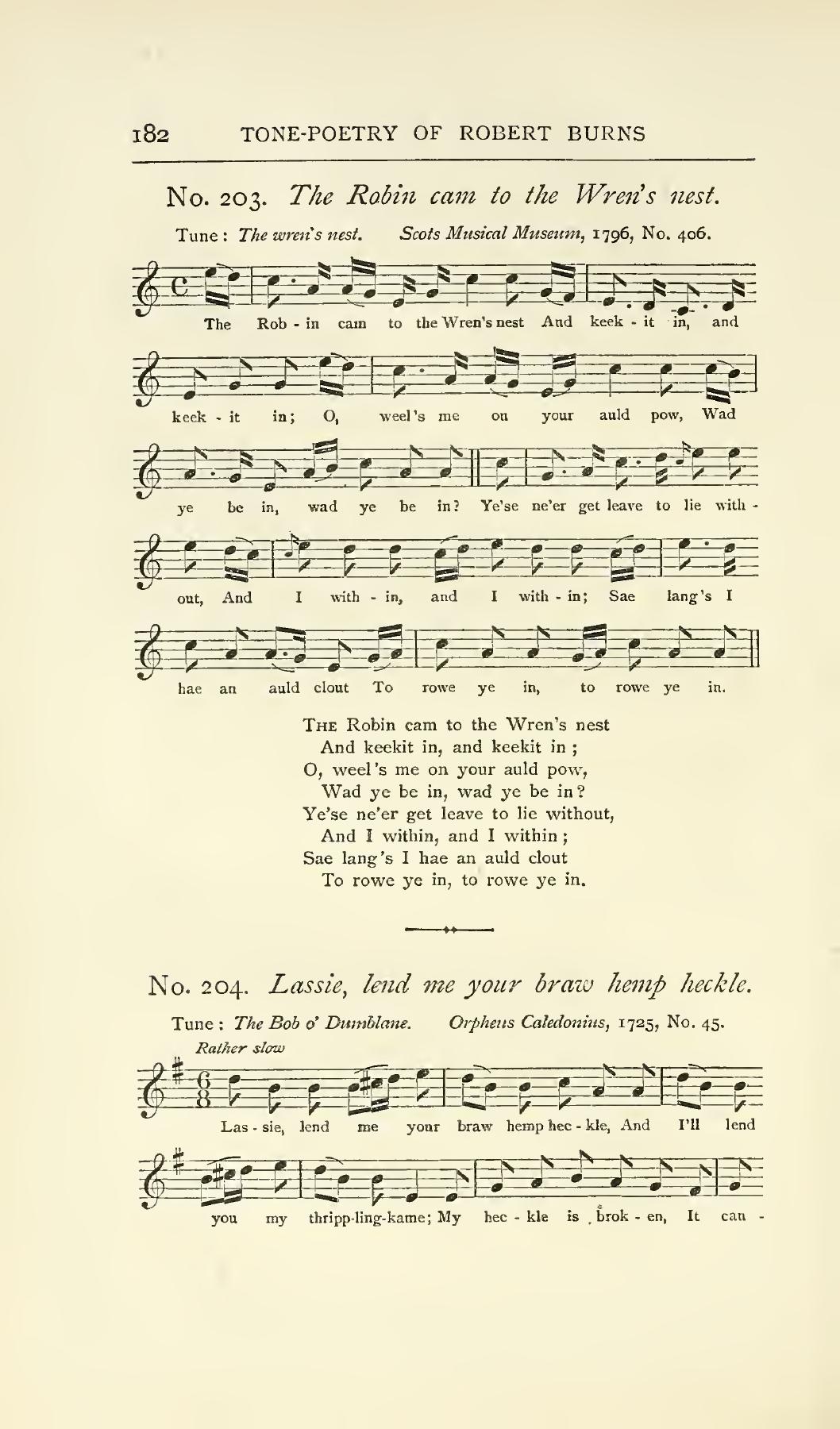 View score Dick’s Songs of Robert Burns (1903)
Lyrics
Dick (1903) · no. 203
The Robin cam to the Wren's nest
And keekit in, and keekit in;
O, weel's me on your auld pow,
Wad ye be in, wad ye be in?
Ye'se ne'er get leave to lie without,
And I within, and I within;
Sae lang's I hae an auld clout
To rowe ye in, to rowe ye in.
Eight lines from Dick’s 1903 edition.
View the source edition · no. 203; p. 182
About this edition
Syllables separated by the musical notation are joined into words in this reading.
Dick describes an older nursery rhyme and transmits Clarke’s account of taking the tune from Mrs Burns’s singing.
Scots Musical Museum, vol. V (catalogued 1796) · no. 406
View the source edition · Volume 5, no. 406; p. 419
Music
View historical scores
Dick’s Songs of Robert Burns (1903)
no. 203; p. 182