Wantonness for evermair
Behind the song
Ruin has taught this speaker very little. ‘Wantonness for evermair’ begins by naming the pleasure that has undone him, then declares his continuing allegiance to it. Across eight lines, regret gives way to a boast about the women whose favour he has won. The song’s joke lies in how readily a confession becomes another celebration.[1]
Read the fuller story
‘Dool’ means sorrow, and the opening quatrain acknowledges both sorrow and care. Yet its first and last lines return to the same promise of wantonness for ever. The repetition makes the admission of suffering part of a circular argument: the consequences are real within the song, but they have produced no change of intention.[1]
The second quatrain turns from consequences to conquests. Black, brown, fair and golden describe the women through contrasting colours, gathering them into the claim to have won every kind of favour in the town. That sweeping list is the speaker’s swagger. Read as a comic voice, its extravagant confidence extends the refusal to reform which drives the opening.[1]
James C. Dick quotes Stenhouse’s statement that Burns wrote and communicated the piece to the Scots Musical Museum. Dick identifies its appearance there in 1796, no. 422. He also points to an air bearing the precise opening title in Aird’s collection of 1788. For Dick, that earlier title indicates an older song, and he leaves open whether Burns’s stanza corrected an existing verse. The printed words therefore sit within a history of possible revision as well as attributed authorship.[2]
The air is headed ‘Wantonness’ and marked ‘Slow’. All eight lines appear beneath the score, carrying the singer from the declaration of ruin into the colourful boast. The measured direction gives room to the repeated opening phrase and its admission of trouble before the song moves on to its catalogue of success.[1]
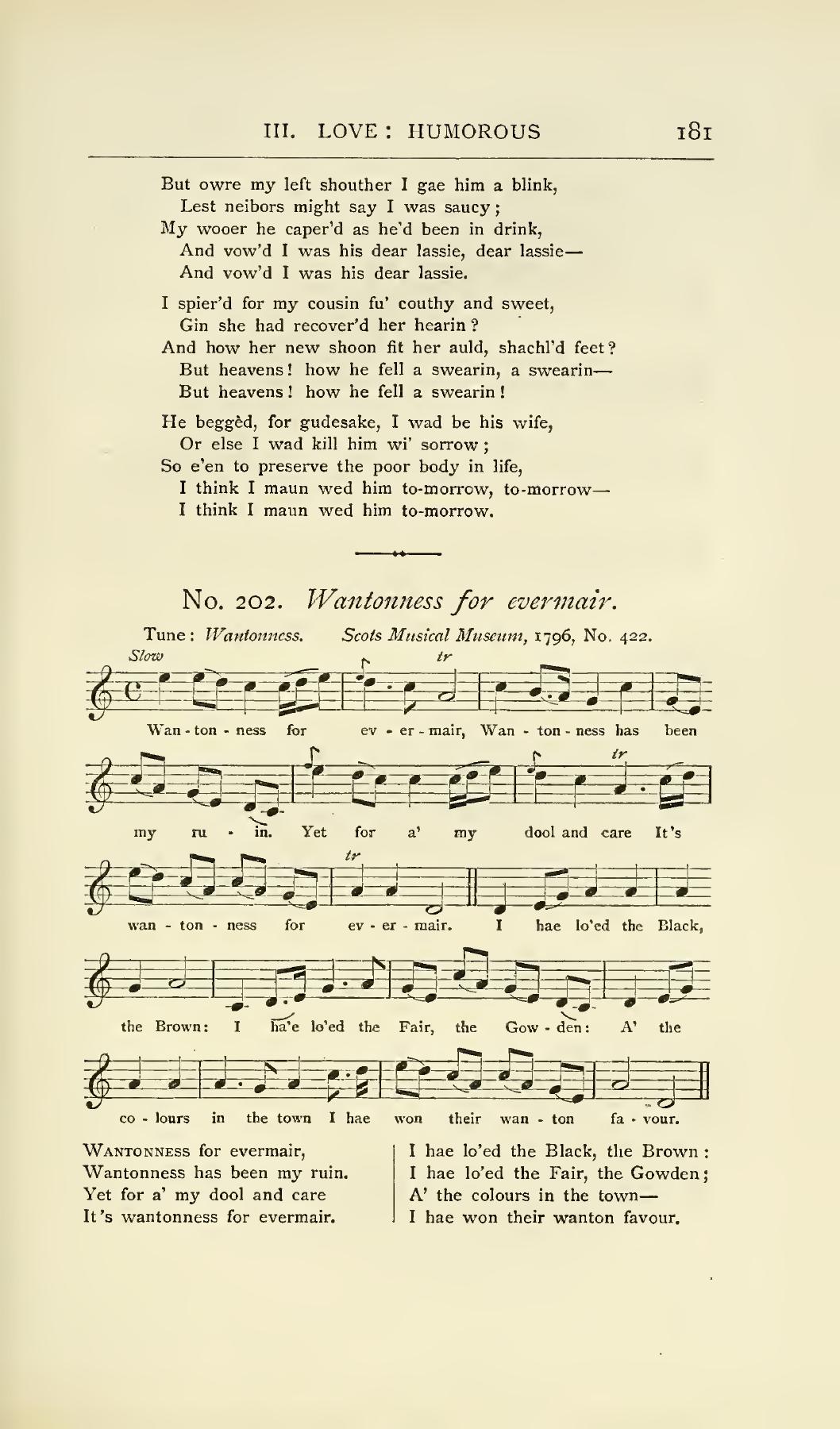 View score Dick’s Songs of Robert Burns (1903)
Lyrics
Dick (1903) · no. 202
Wantonness for evermair,
Wantonness has been my ruin.
Yet for a' my dool and care
It's wantonness for evermair.

I hae lo'ed the Black, the Brown:
I hae lo'ed the Fair, the Gowden;
A' the colours in the town—
I hae won their wanton favour.
Two stanzas from Dick’s 1903 edition.
View the source edition · no. 202; p. 181
About this edition
Syllables separated by the musical notation are joined into words in this reading.
Dick quotes Stenhouse’s account that Burns wrote and communicated the song, and suggests an older text behind Aird’s tune title.
Scots Musical Museum, vol. V (catalogued 1796) · no. 422
View the source edition · Volume 5, no. 422; p. 435
Music
View historical scores
Dick’s Songs of Robert Burns (1903)
no. 202; p. 181