The heather was blooming
Behind the song
The hunt begins at dawn, across flowering heather, cut meadows, moors and glens. Its quarry is a beautiful moor-hen whose plumage seems brighter than spring itself. Yet the chorus addresses young men with advice that sounds as much like courtship as sport. This is a hunting song with a second meaning, turning the pursuit of a bird into a playful, uneasy image of sexual pursuit.[1]
Read the fuller story
The warning is repeated before the instruction arrives: approach this particular bird cautiously. “I rede you” means I advise you; “cannily” suggests care and discretion. The hunters may take other birds on the wing or as they spring up, but the bonnie moor-hen requires stealth. That distinction makes her desirable and difficult to approach, while the repeated warning gives the singer’s advice a teasing edge.[1]
The following verses allow the quarry to dominate the scene. Dew brushes from brown heather bells; her colours reveal her on the mossy hills, and her plumage outshines the season. Even Phoebus, the sun, tries his skill against her. His rays are outdone and serve only to show where she lies. The comparison is extravagant praise, but it also keeps the language of pursuit alive: beauty makes her conspicuous to those who are looking for her.[1]
James C. Dick describes the piece as an amended version of a song once current among the Crochallan Club songs associated with The Merry Muses. He says that the earlier form was no longer available to him. His note also reports that Mrs M’Lehose persuaded Burns not to print it, and that Cromek subsequently included it as “Hunting Song” in the 1808 Reliques. Those details come through Dick’s historical account; the precise division between inherited material and Burns’s amendment remains unclear.[2]
Dick gives the tune as “The Tailor’s March” and marks the setting “Cheerily”. His note connects it with the melody discussed under “The taylor fell thro’ the bed”, including older titles and printings. The chosen air places the repeated advice in a lively musical frame. Three descriptive stanzas surround the printed chorus, giving the singer both a bright outdoor scene and a refrain whose caution can be delivered with a knowing smile.[1][2]
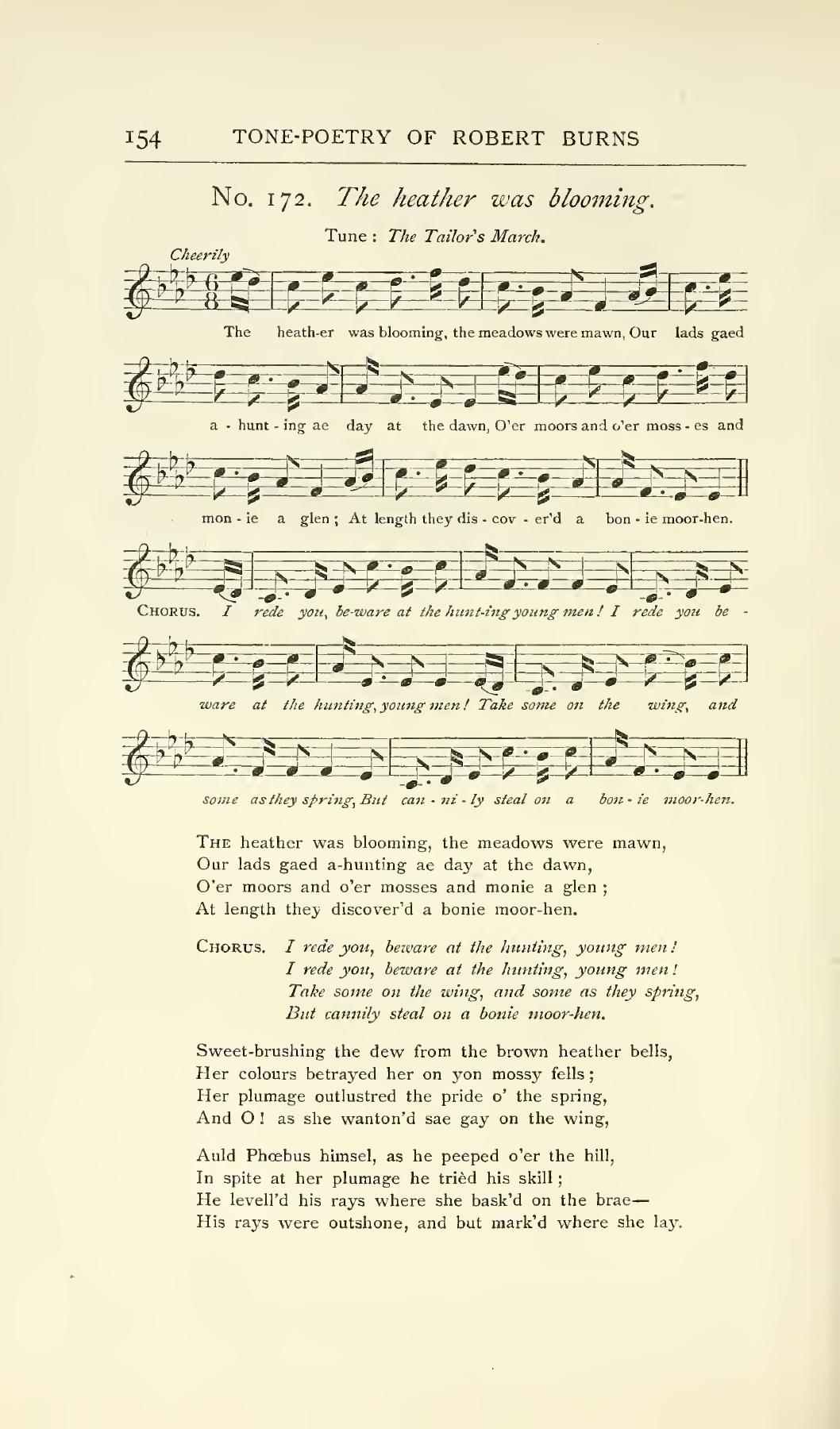 View score Dick’s Songs of Robert Burns (1903)
Lyrics
Dick (1903) · no. 172
The heather was blooming, the meadows were mawn,
Our lads gaed a-hunting ae day at the dawn,
O'er moors and o'er mosses and monie a glen;
At length they discover'd a bonie moor-hen.
CHORUS
I rede you, beware at the hunting, young men!
I rede you, beware at the hunting, young men!
Take some on the wing, and some as they spring,
But cannily steal on a bonie moor-hen.

Sweet-brushing the dew from the brown heather bells,
Her colours betrayed her on yon mossy fells;
Her plumage outlustred the pride o' the spring,
And O! as she wanton'd sae gay on the wing,

Auld Phoebus himsel, as he peeped o'er the hill,
In spite at her plumage he tried his skill;
He levell'd his rays where she bask'd on the brae—
His rays were outshone, and but mark'd where she lay.
Three stanzas and a chorus from Dick’s 1903 edition.
View the source edition · no. 172; p. 154
About this edition
Syllables separated by the musical notation are joined into words in this reading.
Dick describes this as an amended Crochallan Club song printed by Cromek.
Music
View historical scores
Dick’s Songs of Robert Burns (1903)
no. 172; p. 154