’Twas past one o’clock
Behind the song
A little after one in the morning a man gets out of bed and walks across the frost to see his sweetheart. He can now look back on that restless night from the far side of seven years spent faithfully together. [1]
Read the fuller story
The cold is sharply drawn: November blows across the plain, a kirk-bell sounds, and moonlight reveals white mountains and valleys. ‘Cankert’ gives the month a bitter, ill-tempered character. The visitor steals towards the woman’s chamber and kneels below her window, asking her to wake and pity his misery. His account makes love a force that has deprived him of pleasure, peace and rest.[1]
Her reply raises a different concern. Calling herself an innocent maiden, she asks whether he would undo her. He records no verbal answer before leaping into her arms. The narrative then moves straight to daylight and his assurance of lasting constancy, after recording her anxious question.[1]
James C. Dick identifies the Museum publication of 1790, no. 227, and reports that the words were first sketched at Mauchline in August 1788. He quotes a manuscript-list description of them as Burns’s old words and a note recommending a suitable setting in McGibbon. Those details establish the composition and transmission account Dick supplies, without identifying the night’s events as a personal episode in Burns’s life.[2]
The tune is ‘Cold frosty morning’, marked ‘Smoothly’. The complete first stanza is carried through the score; two further eight-line stanzas finish the story. Dick traces earlier forms of the melody through collections and an opera, and notes a previous owner’s annotation suggesting Dutch origin. His discussion preserves those different musical associations. The displayed setting gives the cold night’s detailed opening room to unfold before the narrative turns towards its warmer ending.[1][2]
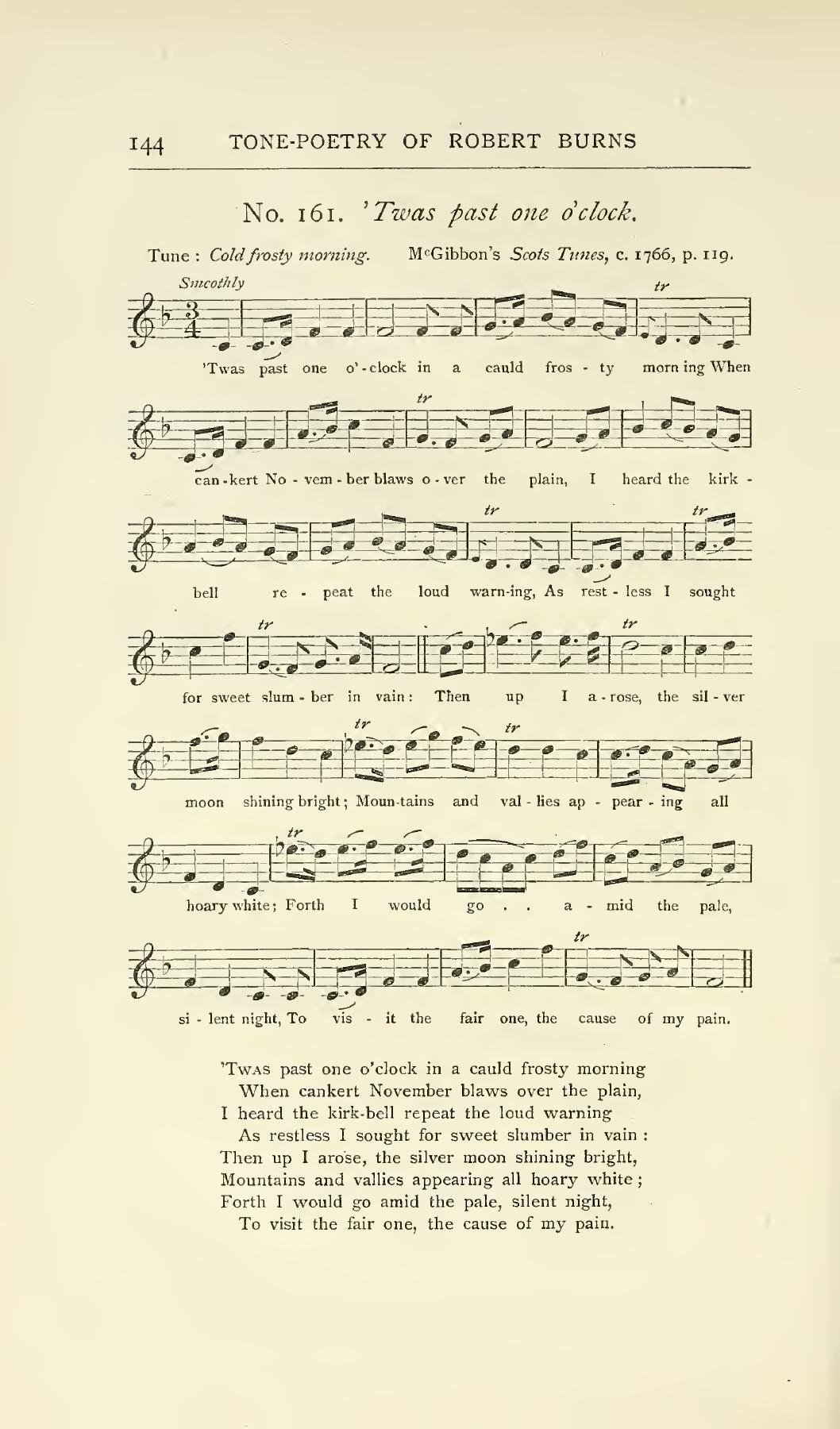 View score Dick’s Songs of Robert Burns (1903)
Lyrics
Dick (1903) · no. 161
'Twas past one o'clock in a cauld frosty morning
When cankert November blaws over the plain,
I heard the kirk-bell repeat the loud warning
As restless I sought for sweet slumber in vain:
Then up I arose, the silver moon shining bright,
Mountains and vallies appearing all hoary white;
Forth I would go amid the pale, silent night,
To visit the fair one, the cause of my pain.

Sae gently I staw to my lovely maid's chamber,
And rapp'd at her window, low down on my knee,
Begging that she would awauk from sweet slumber,
Awauk from sweet slumber and pity me:
For, that a stranger to a' pleasure, peace and rest,
Love into madness had firèd my tortur'd breast,
And that I should be of a' men the maist unblest,
Unless she would pity my sad miserie!

My true love arose and whisperèd to me—
(The moon lookèd in and envy'd my love's charms;—)
'An innocent maiden, ah, would you undo me!'
I made no reply, but leapt into her arms:
Bright Phoebus peep'd over the hills and found me there;
As he has done, now, seven lang years and mair,
A faithfuller, constanter, kinder, more loving pair,
His sweet chearing beam nor enlightens nor warms.
View the source edition · Dick1903 no. 161; pp. 144–145
About this edition
Syllables separated by the musical notation are joined into words in this reading.
Music
View historical scores
Dick’s Songs of Robert Burns (1903)
Dick1903 no. 161; pp. 144–145