Will ye go to the Highlands, Leezie Lindsay?
Behind the song
Leezie Lindsay hears the same invitation three times. Will she go to the Highlands? By the fourth and final line she knows what the singer is asking her to be there, his pride and his darling. We never hear her answer. [1]
Read the fuller story
The repetition makes Leezie’s decision the centre of the song. The place-name gives the invitation its direction, while the recurring personal address keeps bringing it back to the person who must answer. “My pride and my darling to be” reaches into the future. Within this short text the invitation remains open, which gives a singer room to make its return sound hopeful, tender or insistent. [1]
Dick’s 1903 note says Burns appears to have recovered the ballad of Leezie Lindsay and intended to make a complete song from it. He reports a note by James Johnson on the musical manuscript Burns sent: “Mr. Burns is to send words”. Dick identifies the four lines as the whole contribution that resulted. This makes the short lyric a revealing example of Burns’s work with material already circulating in song. [2]
Dick describes the longer ballad published by Robert Jamieson in 1806. In that account Donald MacDonald, heir of Kingcausie, goes to Edinburgh to seek a wife and presents himself as poor, following his mother’s condition. His promised Highland life includes curds and whey and a bed of bracken. That account gives the invitation a setting in courtship across differences of place and supposed wealth. It is the longer ballad’s story, as reported by Dick; the four-line contribution keeps only the repeated invitation and affectionate promise. [2]
The Museum prints those four lines as no. 434, “Leezie Lindsay”, under the musical staff. Dick associates that appearance with 1796 and says Burns communicated the tune to Johnson. The Museum marks the melody “Slow”, while Dick’s version is marked “Moderately”. The text’s few words can therefore occupy a gently paced musical space, allowing the repeated question to carry much of the expression. Its final phrase offers a future together; the music brings that offer to a close while Leezie’s reply remains beyond these lines. [1][2][3]
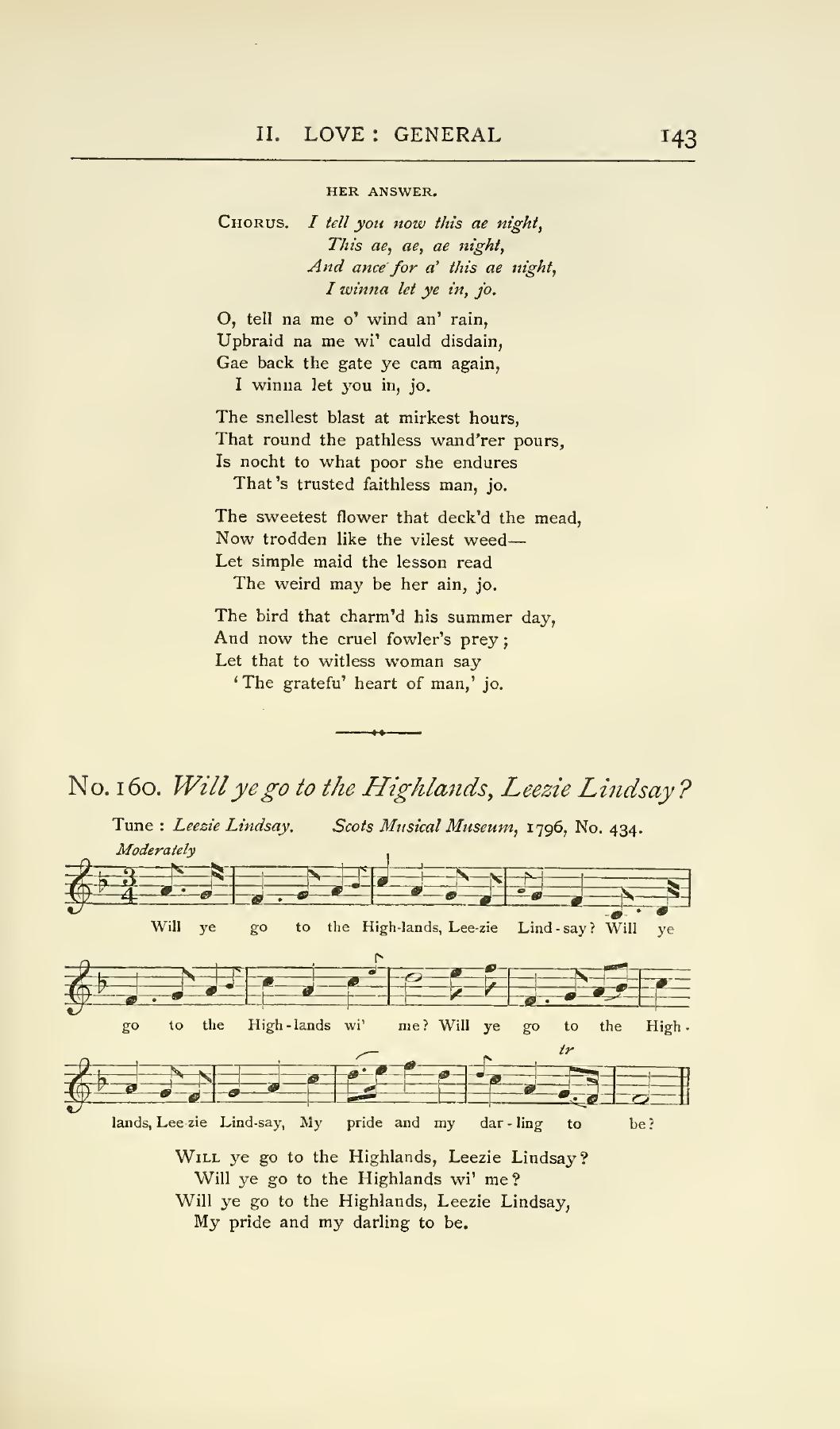 View score Dick’s Songs of Robert Burns (1903)
Lyrics
Dick (1903) · no. 160
Will ye go to the Highlands, Leezie Lindsay?
Will ye go to the Highlands wi' me?
Will ye go to the Highlands, Leezie Lindsay,
My pride and my darling to be.
Complete four-line contribution from Dick’s 1903 edition.
View the source edition · Dick1903 no. 160; p. 143
About this edition
Syllables separated by the musical notation are joined into words in this reading.
These four lines are the complete contribution attributed to Burns by Dick within the longer Leezie Lindsay ballad.
Scots Musical Museum, vol. V (catalogued 1796) · no. 434
View the source edition · Volume 5, no. 434; p. 446
Music
View historical scores
Dick’s Songs of Robert Burns (1903)
Dick1903 no. 160; p. 143