The winter it is past
Behind the song
Summer arrives in this song with birds singing in every tree. The lover who speaks can hear their happiness and describe the season’s beauty, yet remains fixed on the person who has gone. Each of the first two stanzas comes back to that separation. The world moves into a season of warmth and pairing while the singer’s own attachment brings pain. [1]
Read the fuller story
The second stanza draws the scene closer: a rose grows on the brier beside clear running water, with a linnet and a bee finding their pleasures there. The line about their “little loves” gives those small creatures an ease denied to the speaker. The repetition of “little” makes their contentment sound modest and sufficient. The stanza ends by returning to the same personal loss, so that the natural detail briefly expands the song before grief draws it inward again. [1]
James C. Dick assigns a precise part of this inherited song to Burns. In his 1903 note he says Burns wrote the second stanza and corrected the first, which had appeared earlier. He identifies a longer, seven-stanza song in the Herd manuscript and describes other differing versions. On that account, Burns’s work here was concentrated: the opening seasonal complaint was revised, and the new rose, bird and bee stanza deepened its expression. The whole four-stanza reading carries a history of transmission around that contribution. [2]
The remaining stanzas broaden the complaint. The speaker compares personal constancy with the sun and the absent lover’s changing affection with the moon. The last stanza addresses others who love and cannot free themselves, turning solitary distress into sympathy founded on experience. Dick encloses these final two stanzas together in square brackets. The Museum witness prints all four without those brackets, giving the progression from seasonal sadness to a general address to lovers in one continuous text. [1][3]
Dick’s note also repeats an origin story involving a highwayman named Johnson, but calls the earlier song “imperfectly authenticated”. The voice heard in these verses is the separated lover’s, with the rose-and-water stanza providing the particular contribution Dick attributes to Burns. [2]
The Museum setting is marked “Very Slow”; Dick gives “Slowly”. Both offer space for the long opening lines and their descent into the shorter statement of loss. “Simmer”, the form in Dick’s opening, means summer. The season’s arrival gives the singer something beautiful to contemplate and a renewed occasion to feel the distance between that beauty and an unsettled heart. [1][3]
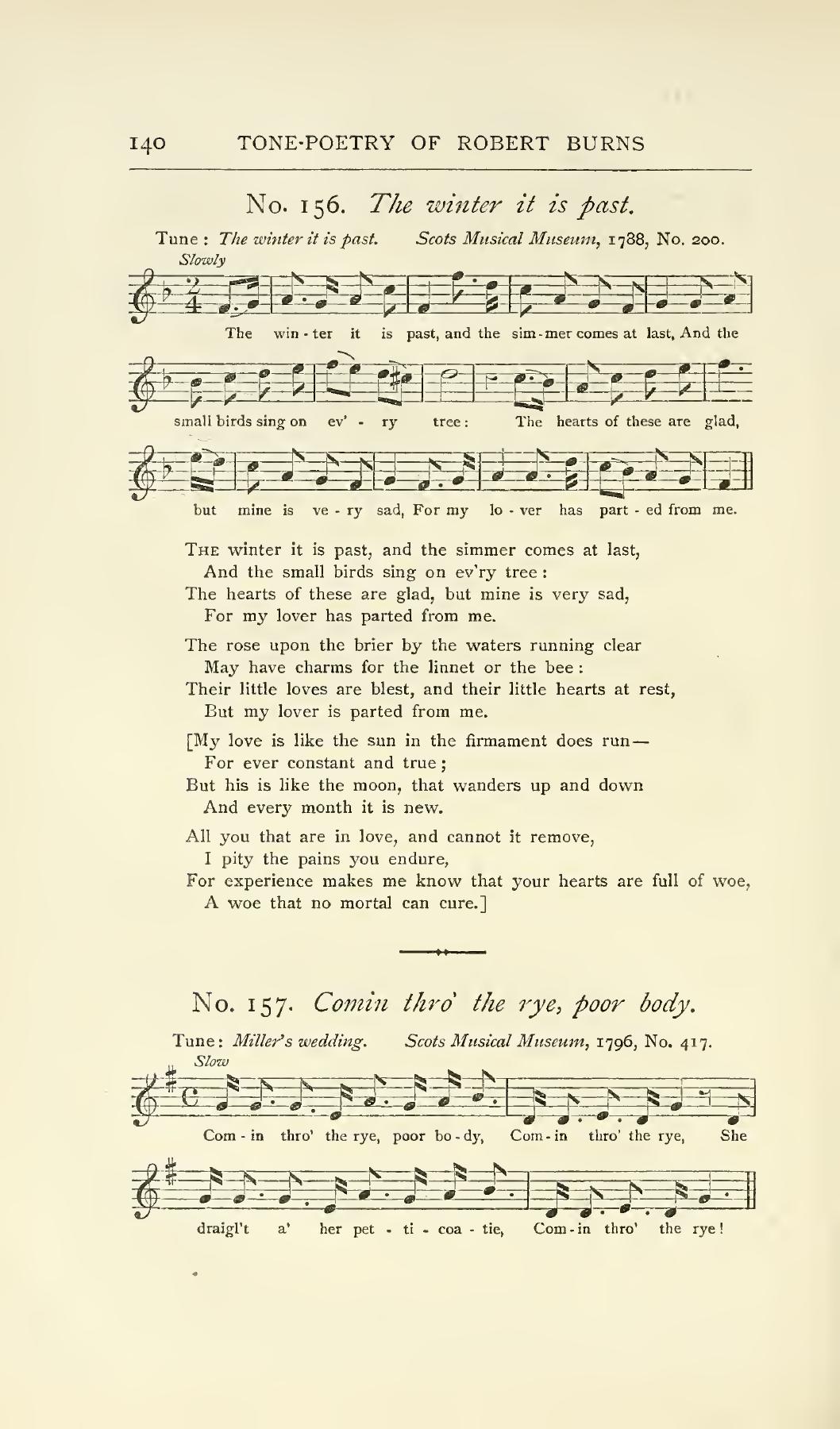 View score Dick’s Songs of Robert Burns (1903)
Lyrics
Choose an edition
Dick (1903) · no. 156
The winter it is past, and the simmer comes at last,
And the small birds sing on ev'ry tree:
The hearts of these are glad, but mine is very sad,
For my lover has parted from me.

The rose upon the brier by the waters running clear
May have charms for the linnet or the bee:
Their little loves are blest, and their little hearts at rest,
But my lover is parted from me.

[My love is like the sun in the firmament does run—
For ever constant and true;
But his is like the moon, that wanders up and down
And every month it is new.

All you that are in love, and cannot it remove,
I pity the pains you endure,
For experience makes me know that your hearts are full of woe,
A woe that no mortal can cure.]
Four stanzas from Dick’s 1903 edition, with the final two in brackets.
View the source edition · Dick1903 no. 156; p. 140
About this edition
Syllables separated by the musical notation are joined into words in this reading.
Dick attributes the second stanza and corrections to the first to Burns. He prints the final two stanzas in brackets.
Scots Musical Museum, vol. II (1788) · no. 200
View the source edition · Volume 2, no. 200; p. 208
Music
View historical scores
Dick’s Songs of Robert Burns (1903)
Dick1903 no. 156; p. 140