Lang hae we parted been
Behind the song
“Lie near me” is all the singer asks after so long a separation. In the beloved’s arms, the hardships of the time apart seem to fall away. [1]
Read the fuller story
The two short verses move from time lost to pain relieved. ‘Lang’ means long, and ‘hae’ have; the first statement that they have been parted is immediately answered by the news that they are together again. The chorus turns that shared history into a direct appeal. ‘Thy lane’ means alone, so the repeated ‘near me’ replaces solitude with bodily companionship.[1]
The second verse gives the reunion its emotional weight. Whatever the speaker has suffered is gathered into a single phrase, then resolved in the embrace. There is no account of why they parted or what happened during the absence. The compression allows a singer to concentrate on the contrast between remembered endurance and present relief.[1]
James C. Dick identifies the Museum printing of 1790, no. 218, and quotes the designation ‘Mr. Burns’s old words’ from Law’s manuscript list. He accepts that an older song lay behind it but says that the amount Burns wrote in the two stanzas is uncertain. This is a transmitted song with an unresolved division between inherited material and Burns’s contribution.[2]
The printed tune is ‘Laddie lie near me’, marked ‘Rather slow’. Dick distinguishes this Scottish setting from English songs and tunes with similar names, noting resemblance of metre without equating the melodies. He also reports that Burns told Thomson he did not know the air well enough to write for it. The displayed verse and chorus show how a handful of phrases could carry its intimate appeal.[1][2]
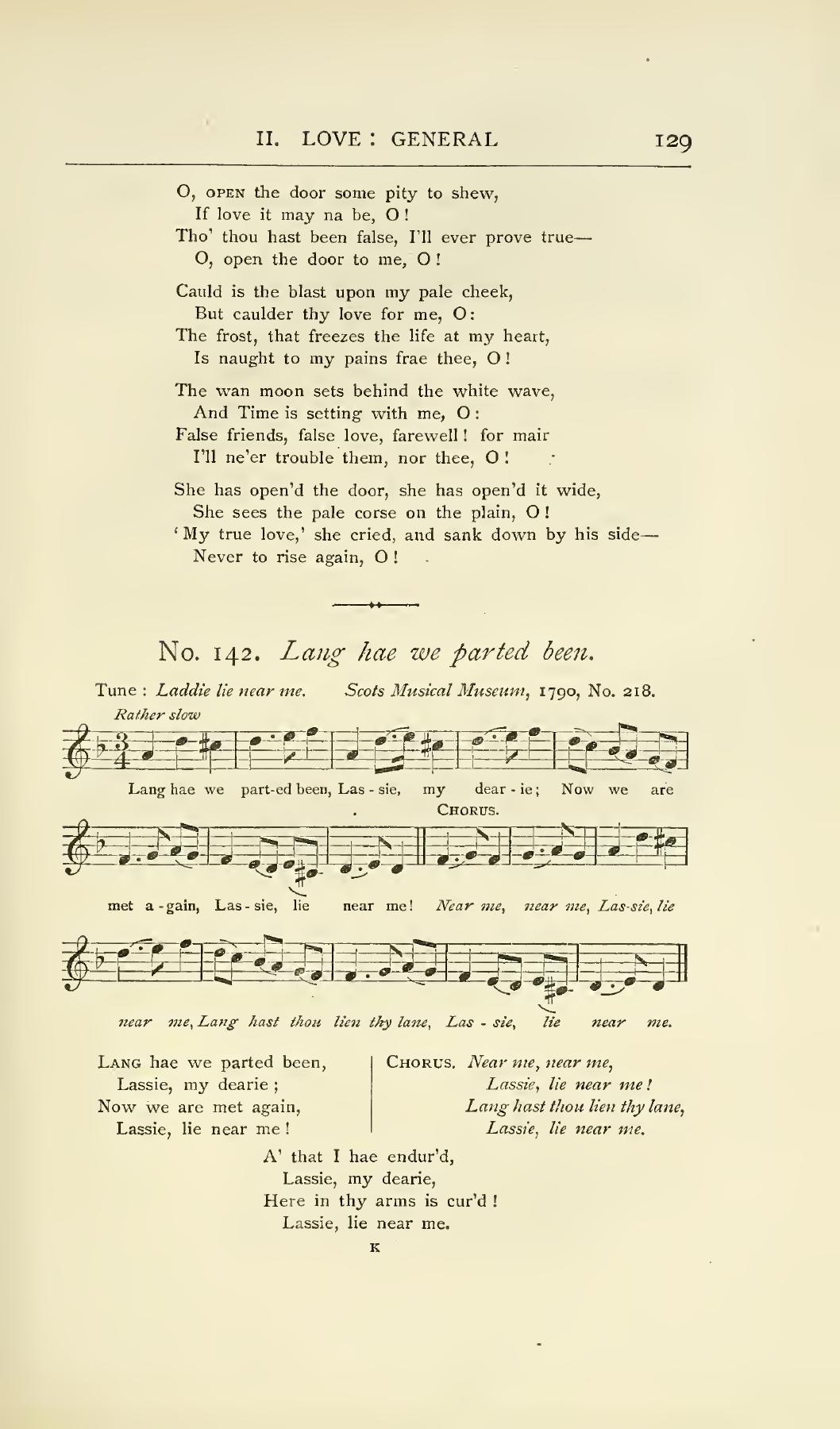 View score Dick’s Songs of Robert Burns (1903)
Lyrics
Choose an edition
Dick (1903) · no. 142
Lang hae we parted been,
Lassie, my dearie;
Now we are met again,
Lassie, lie near me!
CHORUS
Near me, near me,
Lassie, lie near me!
Lang hast thou lien thy lane,
Lassie, lie near me.

A' that I hae endur'd,
Lassie, my dearie,
Here in thy arms is cur'd!
Lassie, lie near me.
View the source edition · Dick1903 no. 142; p. 129
About this edition
Syllables separated by the musical notation are joined into words in this reading.
Scots Musical Museum, vol. III (1790) · no. 218
View the source edition · Volume 3, no. 218; pp. 226–227
About this edition
Lang hae we parted been appears under Old Words after the preceding setting; preceding score and continuation retained.
Music
View historical scores
Dick’s Songs of Robert Burns (1903)
Dick1903 no. 142; p. 129