Sweet are the banks—the banks o’ Doon
Behind the song
The banks of the Doon remain beautiful after love has failed. Flowers spread and birds sing, but their happiness now wounds the speaker who once shared it. ‘Sweet are the banks—the banks o’ Doon’ is the text James C. Dick presents as the first version of the song: its grief unfolds through repeated appeals to a bird and the final image of a stolen rose.[1]
Read the fuller story
The opening sets the flourishing landscape against a heart full of care. The bird’s song brings back days when the false lover seemed true, and its companion recalls the speaker’s own former contentment. Repetition makes memory difficult to escape. The same natural sounds that once belonged to happiness have become reminders of betrayal.[1]
The second twelve-line block returns to earlier walks beside the river and to a rose plucked with a light heart. The lover takes the rose and leaves the thorn. In the final four lines, the speaker’s own flourishing and destruction are compressed into a single day: blooming in the morning, plucked by noon. The rose image becomes an account of vulnerability and loss, moving beyond the object in the hand to the person who gathered it.[1]
Dick identifies an Edinburgh edition of 1877 as the first publication of this version. He prints an extract from Burns’s letter to Alexander Cunningham dated 11 March 1791, describing a song just sketched for a favourite strathspey or reel. Dick uses that letter to challenge Robert Chambers’s earlier claim that the Banks o’ Doon song was written in 1787 for Peggy Kennedy. His disagreement concerns the song’s history; the grief within the lyric remains expressed by its unnamed speaker.[2]
The tune heading here is ‘Cambdelmore’, marked ‘Slow’. In the letter extract, Burns says twelve stanza lines are needed to go through the whole air. The displayed setting accordingly runs through the first twelve lines before the second block continues below. Dick traces the tune under several names, including Ballendalloch and Gordon Castle. The twelve-line musical span lets the repeated appeals to the bird accumulate before the song turns to the rose.[1][2]
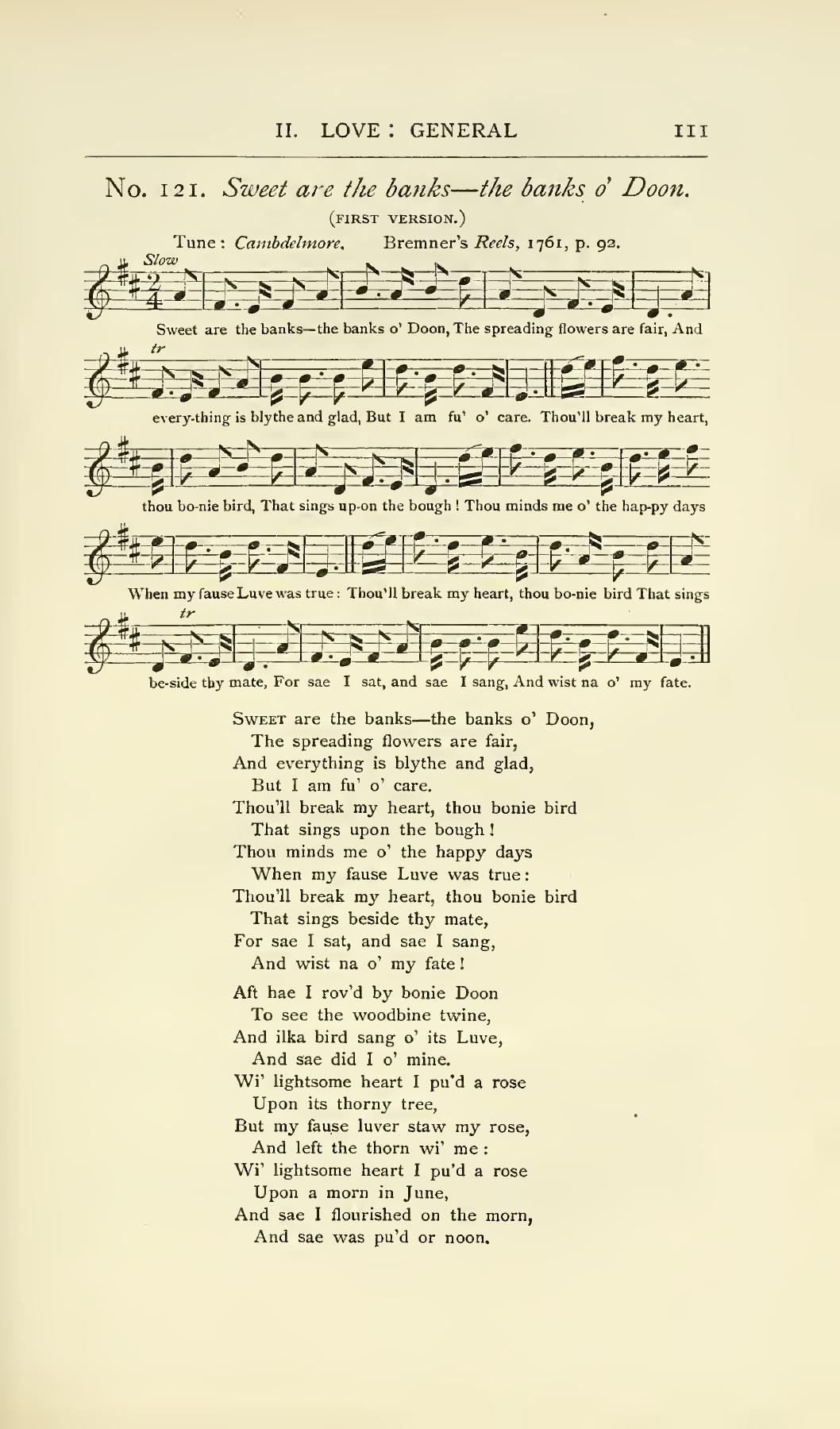 View score Dick’s Songs of Robert Burns (1903)
Lyrics
Dick (1903) · no. 121
FIRST VERSION
Sweet are the banks—the banks o' Doon,
The spreading flowers are fair,
And everything is blythe and glad,
But I am fu' o' care.
Thou'll break my heart, thou bonie bird
That sings upon the bough!
Thou minds me o' the happy days
When my fause Luve was true:
Thou'll break my heart, thou bonie bird
That sings beside thy mate,
For sae I sat, and sae I sang,
And wist na o' my fate!

Aft hae I rov'd by bonie Doon
To see the woodbine twine,
And ilka bird sang o' its Luve,
And sae did I o' mine.
Wi' lightsome heart I pu'd a rose
Upon its thorny tree,
But my fause luver staw my rose,
And left the thorn wi' me:
Wi' lightsome heart I pu'd a rose
Upon a morn in June,
And sae I flourished on the morn,
And sae was pu'd or noon.
View the source edition · Dick1903 no. 121; p. 111
About this edition
Syllables separated by the musical notation are joined into words in this reading.
Music
View historical scores
Dick’s Songs of Robert Burns (1903)
Dick1903 no. 121; p. 111