Hey for a lass wi’ a tocher
Behind the song
The singer measures a woman's charms by the acre. His ideal lass comes with well-stocked farms and a tocher, the marriage portion celebrated three times in the chorus. “The nice yellow guineas for me” makes the attraction plain. The familiar language of beauty becomes a joke about property and ready money. [1]
Beauty is a flower that opens and withers. Green knolls, by contrast, acquire a new covering of white sheep each spring. Even possession can make beauty tiresome, the singer argues, while the yellow darlings stamped with Geordie become dearer the longer he holds them. The comic lover makes an increasingly confident case for assets that can renew or endure. [1]
Read the fuller story
Cunningham dates Burns's communication to Thomson to 17 February 1796 and quotes his description of the song as a kind of rhapsody. Dick's longer extract places it among verses supplied for Irish airs. In it Burns says this is his fourth Irish engagement and names the other melodies. [2][3]
Dick hears a reminiscence of Allan Ramsay's “Gie me a lass wi' a lump o' land” in the song. The resemblance lies in its openly material preference. Burns's version sustains the joke through the flower, the farm and the stamped coins, giving the refrain a fresh reason to return after each change of image. [1][2]
Dick's score names Balin a mone, while Cunningham's heading has Balinamona Ora. Dick prints the chorus after the first stanza; Cunningham prints it there and again at the close. The three verses and their escalating valuation remain together in both readings, ready for the repeated toast to a well-provided lass. [1][3]
Story references
- James C. Dick, The Songs of Robert Burns (1903), No. 198; printed pp. 177–177; PDF pp. 233–233
- James C. Dick, The Songs of Robert Burns (1903), Dick historical note 198; printed 418; PDF 474
- Allan Cunningham, The Complete Works of Robert Burns (1855), printed 310; HTML #CCLXVI. Project Gutenberg transcription.
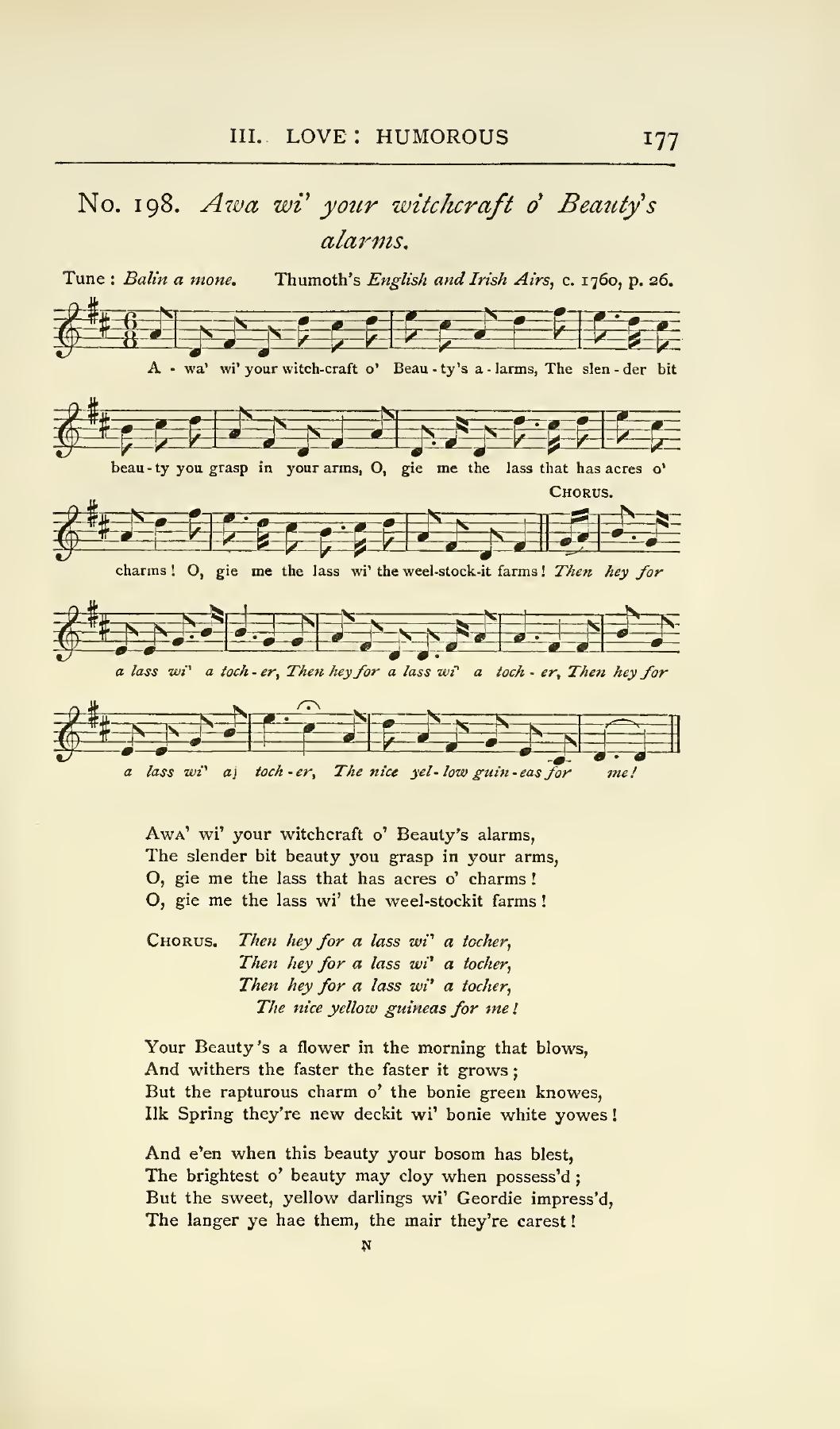 View score Dick’s Songs of Robert Burns (1903)
Lyrics
Choose an edition
Version notes
| Dick (1903) · no. 198 | Cunningham · 1855Ebook transcription |
|---|---|
| not reprinted at end | reprinted at end |
| possess’d | possest |
| impress’d | imprest |
| Balin a mone | Balinamona Ora |
Dick (1903) · no. 198
Awa' wi' your witchcraft o' Beauty's alarms,
The slender bit beauty you grasp in your arms,
O, gie me the lass that has acres o' charms!
O, gie me the lass wi' the weel-stockit farms!

Chorus. Then hey for a lass wi' a tocher,
Then hey for a lass wi' a tocher,
Then hey for a lass wi' a tocher,
The nice yellow guineas for me!

Your Beauty's a flower in the morning that blows,
And withers the faster the faster it grows;
But the rapturous charm o' the bonie green knowes,
Ilk Spring they're new deckit wi' bonie white yowes!

And e'en when this beauty your bosom has blest,
The brightest o' beauty may cloy when possess'd;
But the sweet, yellow darlings wi' Geordie impress'd,
The langer ye hae them, the mair they're carest!
These are the words printed below the score.
View the source edition · no. 198; p. 177
About this edition
Three quatrains and a four-line chorus in both texts. Cunningham reprints the chorus at the end; Dick prints it after stanza1 only. Dick has “possess’d” and “impress’d”, against Cunningham’s “possest” and “imprest”. Corrections PDF56 changes “I” to “it” in note198’s final sentence; no lyric correction is directed.
Cunningham (1855)
Awa wi’ your witchcraft o’ beauty’s alarms,
The slender bit beauty you grasp in your arms:
O, gie me the lass that has acres o’ charms,
O, gie me the lass wi’ the weel-stockit farms.
  Then hey for a lass wi’ a tocher,
  Then hey for a lass wi’ a tocher;
  Then hey for a lass wi’ a tocher,
    The nice yellow guineas for me.

Your beauty’s a flower, in the morning that blows,
And withers the faster, the faster it grows;
But the rapturous charm o’ the bonnie green knowes,
Ilk spring they’re new deckit wi’ bonnie white yowes.

And e’en when this beauty your bosom has blest,
The brightest o’ beauty may cloy when possest;
But the sweet yellow darlings wi’ Geordie imprest,
The langer ye hae them—the mair they’re carest.
  Then hey for a lass wi’ a tocher,
  Then hey for a lass wi’ a tocher;
  Then hey for a lass wi’ a tocher,
    The nice yellow guineas for me.
Digital text from Project Gutenberg.
View the source edition · p. 310
About this edition
Three quatrains and a four-line chorus in both texts. Cunningham reprints the chorus at the end; Dick prints it after stanza1 only. Dick has “possess’d” and “impress’d”, against Cunningham’s “possest” and “imprest”. Corrections PDF56 changes “I” to “it” in note198’s final sentence; no lyric correction is directed.
Music
View historical scores
Dick’s Songs of Robert Burns (1903)
no. 198; p. 177