Peg-a-Ramsey
Behind the song
Cold wind crosses the pool, bare birches mark Yule, and hills and glens disappear in drifting darkness. The final stanza brings the weather to Peg-a-Ramsey’s mill: however murky the night, grist still finds its way there.
Read the fuller story
The repeated evening blast moves the song from cold to biting frost and obscured country. Its close exchanges that broad landscape for a single mill and its visitor’s implied business. The familiar image of grist gives the last two lines their teasing turn.
Cunningham calls most of the words old and says Burns gave them a brushing for the Museum, leaving the individual changes unspecified.[1] The Museum credits the lyric as written by Burns. These accounts leave the extent of his contribution uncertain.[2]
Story references
- Allan Cunningham, ed., The Complete Works of Robert Burns (1855), printed 309; HTML #CCLXIII. Digital transcription; selected complete text and headnote.
- James Johnson, Scots Musical Museum, no. 583, printed p. 603 (PDF p. 103), heading; accompanying note DLXXXIII, printed p. 504 (PDF p. 186). National Library of Scotland digitisation.
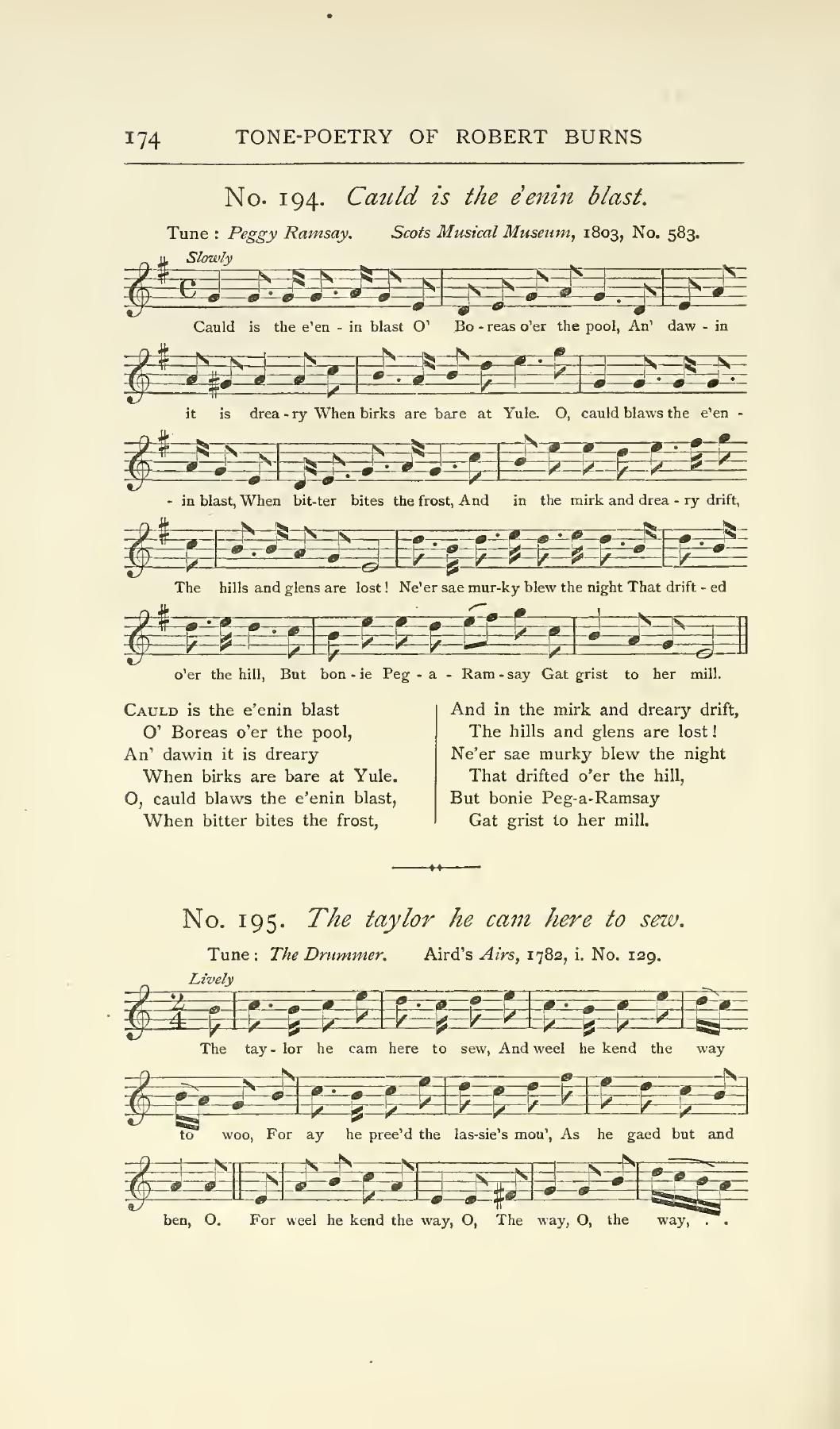 View score Dick’s Songs of Robert Burns (1903)
Lyrics
Choose an edition
Cunningham (1855)
Cauld is the e’enin’ blast
  O’ Boreas o’er the pool,
And dawin’ it is dreary
  When birks are bare at Yule.

O bitter blaws the e’enin’ blast
  When bitter bites the frost,
And in the mirk and dreary drift
  The hills and glens are lost.

Ne’er sae murky blew the night
  That drifted o’er the hill,
But a bonnie Peg-a-Ramsey
  Gat grist to her mill.
Digital text from Project Gutenberg.
View the source edition · p. 309
About this edition
Cunningham’s preface discusses several poems he left out of the collection.
Dick (1903) · no. 194
The words are on the score page.
View the source edition · no. 194; p. 174
Music
View historical scores
Dick’s Songs of Robert Burns (1903)
no. 194; p. 174
Burns’s amendments — qualified attribution
Cunningham describes older words revised by Burns; the Museum credits the lyric as written by him. Extent remains uncertain.
Words Older song amended by Robert Burns, according to Cunningham
Burns’s role Burns’s amendments — qualified attribution