The Highland Widow’s Lament
Behind the song
The widow arrives in the low country without enough money for a meal. She remembers a Highland household sustained by twenty cattle and sixty sheep, with milk from the hills and wool from the knolls. The repeated cry of Ochon punctuates a precise account of what she has lost. [1]
Donald was the finest man in her world and belonged to her. Then Charlie Stewart came, Donald's arm was needed, and he fell with his country at Culloden. The last stanza turns directly to him: “Ochon! O Donald, O!” Her recollection of prosperity has led to the loss that gives every remembered possession its weight. [1]
Read the fuller story
Cunningham introduces the song as a reported version of a Gaelic lament for the ruin following the rising of 1745. Dick is cautious too: the song, or its germ, was supposed to have come from the Highlands. Their accounts leave its earlier form uncertain while preserving the song's setting in dispossession and bereavement. [2][3]
Dick records its Museum publication in 1796 and says Burns supplied the melody. He also points to Schumann's later setting in the collection he calls Liederkreis, Op.25. That is a further stage in the lyric's musical life, beyond the very slow Highland widow's lament printed with the words in Dick's own edition. [2]
Cunningham closes by repeating “Oh! I am come to the low countrie”, where Dick cries directly to Donald. Dick calls him the “brawest man”, Cunningham the “brawest lad”. Both have eight quatrains. The different ending changes how the lament returns to its opening grief: through the place of exile or through the dead man's name. [1][3]
Story references
- James C. Dick, The Songs of Robert Burns (1903), No. 295; printed pp. 278–278; PDF pp. 334–334
- James C. Dick, The Songs of Robert Burns (1903), Dick historical note 295; printed 469; PDF 525
- Allan Cunningham, The Complete Works of Robert Burns (1855), printed 308; HTML #CCLXI. Project Gutenberg transcription.
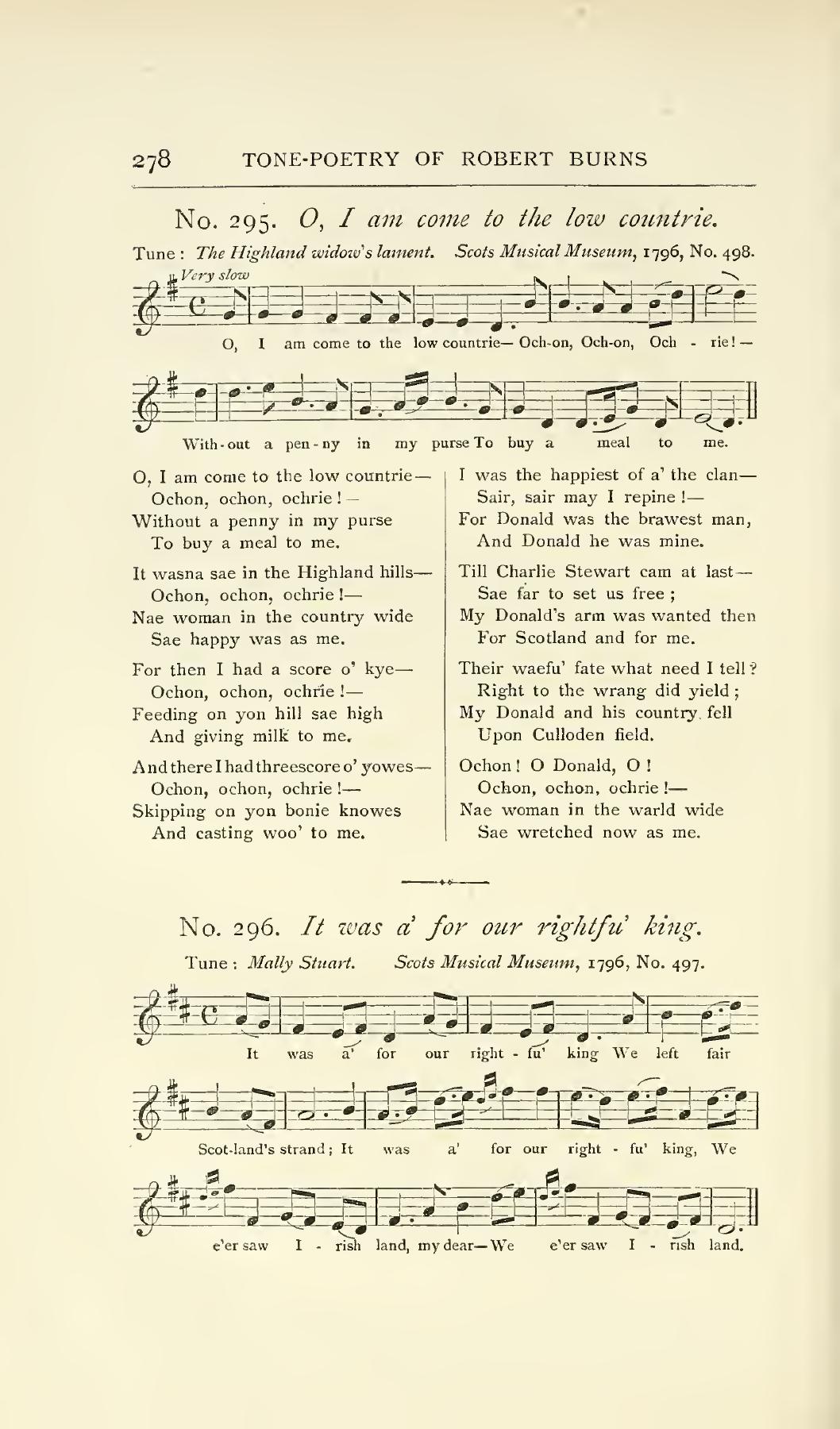 View score Dick’s Songs of Robert Burns (1903)
Lyrics
Choose an edition
Version notes
| Dick (1903) · no. 295 | Cunningham · 1855Ebook transcription |
|---|---|
| Ochon! O Donald, O! | Oh! I am come to the low countrie |
| brawest man | brawest lad |
| Ochon, ochon, ochrie | Och-on, och-on, och-rie |
Dick (1903) · no. 295
O, I am come to the low countrie—
Ochon, ochon, ochrie!—
Without a penny in my purse
To buy a meal to me.

It wasna sae in the Highland hills—
Ochon, ochon, ochrie!—
Nae woman in the country wide
Sae happy was as me.

For then I had a score o' kye—
Ochon, ochon, ochrie!—
Feeding on yon hill sae high
And giving milk to me.

And there I had threescore o' yowes—
Ochon, ochon, ochrie!—
Skipping on yon bonie knowes
And casting woo' to me.

I was the happiest of a' the clan—
Sair, sair may I repine!—
For Donald was the brawest man,
And Donald he was mine.

Till Charlie Stewart cam at last—
Sae far to set us free;
My Donald's arm was wanted then
For Scotland and for me.

Their waefu' fate what need I tell?
Right to the wrang did yield;
My Donald and his country fell
Upon Culloden field.

Ochon! O Donald, O!
Ochon, ochon, ochrie!—
Nae woman in the warld wide
Sae wretched now as me.
These are the words printed below the score.
View the source edition · no. 295; p. 278
About this edition
Eight quatrains in both editions. Dick’s last stanza opens “Ochon! O Donald, O!”, Cunningham’s “Oh! I am come to the low countrie”. Dick has “brawest man”, Cunningham “brawest lad”; Ochon/ochrie is hyphenated Och-on/och-rie in Cunningham. The different Oh ono chrio song discussed in Dick’s note is explicitly separate from this lyric.
Cunningham (1855)
Oh! I am come to the low countrie,
  Och-on, och-on, och-rie!
Without a penny in my purse,
  To buy a meal to me.

It was na sae in the Highland hills,
  Och-on, och-on, och-rie!
Nae woman in the country wide
  Sae happy was as me.

For then I had a score o’ kye,
  Och-on, och-on, och-rie!
Feeding on yon hills so high,
  And giving milk to me.

And there I had three score o’ yowes,
  Och-on, och-on, och-rie!
Skipping on yon bonnie knowes,
  And casting woo’ to me.

I was the happiest of a’ the clan,
  Sair, sair, may I repine;
For Donald was the brawest lad,
  And Donald he was mine.

Till Charlie Stewart cam’ at last,
  Sae far to set us free;
My Donald’s arm was wanted then,
  For Scotland and for me.

Their waefu’ fate what need I tell,
  Right to the wrang did yield:
My Donald and his country fell
  Upon Culloden’s field.

Oh! I am come to the low countrie,
  Och-on, och-on, och-rie!
Nae woman in the world wide
  Sae wretched now as me.
Digital text from Project Gutenberg.
View the source edition · p. 308
About this edition
Eight quatrains in both editions. Dick’s last stanza opens “Ochon! O Donald, O!”, Cunningham’s “Oh! I am come to the low countrie”. Dick has “brawest man”, Cunningham “brawest lad”; Ochon/ochrie is hyphenated Och-on/och-rie in Cunningham. The different Oh ono chrio song discussed in Dick’s note is explicitly separate from this lyric.
Scots Musical Museum, vol. V (catalogued 1796) · no. 498
View the source edition · Volume 5, no. 498; p. 514
Music
View historical scores
Dick’s Songs of Robert Burns (1903)
no. 295; p. 278