O lassie, art thou sleeping yet
Behind the song
A caller asks whether the lassie is asleep or awake and begs to be admitted for one night. He speaks of love binding his hands and feet, then calls the wind, sleet and rain as witnesses to his need for shelter. By the third stanza he puts his suffering at her door, declaring that her cold heart causes all his grief. [1]
The answer refuses his account of the danger. She tells him to return the way he came and places the suffering of a woman who has trusted a faithless man beside his complaint about the weather. A trampled flower and a captured songbird carry her warning forward. Her chorus is as firm as his is pleading: she will not let him in. Printing both voices gives the refusal room to answer the pressure of the invitation. [1]
Read the fuller story
Dick describes several attempts to reshape an older song, ending with the version sent to Thomson in February 1795. He assigns the first stanza and chorus to the older song and calls the rest original. Cunningham links the caller’s song with Mrs Riddell as something said about its composition, while printing the woman’s answer separately. [2][3][4]
Dick prints a chorus and three quatrains for the caller, followed by Her Answer with its own chorus and four quatrains. Cunningham’s answer has a different final stanza, asking how often a trusting woman shares the bird’s fate. Dick also reports disagreement over which part of the tune should carry the chorus. His own printed setting is Will ye lend me your loom, lass?, marked Slowly. [1][4][2]
Story references
- James C. Dick, The Songs of Robert Burns (1903), No. 159; printed pp. 142–143; PDF pp. 198–199
- James C. Dick, The Songs of Robert Burns (1903), Dick note 159; printed 406,407; PDF 462,463
- Allan Cunningham, The Complete Works of Robert Burns (1855), printed 302; HTML #CCXLVI. Project Gutenberg transcription.
- Allan Cunningham, The Complete Works of Robert Burns (1855), printed303, O tell na me o’ wind and rain. Project Gutenberg transcription.
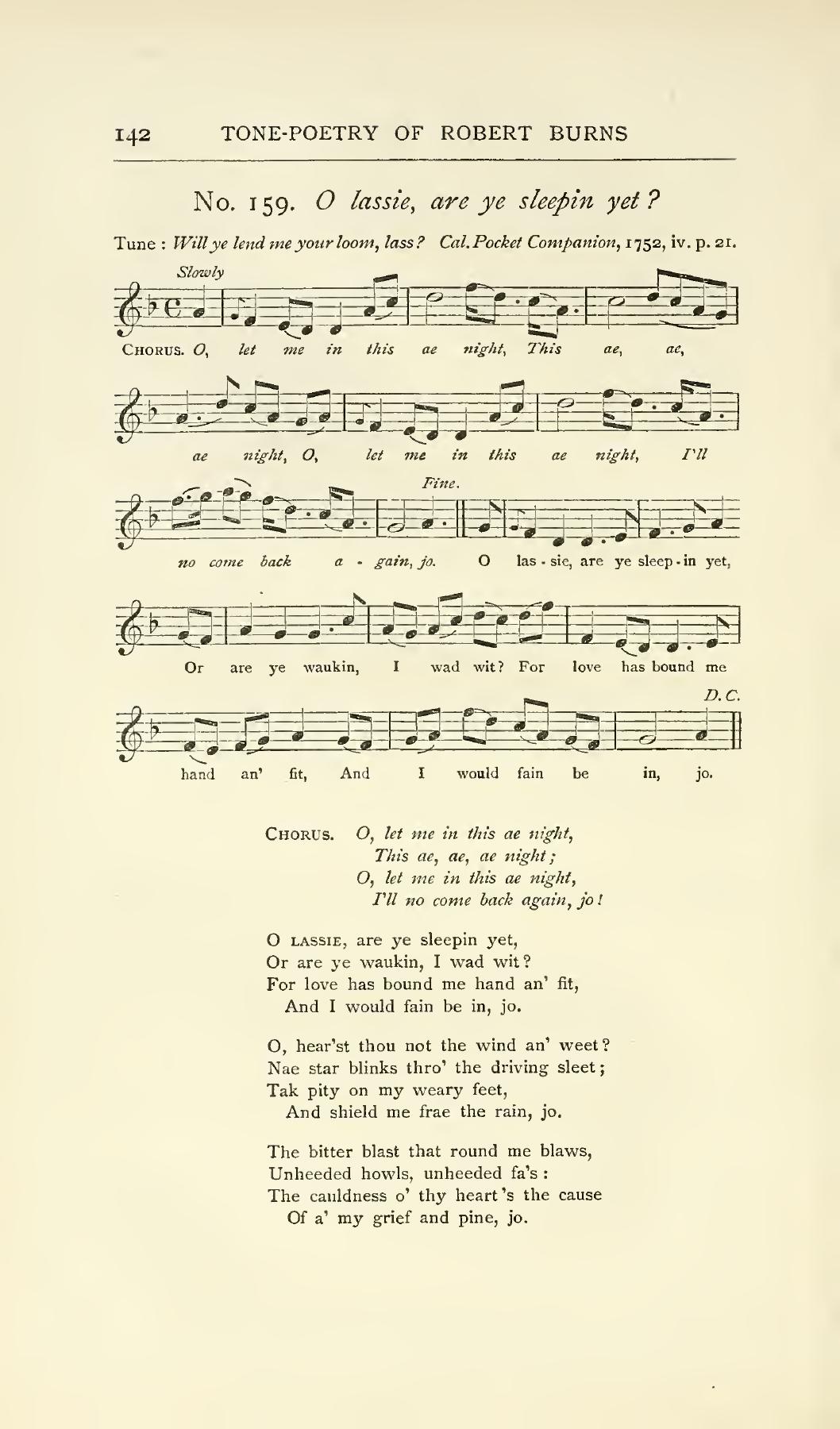 View score Dick’s Songs of Robert Burns (1903)
Lyrics
Choose an edition
Version notes
| Dick (1903) · no. 159 | Cunningham · 1855Ebook transcription |
|---|---|
| O lassie, are ye sleepin yet | O Lassie, art thou sleeping yet |
| O, let me in this ae night / I’ll no come back again, jo! | For pity’s sake this ae night / O rise and let me in, jo! |
| O, hear’st thou not the wind an’ weet? | Thou hear’st the winter wind and weet! |
| grief and pine | grief and pain |
More differences between these editions
| Dick (1903) · no. 159 | Cunningham · 1855Ebook transcription |
|---|---|
| caller chorus before three quatrains; answer chorus before four quatrains | choruses embedded after first stanza and repeated at end of each separate piece |
Dick (1903) · no. 159
CHORUS.
O, let me in this ae night,
This ae, ae, ae night;
O, let me in this ae night,
I'll no come back again, jo!

O lassie, are ye sleepin yet,
Or are ye waukin, I wad wit?
For love has bound me hand an' fit,
And I would fain be in, jo.

O, hear'st thou not the wind an' weet?
Nae star blinks thro' the driving sleet;
Tak pity on my weary feet,
And shield me frae the rain, jo.

The bitter blast that round me blaws,
Unheeded howls, unheeded fa's:
The cauldness o' thy heart's the cause
Of a' my grief and pine, jo.

HER ANSWER.
CHORUS.
I tell you now this ae night,
This ae, ae, ae night,
And ance for a' this ae night,
I winna let ye in, jo.

O, tell na me o' wind an' rain,
Upbraid na me wi' cauld disdain,
Gae back the gate ye cam again,
I winna let you in, jo.

The snellest blast at mirkest hours,
That round the pathless wand'rer pours,
Is nocht to what poor she endures
That's trusted faithless man, jo.

The sweetest flower that deck'd the mead,
Now trodden like the vilest weed—
Let simple maid the lesson read
The weird may be her ain, jo.

The bird that charm'd his summer day,
And now the cruel fowler's prey;
Let that to witless woman say
'The gratefu' heart of man,' jo.
View the source edition · no. 159; pp. 142–143
About this edition
Dick includes both the caller and Her Answer: an initial chorus followed by three quatrains, then another chorus and four answering quatrains. Cunningham prints the two voices as separate pieces, with choruses embedded and repeated. The caller’s chorus, opening address, weather appeal and pine/pain differ. The answer’s final stanza differs substantially; the separately labelled answer companion gives its own comparison.
Cunningham (1855)
O Lassie, art thou sleeping yet,
Or art thou waking, I would wit?
For love has bound me hand and foot,
  And I would fain be in, jo.
    O let me in this ae night,
      This ae, ae, ae night;
    For pity’s sake this ae night,
      O rise and let me in, jo!

Thou hear’st the winter wind and weet!
Nae star blinks thro’ the driving sleet:
Tak pity on my weary feet,
  And shield me frae the rain, jo.

The bitter blast that round me blaws,
Unheeded howls, unheeded fa’s;
The cauldness o’ thy heart’s the cause
  Of a’ my grief and pain, jo.
    O let me in this ae night,
      This ae, ae, ae night;
    For pity’s sake this ae night,
      O rise and let me in, jo!
Digital text from Project Gutenberg.
View the source edition · p. 302
About this edition
Dick includes both the caller and Her Answer: an initial chorus followed by three quatrains, then another chorus and four answering quatrains. Cunningham prints the two voices as separate pieces, with choruses embedded and repeated. The caller’s chorus, opening address, weather appeal and pine/pain differ. The answer’s final stanza differs substantially; the separately labelled answer companion gives its own comparison.
Music
View historical scores
Dick’s Songs of Robert Burns (1903)
no. 159; pp. 142–143