For a’ that, and a’ that
Behind the song
Take a guinea in your hand. Rank is the stamp on the coin, says the singer. The person is the gold. The principle holds whether you dine plainly or richly, wear homespun or silk, or strut in front of a company that bows to your title. [1]
The poor can hold their heads up. The lord enjoying all that attention is a “coof”, a fool. A prince may make knights and dukes at will, but an honest man is beyond his power to make. [1]
Read the fuller story
Dick dates the song’s dispatch to Thomson to 1 January 1795. He prints Burns’s playful dismissal of it as thoughts turned into rhyme and his reservation about offering it for Thomson’s book. Cunningham also quotes the self-deprecating remark. These later editions preserve the exchange through their editorial accounts. [2][3]
Dick quotes a Jacobite use of “For a’ that” and connects the air with Lady Macintosh’s Reel. In his score he names For a’ that and cites the Scots Musical Museum of 1790. The heading dates the musical source to 1790; his commentary places Burns’s present lyric later. [1][2]
The final stanza widens the promise from the individual to the world. Its hoped-for brotherhood grows out of the qualities already valued in the song: sense, honesty and worth. Cunningham’s fourth stanza begins “A king can make”, while Dick prints “A prince can mak”. Both readings carry the argument towards that shared future. [1][3]
Story references
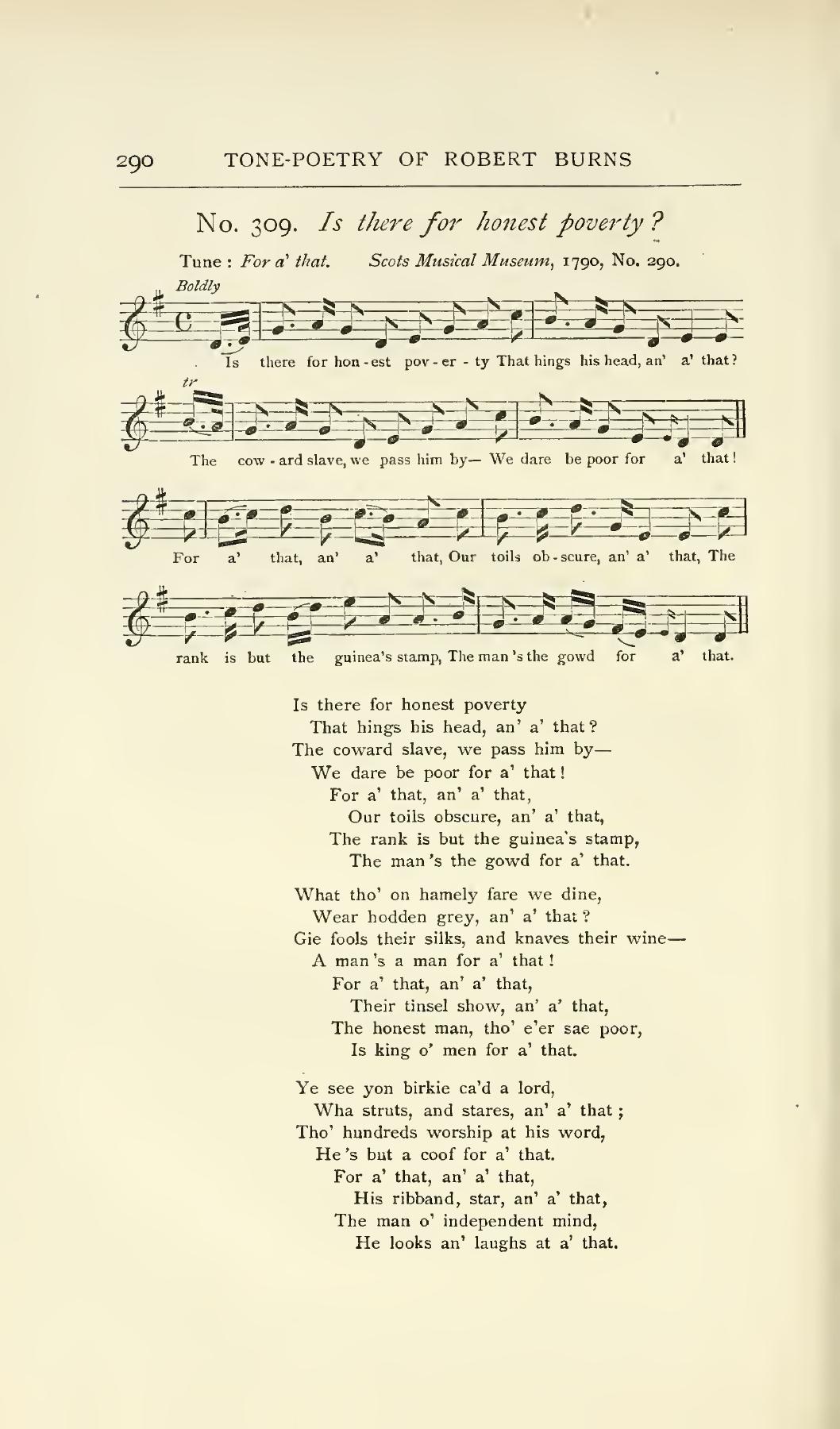 View score Dick’s Songs of Robert Burns (1903)
Lyrics
Choose an edition
Version notes
| Dick (1903) · no. 309 | Cunningham · 1855Ebook transcription |
|---|---|
| The man’s the gowd for a’ that. | The man’s the gowd for a’ that! |
Dick (1903) · no. 309
Is there for honest poverty
    That hings his head, an’ a’ that?
The coward slave, we pass him by—
    We dare be poor for a’ that!
      For a’ that, an’ a’ that,
        Our toils obscure, an’ a’ that,
      The rank is but the guinea’s stamp,
        The man’s the gowd for a’ that.

What tho’ on hamely fare we dine,
    Wear hodden grey, an’ a’ that?
Gie fools their silks, and knaves their wine—
    A man’s a man for a’ that!
      For a’ that, an’ a’ that,
        Their tinsel show, an’ a’ that,
      The honest man, tho’ e’er sae poor,
        Is king o’ men for a’ that.

Ye see yon birkie ca’d a lord,
    Wha struts, and stares, an’ a’ that;
Tho’ hundreds worship at his word,
    He’s but a coof for a’ that.
      For a’ that, an’ a’ that,
        His ribband, star, an’ a’ that,
      The man o’ independent mind,
        He looks an’ laughs at a’ that.

A prince can mak a belted knight,
    A marquis, duke, an’ a’ that,
But an honest man’s aboon his might—
    Gude faith, he mauna fa’ that!
      For a’ that, an’ a’ that,
        Their dignities, an’ a’ that,
      The pith o’ sense an’ pride o’ worth
        Are higher rank than a’ that.

Then let us pray that come it may—
    As come it will, for a’ that—
That sense and worth, o’er a’ the earth
    Shall bear the gree, an’ a’ that;
      For a’ that, an’ a’ that,
        It’s comin yet for a’ that,
      That man to man the world o’er,
        Shall brothers be for a’ that.
View the source edition · no. 309; pp. 290–291
About this edition
Cunningham prints “A king can make a belted knight”, where Dick has “A prince can mak”. His “May bear the gree” differs from Dick’s “Shall bear the gree”. “Hoddin gray” and “hodden grey” are edition spellings. Both give five eight-line stanzas.
Cunningham (1855)
Is there, for honest poverty,
  That hangs his head, and a’ that?
The coward-slave, we pass him by,
  We dare be poor for a’ that!
For a’ that, and a’ that,
  Our toils obscure, and a’ that;
The rank is but the guinea’s stamp,
  The man’s the gowd for a’ that!

What tho’ on hamely fare we dine,
  Wear hoddin gray, and a’ that;
Gie fools their silks, and knaves their wine,
  A man’s a man, for a’ that!
For a’ that, and a’ that,
  Their tinsel show, and a’ that;
The honest man, though e’er sae poor,
  Is king o’ men for a’ that!

Ye see yon birkie, ca’d—a lord,
  Wha struts, and stares, and a’ that;
Though hundreds worship at his word,
  He’s but a coof for a’ that:
For a’ that, and a’ that,
  His riband, star, and a’ that,
The man of independent mind,
  He looks and laughs at a’ that.

A king can make a belted knight,
  A marquis, duke, and a’ that,
But an honest man’s aboon his might,
  Guid faith, he maunna fa’ that!
For a’ that, and a’ that,
  Their dignities, and a’ that,
The pith o’ sense, and pride o’ worth,
  Are higher ranks than a’ that.

Then let us pray that come it may—
  As come it will for a’ that—
That sense and worth, o’er a’ the earth,
  May bear the gree, and a’ that;
For a’ that, and a’ that,
  It’s comin’ yet for a’ that,
That man to man, the warld o’er,
  Shall brothers be for a’ that!
Digital text from Project Gutenberg.
View the source edition · p. 301
About this edition
Cunningham prints “A king can make a belted knight”, where Dick has “A prince can mak”. His “May bear the gree” differs from Dick’s “Shall bear the gree”. “Hoddin gray” and “hodden grey” are edition spellings. Both give five eight-line stanzas.
Music
View historical scores
Dick’s Songs of Robert Burns (1903)
no. 309; pp. 290–291