The Fête Champêtre
Behind the song
Ayr needs a member of Parliament, and Cunninghame of Enterkin lays on a lavish party beside the river. So Allan Cunningham explains the occasion. The host expected a dissolution of Parliament. When it failed to come, all that wine had done him little electoral good. [1]
Burns gives Love, Beauty and Mirth charge of the entertainment. Even Politics has to leave his name at the gate and beg to be let in. [1]
Read the fuller story
Seven eight-line stanzas turn electoral hospitality into an elaborate joke. Money, wine and talk are followed by the attraction of a fête champêtre. Love and Beauty seal a pact against ‘Sir Politicks’, while Mirth summons the pleasures of woods and water to the Ayr. The gathering becomes a moonlit spectacle of music, dancing, jewels and flowing robes. [1]
Personification controls the scene. Boreas and his unruly winds are tied up like cattle, and even Politics cannot cross the party’s enchanted boundary. He must surrender his name and ask humbly to share the festivities. The closing reversal lets social pleasure temporarily master the electoral business which opened the song. [1]
Cunningham says that the occasion promoted Cunninghame of Enterkin’s parliamentary ambitions through a sumptuous entertainment beside the Ayr. He adds that the expected dissolution of Parliament did not follow, so the host’s wine achieved no intended result. The tune is ‘Killiecrankie’. [1]
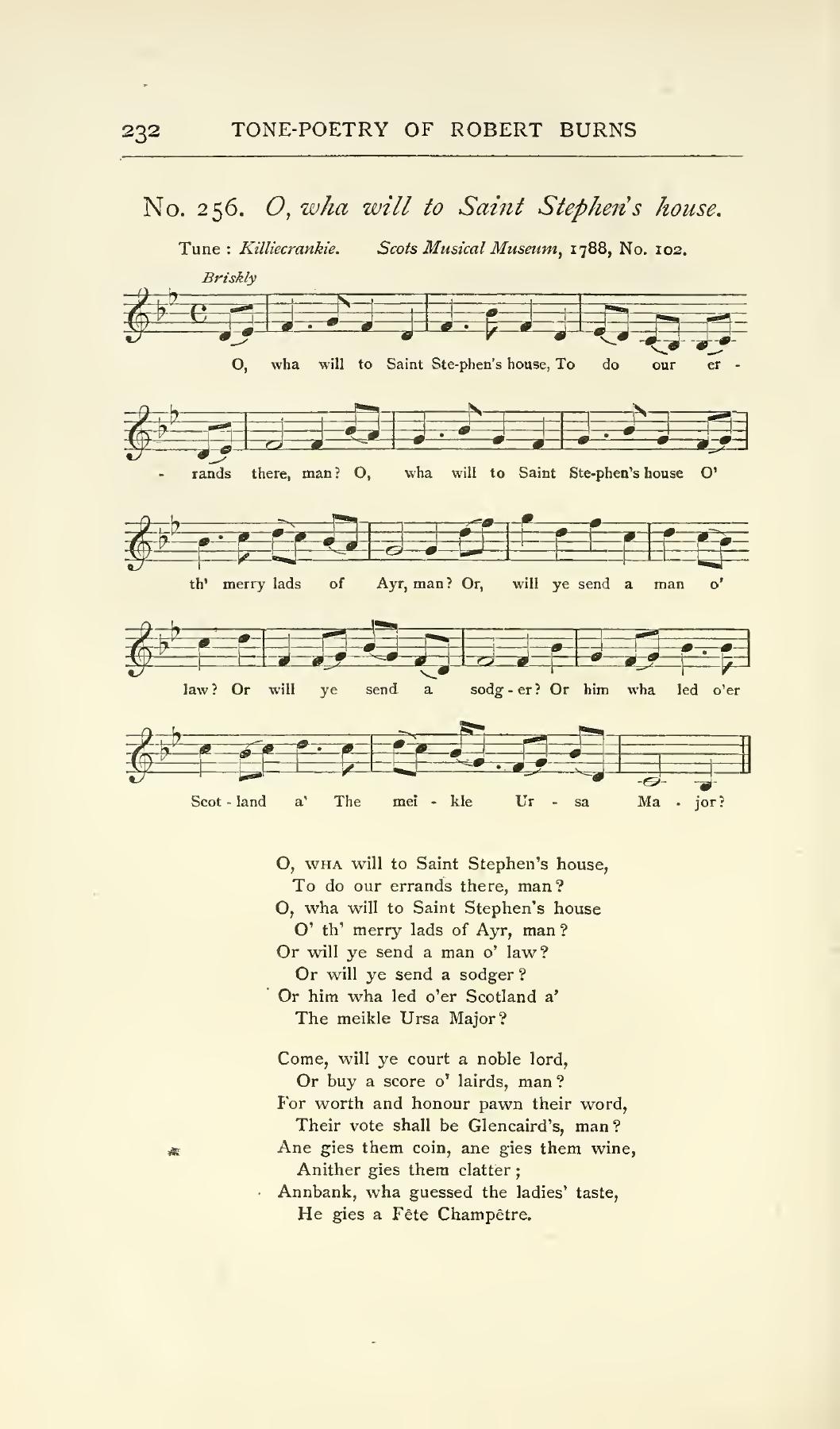 View score Dick’s Songs of Robert Burns (1903)
Lyrics
Choose an edition
Cunningham (1855)
O wha will to Saint Stephen’s house,
  To do our errands there, man?
O wha will to Saint Stephen’s house,
  O’ th’ merry lads of Ayr, man?
Or will we send a man-o’-law?
  Or will we send a sodger?
Or him wha led o’er Scotland a’
  The meikle Ursa-Major?

Come, will ye court a noble lord,
  Or buy a score o’ lairds, man?
For worth and honour pawn their word,
  Their vote shall be Glencaird’s, man?
Ane gies them coin, ane gies them wine,
  Anither gies them clatter;
Anbank, wha guess’d the ladies’ taste,
  He gies a Fête Champêtre.

When Love and Beauty heard the news,
  The gay green-woods amang, man;
Where gathering flowers and busking bowers,
  They heard the blackbird’s sang, man;
A vow, they seal’d it with a kiss,
  Sir Politicks to fetter,
As theirs alone, the patent-bliss
  To hold a Fête Champêtre.

Then mounted Mirth, on gleesome wing,
  O’er hill and dale she flew, man;
Ilk wimpling burn, ilk crystal spring,
  Ilk glen and shaw she knew, man:
She summon’d every social sprite
  That sports by wood or water,
On th’ bonny banks of Ayr to meet,
  And keep this Fête Champêtre.

Cauld Boreas, wi’ his boisterous crew,
  Were bound to stakes like kye, man;
And Cynthia’s car, o’ silver fu’,
  Clamb up the starry sky, man:
Reflected beams dwell in the streams,
  Or down the current shatter;
The western breeze steals thro’ the trees,
  To view this Fête Champêtre.

How many a robe sae gaily floats!
  What sparkling jewels glance, man!
To Harmony’s enchanting notes,
  As moves the mazy dance, man.
The echoing wood, the winding flood,
  Like Paradise did glitter,
When angels met, at Adam’s yett,
  To hold their Fête Champêtre.

When Politics came there, to mix
  And make his ether-stane, man!
He circled round the magic ground,
  But entrance found he nane, man:
He blush’d for shame, he quat his name,
  Forswore it, every letter,
Wi’ humble prayer to join and share
  This festive Fête Champêtre.
Digital text from Project Gutenberg.
View the source edition · p. 300
About this edition
Cunningham’s preface discusses several poems he left out of the collection.
Dick (1903) · no. 256
The words are on the score page.
View the source edition · no. 256; pp. 232–233
Music
View historical scores
Dick’s Songs of Robert Burns (1903)
no. 256; pp. 232–233