Contented wi’ little and cantie wi’ mair
Behind the song
When sorrow and care creep up on him, the singer gives them a skelp with good ale and an old Scots song. Mirth is money in his pocket, freedom a piece of land beyond the reach of any king. [1]
He expects a rough road and has made his own reckoning. One night in good company at the end of it can make up for a year of trouble. [1]
Read the fuller story
Dick places the song's beginnings in Thomson's request for words to Lumps o' Pudding around the middle of November 1794. He also relates it to a gift of David Allan's picture of The Cottar's Saturday Night in May 1795. In the letter he quotes, Burns proposes the song's opening as a motto to accompany an image of himself. [2]
The quoted wish joins a portrait of the face to a picture of the mind. It gives the song a particular place in Burns's presentation of himself to posterity. The lyric's spirited welcome can be read beside that deliberate choice of motto, with its good humour, independence and awareness of care. [1][2]
Both Dick and Cunningham name Lumps o' Pudding as the air. Dick marks the music “Cheerily” and gives the words in four quatrains. Their spellings differ in small ways: his “soger” becomes Cunningham's “sodger”, while “daur” becomes “dare”. The assertion of freedom stays at the centre of both readings. [1][3]
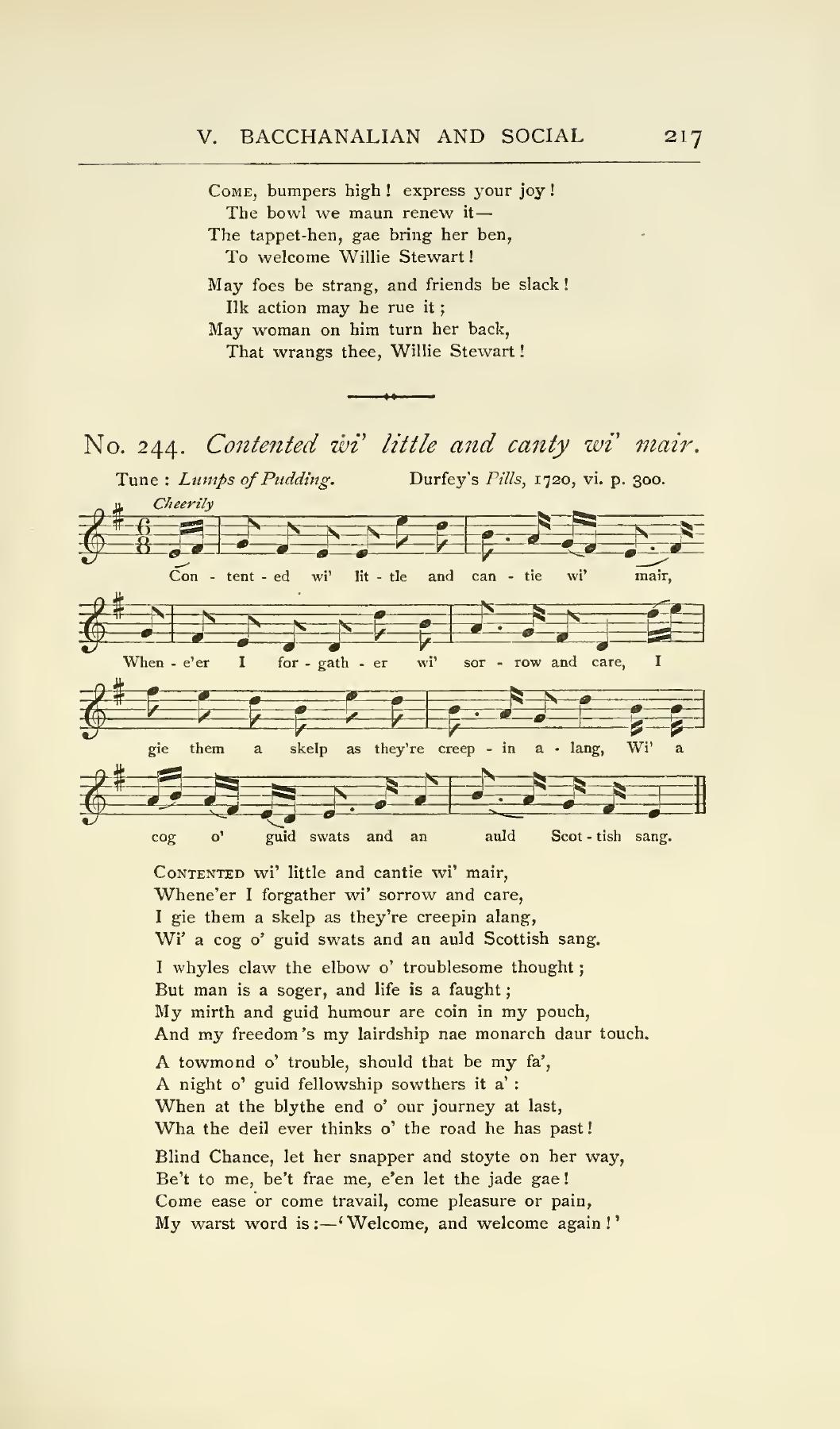 View score Dick’s Songs of Robert Burns (1903)
Lyrics
Choose an edition
Version notes
| Dick (1903) · no. 244 | Cunningham · 1855Ebook transcription |
|---|---|
| soger | sodger |
| daur | dare |
| sorrow and care | sorrow end care |
Dick (1903) · no. 244
Contented wi' little and cantie wi' mair,
Whene'er I forgather wi' sorrow and care,
I gie them a skelp as they're creepin alang,
Wi' a cog o' guid swats and an auld Scottish sang.

I whyles claw the elbow o' troublesome thought;
But man is a soger, and life is a faught;
My mirth and guid humour are coin in my pouch,
And my freedom's my lairdship nae monarch daur touch.

A towmond o' trouble, should that be my fa',
A night o' guid fellowship sowthers it a':
When at the blythe end o' our journey at last,
Wha the deil ever thinks o' the road he has past!

Blind Chance, let her snapper and stoyte on her way,
Be't to me, be't frae me, e'en let the jade gae!
Come ease or come travail, come pleasure or pain,
My warst word is:—'Welcome, and welcome again!'
These are the words printed below the score.
View the source edition · no. 244; p. 217
About this edition
Both print four quatrains. Dick has “soger” and “daur”; Cunningham “sodger” and “dare”. Cunningham’s opening ebook stanza has “sorrow end care”, while Dick clearly prints “sorrow and care”; the ebook anomaly remains distinct.
Cunningham (1855)
Contented wi’ little, and cantie wi’ mair,
Whene’er I forgather wi’ sorrow end care,
I gie them a skelp, as they’re creepin alang,
Wi’ a cog o’ guid swats, and an auld Scottish sang.

I whyles claw the elbow o’ troublesome thought;
But man is a sodger, and life is a faught:
My mirth and guid humour are coin in my pouch,
And my freedom’s my lairdship nae monarch dare touch.

A towmond o’ trouble, should that be my fa’,
A night o’ guid fellowship sowthers it a’:
When at the blithe end o’ our journey at last,
Wha the deil ever thinks o’ the road he has past?

Blind chance, let her snapper and stoyte on her way;
Be’t to me, be’t frae me, e’en let the jade gae:
Come ease, or come travail; come pleasure or pain;
My warst word is—“Welcome, and welcome again!”
Digital text from Project Gutenberg.
View the source edition · p. 297
About this edition
Both print four quatrains. Dick has “soger” and “daur”; Cunningham “sodger” and “dare”. Cunningham’s opening ebook stanza has “sorrow end care”, while Dick clearly prints “sorrow and care”; the ebook anomaly remains distinct.
Music
View historical scores
Dick’s Songs of Robert Burns (1903)
no. 244; p. 217