O saw ye my dear, my Phely?
Behind the song
Willy asks after Philly twice, then receives the answer that she is in the grove with a new love and will not come home to him. The next question is equally insistent: what does she say? The reply sharpens the rejection, telling him that she has forgotten him and disowns him for ever. Each repeated question delays an answer whose shortness makes it harder to evade. [1]
The third stanza turns from asking about Philly to addressing her. Willy wishes twice that he had never seen her, then calls her as false as she is fair and says she has broken his heart. The same familiar names, Philly and Willy, run through the exchange, giving a compact dialogue the intimacy of a private grievance. The final stanza leaves the singer with his own judgement after the earlier reported replies. [1]
Read the fuller story
Cunningham identifies the disappointed lover with the musician Stephen Clarke and the woman with Phillis M’Murdo, saying that Clarke persuaded Burns to write the accusation. Dick describes the song as a version of Eppie M’Nab and says it was supplied to Thomson in October 1794. These editorial accounts connect the lyric with both a song relationship and a reported personal occasion. [2][3]
Dick quotes Burns recommending pauses in When she cam ben she bobbit, with a full bass at the stops and a thin, dropping bass through the rest of the air. He reports that Thomson adopted the pauses and that Haydn filled the vocal gaps with instrumental chords. The selected Dick setting is headed When she cam ben she bobbit and marked Slow. Its lyric uses Philly throughout, where Cunningham prints Phely. [3][1][2]
Story references
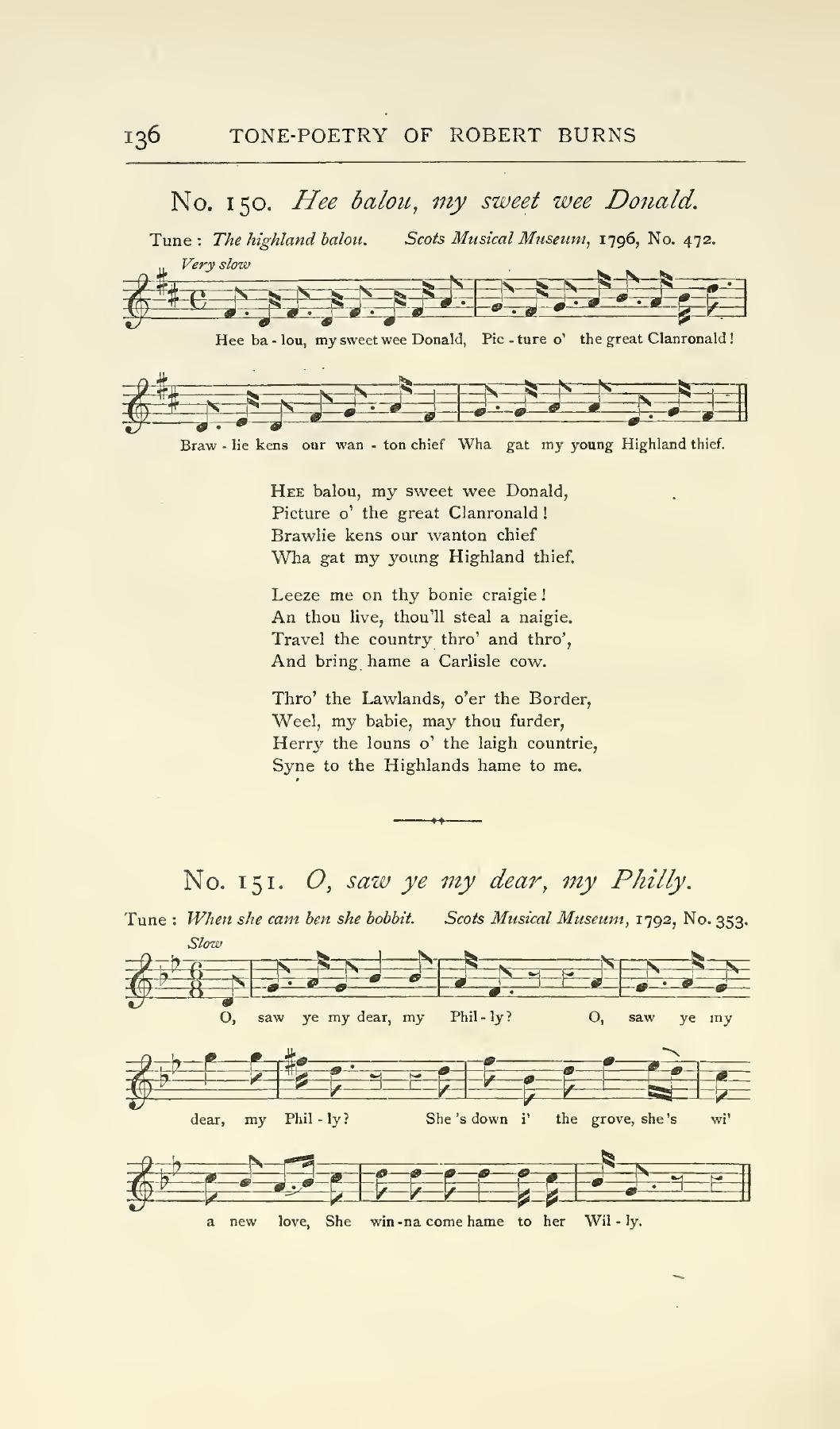 View score Dick’s Songs of Robert Burns (1903)
Lyrics
Choose an edition
Version notes
| Dick (1903) · no. 151 | Cunningham · 1855Ebook transcription |
|---|---|
| Philly | Phely |
| What says she my dear | What says she, my dearest |
| She lets thee to wit she has thee forgot | She lets thee to wit that she has thee forgot |
| new love, | new love! |
Dick (1903) · no. 151
O, saw ye my dear, my Philly?
O, saw ye my dear, my Philly?
She's down i' the grove, she's wi' a new love,
She winna come hame to her Willy.

What says she my dear, my Philly?
What says she my dear, my Philly?
She lets thee to wit she has thee forgot,
And for ever disowns thee, her Willy.

O, had I ne'er seen thee, my Philly!
O, had I ne'er seen thee, my Philly!
As light as the air, and fause as thou's fair,
Thou's broken the heart o' thy Willy.
View the source edition · no. 151; pp. 136–137
About this edition
The complete Dick lyric follows the score on the second page. Both editions have three quatrains. Dick reads Philly, my dear and She lets thee to wit she has thee forgot; Cunningham reads Phely, my dearest and includes that before she has thee forgot. Dick’s first reply ends new love, where Cunningham has new love!
Cunningham (1855)
O saw ye my dear, my Phely?
O saw ye my dear, my Phely?
She’s down i’ the grove, she’s wi’ a new love!
  She winna come hame to her Willy.

What says she, my dearest, my Phely?
What says she, my dearest, my Phely?
She lets thee to wit that she has thee forgot,
  And for ever disowns thee, her Willy.

O had I ne’er seen thee, my Phely!
O had I ne’er seen thee, my Phely!
As light as the air, and fause as thou’s fair,
  Thou’s broken the heart o’ thy Willy.
Digital text from Project Gutenberg.
View the source edition · p. 294
About this edition
The complete Dick lyric follows the score on the second page. Both editions have three quatrains. Dick reads Philly, my dear and She lets thee to wit she has thee forgot; Cunningham reads Phely, my dearest and includes that before she has thee forgot. Dick’s first reply ends new love, where Cunningham has new love!
Music
View historical scores
Dick’s Songs of Robert Burns (1903)
no. 151; pp. 136–137