On the seas and far away
Behind the song
The woman left at home cannot keep her thoughts from her sailor. In the heat of summer, while the sheep pant around her, she imagines him firing his gun at sea. Her plea addresses the bullets themselves: spare the boy she loves, whatever fate may do to her. The distant fighting enters the familiar weather and work of home. [1]
Winter brings another danger. Wind tears through the forest and surf roars against the shore; she can weep and pray for his safety. The final stanza turns that private fear into an appeal to Peace, asking that people meet as brothers and that favourable winds return the sailor to her arms. Her imagined reunion depends on an end to war. [1]
Read the fuller story
Cunningham prints Burns's account of making the stanzas while walking and thinking about O'er the hills and far away, dated 29 August 1794. Dick gives 30 August for their sending to Thomson. In Cunningham's extract, Burns moves quickly from pleasure in particular lines to doubt about the whole song, giving Thomson leave to criticise it gently. [2][3]
Dick reports a later withdrawal and quotes Burns comparing the making of a song to having a son whose wisdom or foolishness becomes clear only when he reaches the world. He also says Thomson omitted the second stanza and repeated one chorus without variation. That editing would remove the woman imagining her sailor at his gun and reduce the changing shape of her refrains. [2]
Dick prints a four-line refrain after every eight-line stanza, changing its last two lines to carry the fear or hope just expressed. Cunningham prints the common refrain after the opening and closing stanzas. Both name O'er the hills as the tune, with Dick giving the fuller title O'er the hills and far away. The repeated distance is the song's organising phrase. [1][3]
Story references
- James C. Dick, The Songs of Robert Burns (1903), No. 257; printed pp. 234–235; PDF pp. 290–291
- James C. Dick, The Songs of Robert Burns (1903), Dick historical note 257; printed 451,452; PDF 507,508
- Allan Cunningham, The Complete Works of Robert Burns (1855), printed 292; HTML #CCXXIV. Project Gutenberg transcription.
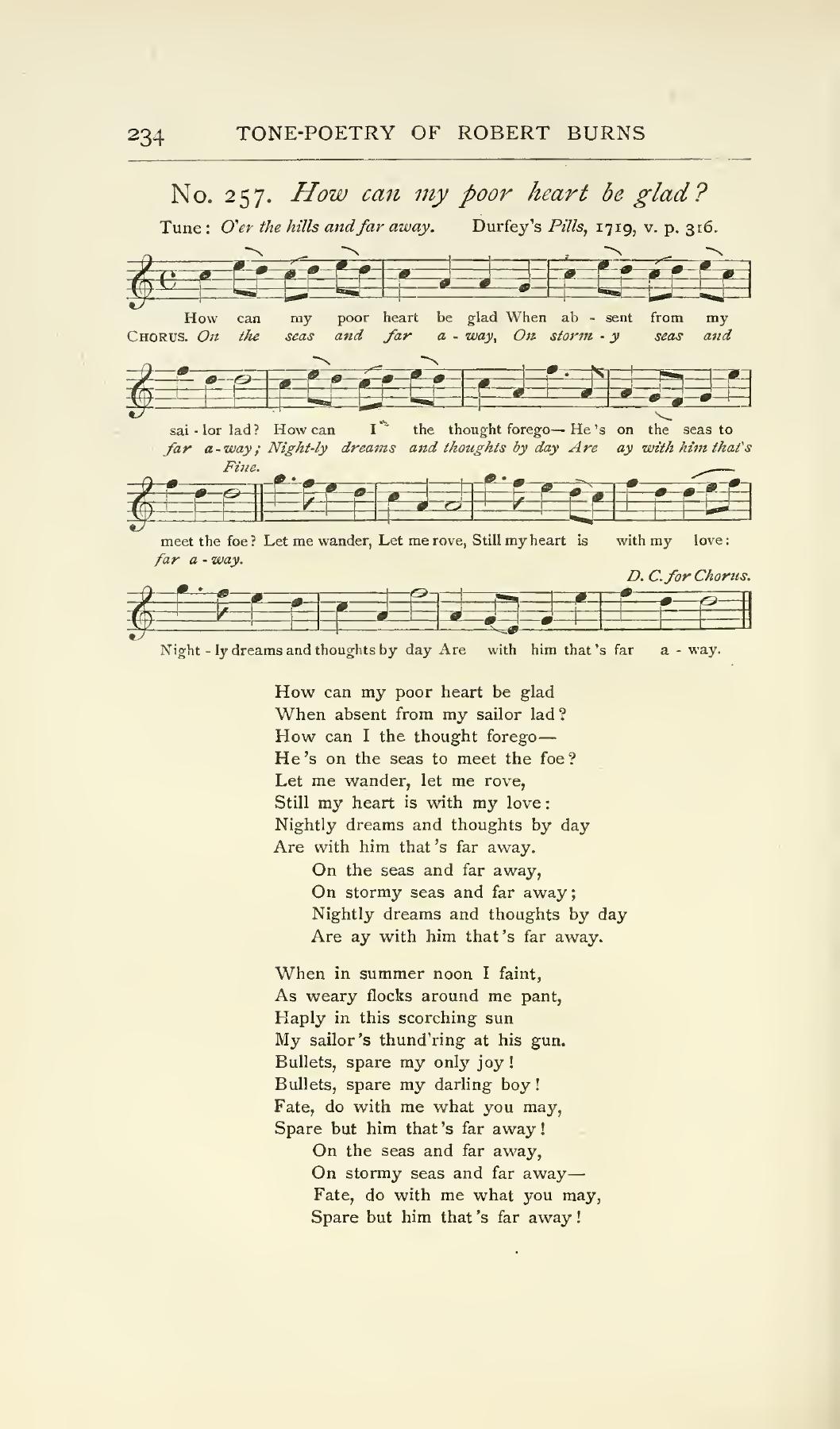 View score Dick’s Songs of Robert Burns (1903)
Lyrics
Choose an edition
Version notes
| Dick (1903) · no. 257 | Cunningham · 1855Ebook transcription |
|---|---|
| four varying refrains, one after each stanza | common refrain after first and last stanzas |
| summer noon | summer’s noon |
| forest | forests |
| as brother | as a brother |
Dick (1903) · no. 257
How can my poor heart be glad
When absent from my sailor lad?
How can I the thought forego—
He's on the seas to meet the foe?
Let me wander, let me rove,
Still my heart is with my love:
Nightly dreams and thoughts by day
Are with him that's far away.
On the seas and far away,
On stormy seas and far away;
Nightly dreams and thoughts by day
Are ay with him that's far away.

When in summer noon I faint,
As weary flocks around me pant,
Haply in this scorching sun
My sailor's thund'ring at his gun.
Bullets, spare my only joy!
Bullets, spare my darling boy!
Fate, do with me what you may,
Spare but him that's far away!
On the seas and far away,
On stormy seas and far away—
Fate, do with me what you may,
Spare but him that's far away!

At the starless, midnight hour,
When winter rules with boundless power,
As the storms the forest tear,
And thunders rend the howling air,
Listening to the doubling roar
Surging on the rocky shore,
All I can—I weep and pray
For his weal that's far away.
On the seas and far away,
On stormy seas and far away,
All I can—I weep and pray
For his weal that's far away.

Peace, thy olive wand extend
And bid wild War his ravage end;
Man with brother Man to meet,
And as brother kindly greet!
Then may Heaven with prosperous gales
Fill my sailor's welcome sails,
To my arms their charge convey
My dear lad that's far away.
On the seas and far away,
On stormy seas and far away,
To my arms their charge convey
My dear lad that's far away!
These are the words printed below the score.
View the source edition · no. 257; pp. 234–235
About this edition
Dick prints four eight-line stanzas, each followed by a four-line refrain whose last pair varies. Cunningham prints the common refrain after stanzas1 and4, omitting the changing refrains after2 and3. Dick’s “summer noon”, “forest” and “as brother” differ from Cunningham’s “summer’s noon”, “forests” and “as a brother”.
Cunningham (1855)
How can my poor heart be glad,
When absent from my sailor lad?
How can I the thought forego,
He’s on the seas to meet the foe?
Let me wander, let me rove,
Still my heart is with my love:
Nightly dreams, and thoughts by day,
Are with him that’s far away.
  On the seas and far away,
  On stormy seas and far away;
  Nightly dreams, and thoughts by day,
  Are ay with him that’s far away.

When in summer’s noon I faint,
As weary flocks around me pant,
Haply in this scorching sun
My sailor’s thund’ring at his gun:
Bullets, spare my only joy!
Bullets, spare my darling boy!
Fate, do with me what you may—
Spare but him that’s far away!

At the starless midnight hour,
When winter rules with boundless power:
As the storms the forests tear,
And thunders rend the howling air,
Listening to the doubling roar,
Surging on the rocky shore,
All I can—I weep and pray,
For his weal that’s far away.

Peace, thy olive wand extend,
And bid wild war his ravage end,
Man with brother man to meet,
And as a brother kindly greet:
Then may heaven with prosp’rous gales,
Fill my sailor’s welcome sails,
To my arms their charge convey—
My dear lad that’s far away.
  On the seas and far away
  On stormy seas and far away;
  Nightly dreams, and thoughts by day,
  Are ay with him that’s far away.
Digital text from Project Gutenberg.
View the source edition · p. 292
About this edition
Dick prints four eight-line stanzas, each followed by a four-line refrain whose last pair varies. Cunningham prints the common refrain after stanzas1 and4, omitting the changing refrains after2 and3. Dick’s “summer noon”, “forest” and “as brother” differ from Cunningham’s “summer’s noon”, “forests” and “as a brother”.
Music
View historical scores
Dick’s Songs of Robert Burns (1903)
no. 257; pp. 234–235