Here’s to thy health, my bonnie lass
Behind the song
The lover drinks the woman’s health and announces that he will stop calling at her door. He defends his independence against the hope of a richer match, then ends by promising to return at midnight. Cunningham describes the song as an early Burns composition later revised and sent to Johnson.[1]
Read the fuller story
The opening insists that the speaker can manage without the woman who delays marriage. He matches her freedom of choice with his own refusal to wait. The next stanza blames her friends for encouraging the delay in expectation of something grander, warning that fortune may disappoint them.[1]
His answer to their disdain is an account of modest self-sufficiency. Health is his wealth, and employment will keep him from want. The claims of freedom and dignity give the complaint a social edge: lack of money should not cancel the value of the person offering affection.[1]
The final stanza warns that a distant prospect may look better than it proves. Then the argument gives way to the promise of another visit, because true love can make a journey easy. Cunningham names “Laggan Burn” as the tune and quotes Sir Harris Nicolas on its Museum appearance with Burns’s name. The song’s last turn leaves its proud farewell entangled with continuing attachment.[1]
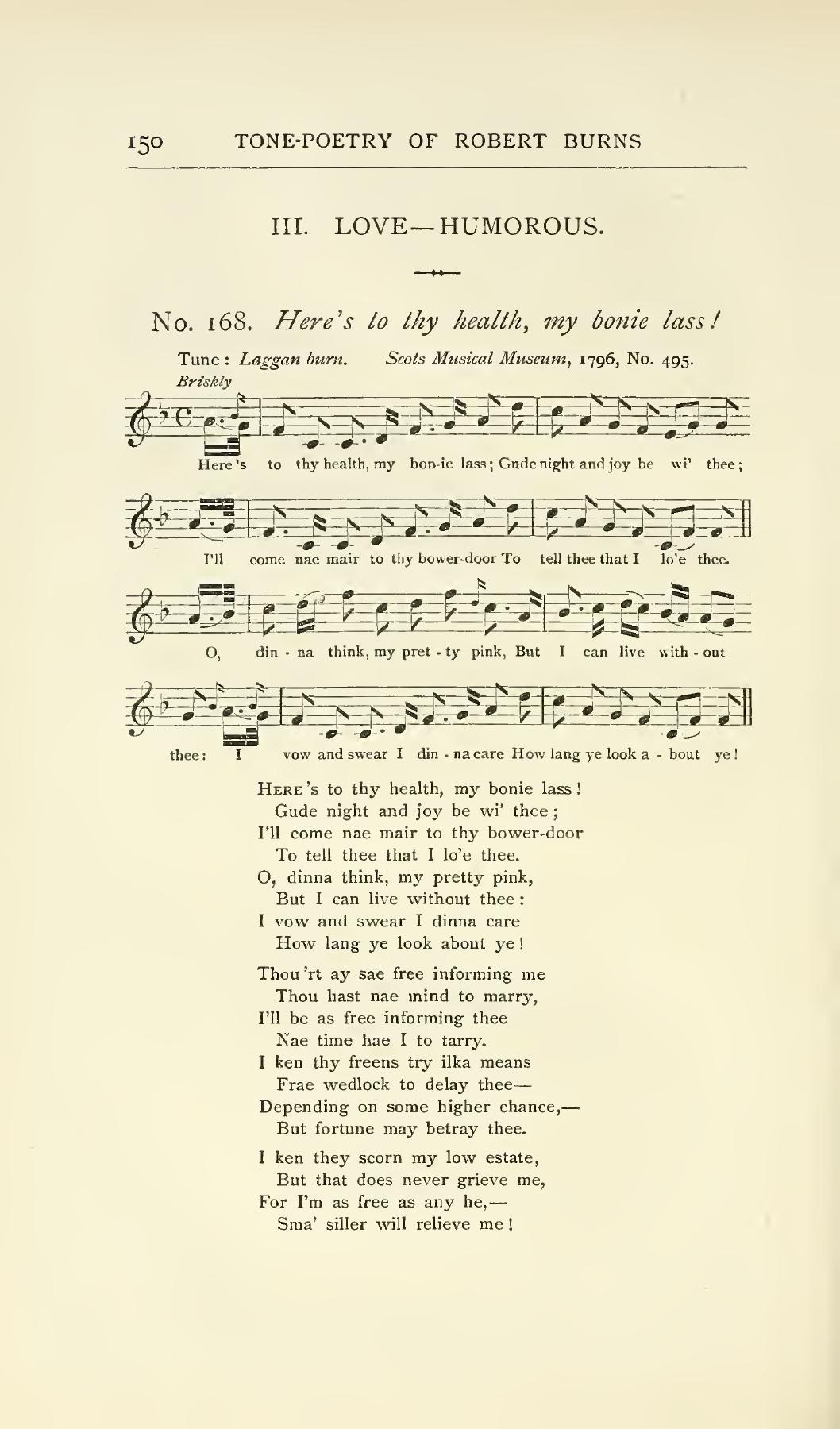 View score Dick’s Songs of Robert Burns (1903)
Lyrics
Choose an edition
Cunningham (1855)
Here’s to thy health, my bonnie lass,
  Gude night, and joy be wi’ thee;
I’ll come na mair to thy bower-door,
  To tell thee that I lo’e thee.
O dinna think, my pretty pink,
  But I can live without thee:
I vow and swear I dinna care
  How lang ye look about ye.

Thou’rt ay sae free informing me
  Thou hast na mind to marry;
I’ll be as free informing thee
  Nae time hae I to tarry.
I ken thy friends try ilka means,
  Frae wedlock to delay thee;
Depending on some higher chance—
  But fortune may betray thee.

I ken they scorn my low estate,
  But that does never grieve me;
But I’m as free as any he,
  Sma’ siller will relieve me.
I count my health my greatest wealth,
  Sae long as I’ll enjoy it:
I’ll fear na scant, I’ll bode nae want,
  As lang’s I get employment.

But far off fowls hae feathers fair,
  And ay until ye try them:
Tho’ they seem fair, still have a care,
  They may prove waur than I am.
But at twal at night, when the moon shines bright,
  My dear, I’ll come and see thee;
For the man that lo’es his mistress weel,
  Nae travel makes him weary.
Digital text from Project Gutenberg.
View the source edition · p. 290
About this edition
Cunningham’s preface discusses several poems he left out of the collection.
Dick (1903) · no. 168
The words are on the score page.
View the source edition · no. 168; pp. 150–151
Scots Musical Museum, vol. V (catalogued 1796) · no. 495
View the source edition · Volume 5, no. 495; p. 511
Music
View historical scores
Dick’s Songs of Robert Burns (1903)
no. 168; pp. 150–151
Words attributed to Burns
Cunningham identifies it as Burns’s early song, later trimmed by him and sent to Johnson; the revised earlier composition is attributed to the same writer.
Words Robert Burns
Burns’s role Wrote the words