But lately seen in gladsome green
Behind the song
The woods will recover their green splendour when May returns. The ageing singer sees no such renewal ahead: winter has become an image of the body’s decline and lost youth. [1]
Read the fuller story
Two eight-line stanzas turn the seasonal comparison against itself. The first remembers flourishing woods and confidently awaits their restoration. The second answers with the speaker’s white head, which no gentle thaw can clear of age’s snow. Weary days and sleepless pain lead to a final question addressed to youth: why will it not return? [1]
Cunningham says that the song was written for Johnson’s Museum in 1794. He describes the air as brought from Hindostan by a friend of the poet, and mentions other settings to ‘Gil Morrice’ and ‘The Death of the Linnet’. These are his accounts of the song’s publication and musical associations. The selected heading names ‘The winter of life’. [1]
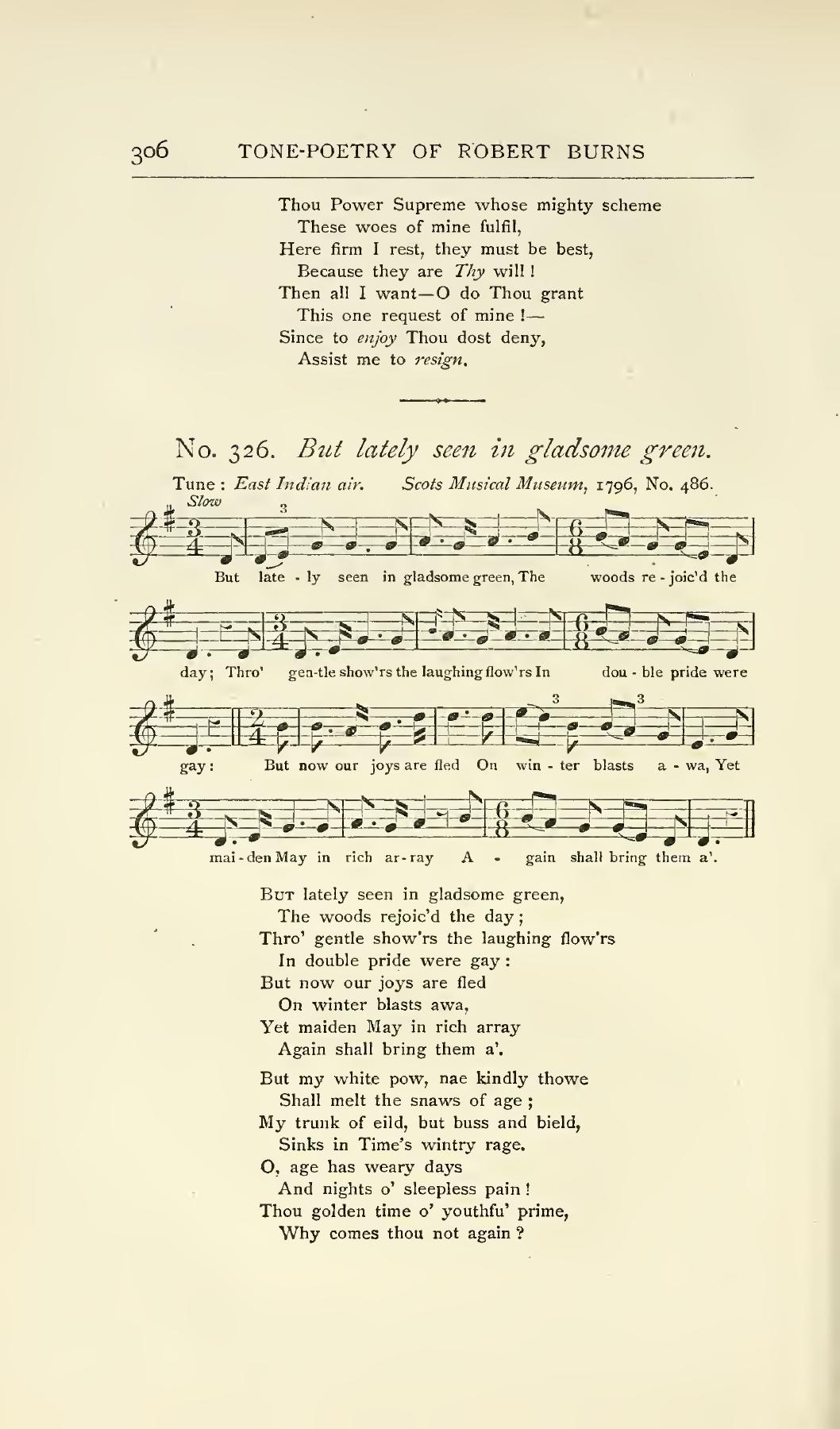 View score Dick’s Songs of Robert Burns (1903)
Lyrics
Choose an edition
Cunningham (1855)
But lately seen in gladsome green,
  The woods rejoiced the day;
Thro’ gentle showers and laughing flowers,
  In double pride were gay:
But now our joys are fled
  On winter blasts awa!
Yet maiden May, in rich array,
  Again shall bring them a’.

But my white pow, nae kindly thowe
  Shall melt the snaws of age;
My trunk of eild, but buss or bield,
  Sinks in Time’s wintry rage.
Oh! age has weary days,
  And nights o’ sleepless pain!
Thou golden time o’ youthfu’ prime,
  Why comes thou not again?
Digital text from Project Gutenberg.
View the source edition · p. 290
About this edition
Cunningham’s preface discusses several poems he left out of the collection.
Dick (1903) · no. 326
The words are on the score page.
View the source edition · no. 326; p. 306
Scots Musical Museum, vol. V (catalogued 1796) · no. 486
View the source edition · Volume 5, no. 486; p. 501
Music
View historical scores
Dick’s Songs of Robert Burns (1903)
no. 326; p. 306