Husband, husband, cease your strife
Behind the song
Nancy threatens to haunt her husband’s bed after she dies. He already has a remedy. He will marry another like her, fierce enough to frighten hell away. It is the last round in a quarrel that begins with his demand for obedience. Allan Cunningham links the song with Allan Ramsay’s My Jo Janet and older songs about quarrelling couples. [1]
Read the fuller story
The first exchange gives Nancy a forceful opening: marriage has made her a wife, not a slave. Her husband answers with the claim that one of them must obey. When she threatens to desert her sovereign lord, his reply admits sadness but immediately considers how he might manage without her.[1]
Nancy then imagines her own death and asks him to think about the loss. He answers with a pious confidence that heaven will give him strength. Her final threat is supernatural, promising to haunt his bed; his closing plan is to marry another woman like her, who would frighten hell itself away.[1]
The repeated address to Nancy gives the husband’s answers a steady pattern against her escalating warnings. The heading names “Jo Janet” as the tune. Cunningham says Burns asked Thomson for a judgement and records the reply as “Inimitable”. The four stanzas make their comedy through opposed voices, turning a quarrel over authority into a contest over who can outlast the other’s threats.[1]
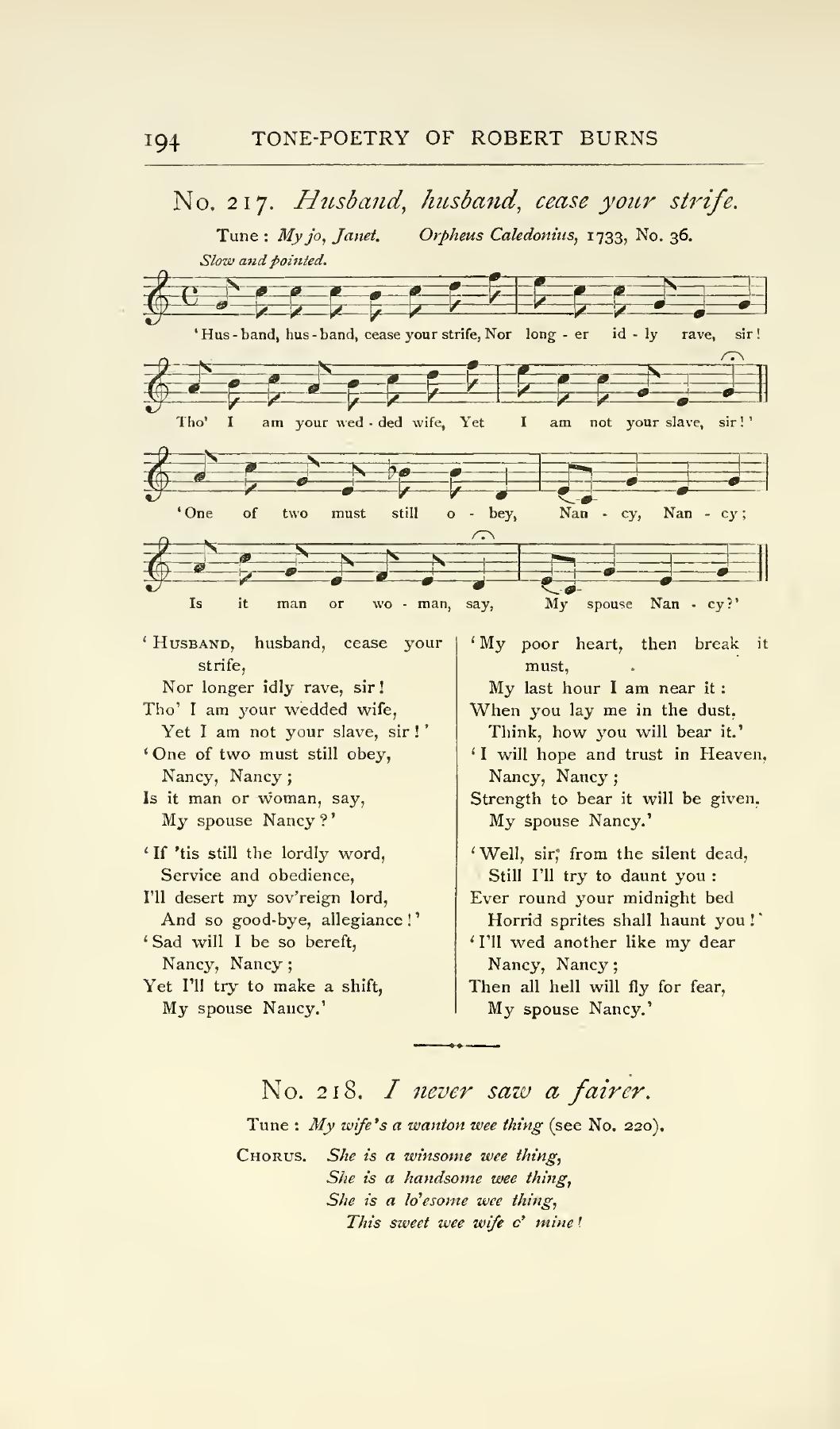 View score Dick’s Songs of Robert Burns (1903)
Lyrics
Choose an edition
Cunningham (1855)
Husband, husband, cease your strife,
  Nor longer idly rave, sir;
Tho’ I am your wedded wife,
  Yet I am not your slave, sir.
“One of two must still obey,
  Nancy, Nancy;
Is it man or woman, say,
  My spouse, Nancy?”

If ’tis still the lordly word,
  Service and obedience;
I’ll desert my sov’reign lord,
  And so, good bye, allegiance!
“Sad will I be, so bereft,
  Nancy, Nancy;
Yet I’ll try to make a shift,
  My spouse, Nancy.”

My poor heart then break it must,
  My last hour I’m near it:
When you lay me in the dust,
  Think, think, how you will bear it.
“I will hope and trust in heaven,
  Nancy, Nancy;
Strength to bear it will be given,
  My spouse, Nancy.”

Well, sir, from the silent dead,
  Still I’ll try to daunt you;
Ever round your midnight bed
  Horrid sprites shall haunt you.
“I’ll wed another, like my dear
  Nancy, Nancy;
Then all hell will fly for fear,
  My spouse, Nancy.”
Digital text from Project Gutenberg.
View the source edition · p. 289
About this edition
Cunningham’s preface discusses several poems he left out of the collection.
Dick (1903) · no. 217
The words are on the score page.
View the source edition · no. 217; p. 194
Music
View historical scores
Dick’s Songs of Robert Burns (1903)
no. 217; p. 194
Words attributed to Burns
Cunningham attributes these verses to Burns while asserting a connection with Ramsay’s My Jo Janet and older matrimonial bickering songs; the earlier texts have not been independently compared.
Words Robert Burns
Burns’s role Wrote the words