By Allan stream
Behind the song
A walker beside Allan stream hears a lover’s song as the sun sinks beyond Benledi. Its declaration of love for Annie opens into a remembered embrace and a celebration of meeting the beloved. Cunningham quotes Burns praising the song he had written for Thomson and acknowledges an older lyric behind it.[1]
Read the fuller story
The first stanza gives the love-song an attentive listener. Whispering wind and ripe corn surround the walk, while the woodland echoes carry Annie’s name. The speaker’s thoughts turn towards the pleasures of youth, making the landscape a setting for both present hearing and recollection.[1]
The next stanza blesses the bower where the lovers met and pledged constancy. Even the possibility of a frightening night spirit is wished away, so that the place and moment may remain free from sorrow. The closing stanza moves through primrose spring, summer flocks and yellow autumn before asking whether any season can equal the bodily joy of reunion.[1]
In Cunningham’s headnote, Burns describes autumn as his most productive season and invites Thomson to supply music if he approves the words. The editor also says the older song “O my love Annie’s very bonnie” helped the composition. The selected text brings that inherited love-song setting into its own sequence of listening, remembrance and praise.[1]
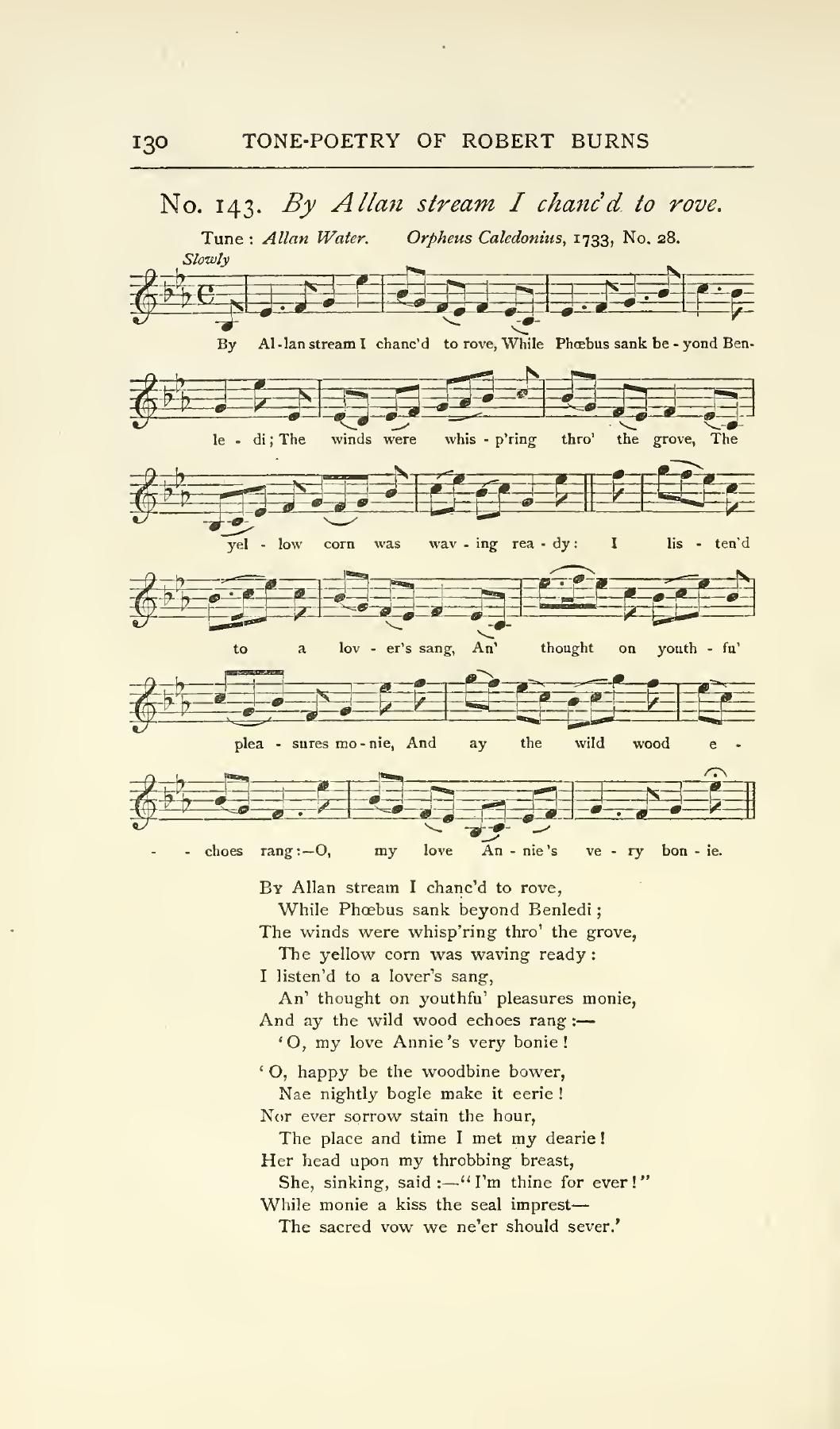 View score Dick’s Songs of Robert Burns (1903)
Lyrics
Choose an edition
Cunningham (1855)
By Allan stream I chanced to rove
  While Phœbus sank beyond Benledi;
The winds were whispering through the grove,
  The yellow corn was waving ready;
I listened to a lover’s sang,
  And thought on youthfu’ pleasures mony:
And aye the wild wood echoes rang—
  O dearly do I lo’e thee, Annie!

O happy be the woodbine bower,
  Nae nightly bogle make it eerie;
Nor ever sorrow stain the hour,
  The place and time I met my dearie!
Her head upon my throbbing breast,
  She, sinking, said, “I’m thine for ever?”
While mony a kiss the seal imprest,
  The sacred vow,—we ne’er should sever.

The haunt o’ Spring’s the primrose brae,
  The Simmer joys the flocks to follow;
How cheery, thro’ her shortening day,
  Is Autumn, in her weeds o’ yellow!
But can they melt the glowing heart,
  Or chain the soul in speechless pleasure,
Or thro’ each nerve the rapture dart,
  Like meeting her, our bosom’s treasure?
Digital text from Project Gutenberg.
View the source edition · p. 283
About this edition
Cunningham’s preface discusses several poems he left out of the collection.
Dick (1903) · no. 143
The words are on the score page.
View the source edition · no. 143; pp. 130–131
Music
View historical scores
Dick’s Songs of Robert Burns (1903)
no. 143; pp. 130–131
Words attributed to Burns
Cunningham attributes this lyric to Burns while saying the older O my love Annie’s very bonnie helped its making; the earlier words have not been independently compared.
Words Robert Burns
Burns’s role Wrote the words