O were my love yon lilac fair
Behind the song
Burns told George Thomson that he had made a stanza while balancing on the back legs of his chair. He wanted to put his new words first and save the thought he liked best in the older verse for last. James C. Dick credits Burns with the opening eight lines. [2]
First the lover wishes to be a little bird sheltering in a lilac. Its May blossom sets him singing and the bare winter branches make him mourn. Then the beloved is a rose on a castle wall and the lover a drop of dew in its folds, safe for the night until the sun drives him away. Dick sets the rose passage in brackets. [1]
Read the fuller story
Dick assigns the first eight lines to Burns. He quotes a letter to Thomson of 25 June 1793 in which Burns praises the older fragment, describes trying to add to it, and says he produced a stanza while balancing on the back legs of his chair. Burns's reported proposal was to put his addition first, reserving the thought he admired most for the close. [2]
Cunningham's introduction reverses that account: it describes the first verse as old material and the second as Burns's addition. Dick's allocation, his brackets and the letter he transmits support the ordering explained here. The disagreement makes the contribution question part of the song's editorial history, alongside its two sustained images of shelter and desire. [2][3]
The editions also offer different musical directions. Dick prints Gin my love were yon red rose; Cunningham's heading is Hughie Graham. Dick reports that Thomson's later edition combined Burns's stanza, a stanza by Richardson and the anonymous original, with music supplied by more than one hand. The shorter two-part reading here keeps the lilac and rose passages together in Dick's order. [1][2][3]
Story references
- James C. Dick, The Songs of Robert Burns (1903), No. 146; printed pp. 132–133; PDF pp. 188–189
- James C. Dick, The Songs of Robert Burns (1903), Dick historical note 146; printed 401; PDF 457
- Allan Cunningham, The Complete Works of Robert Burns (1855), printed 281; HTML #CXCVII. Project Gutenberg transcription.
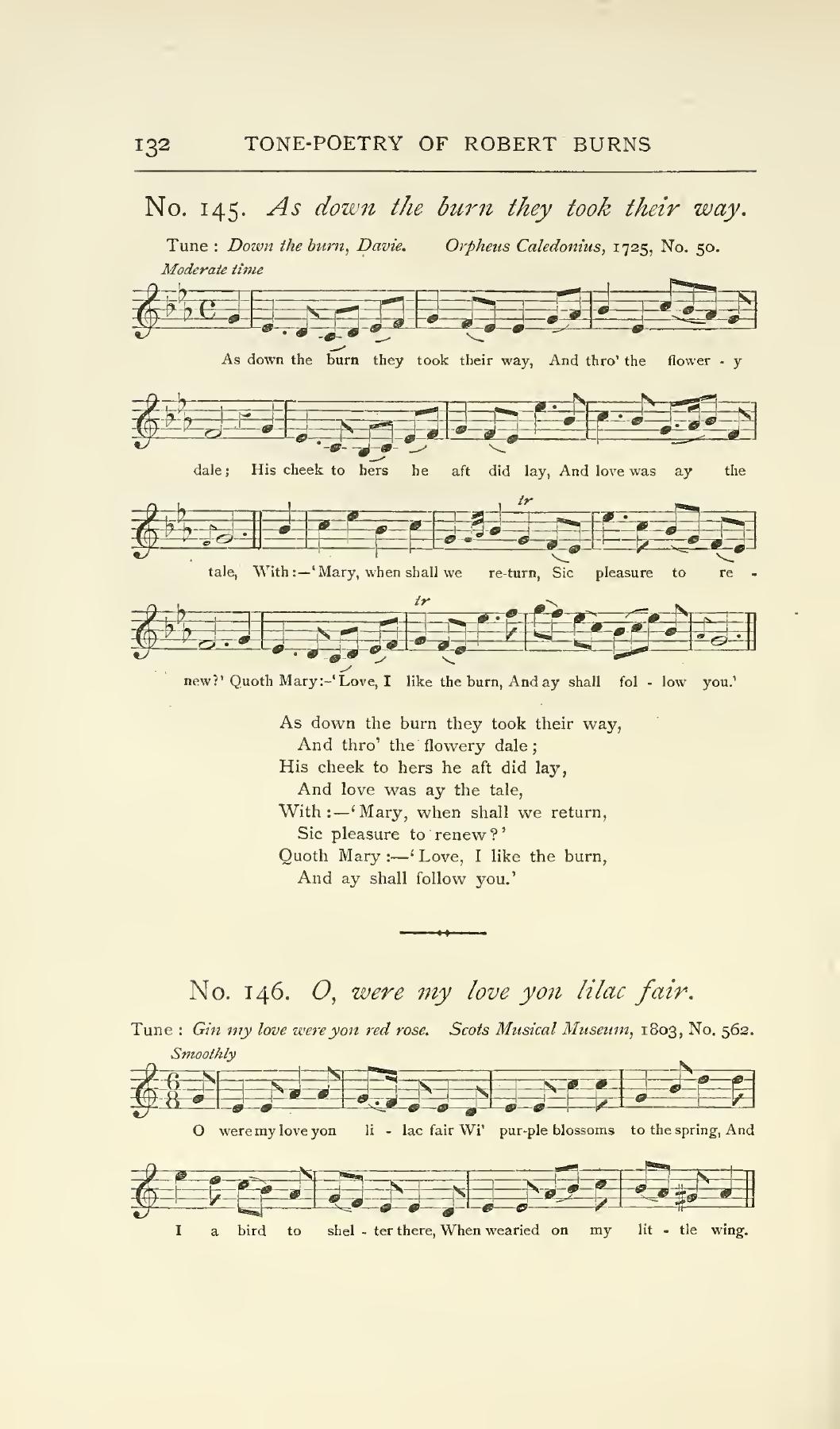 View score Dick’s Songs of Robert Burns (1903)
Lyrics
Choose an edition
Version notes
| Dick (1903) · no. 146 | Cunningham · 1855Ebook transcription |
|---|---|
| last eight lines bracketed | no brackets |
| renew’d | renewed |
| Gin my love were yon red rose | Hughie Graham |
| four quatrains | two octaves |
Dick (1903) · no. 146
O, were my love yon lilac fair
Wi' purple blossoms to the spring,
And I a bird to shelter there,
When wearied on my little wing,

How I wad mourn when it was torn
By autumn wild and winter rude!
But I wad sing on wanton wing,
When youthfu' May its bloom renew'd.

[O, gin my love were yon red rose,
That grows upon the castle wa',
And I mysel a drap o' dew
Into her bonie breast to fa',

O, there, beyond expression blest,
I'd feast on beauty a' the night,
Seal'd on her silk-saft faulds to rest,
Till fley'd awa' by Phœbus' light.]
These are the words printed below the score.
View the source edition · no. 146; pp. 132–133
About this edition
Dick separates sixteen lines into four quatrains, bracketing the last eight as inherited material; Cunningham groups them as two octaves without these brackets. Dick has “renew’d”, Cunningham “renewed”. Cunningham’s introductory allocation of old/new verses conflicts with Dick’s and the letter excerpt in note146.
Cunningham (1855)
O were my love yon lilac fair,
  Wi’ purple blossoms to the spring;
And I, a bird to shelter there,
  When wearied on my little wing!
How I wad mourn, when it was torn
  By autumn wild, and winter rude!
But I wad sing on wanton wing,
  When youthfu’ May its bloom renewed.

O gin my love were yon red rose,
  That grows upon the castle wa’;
And I mysel’ a drap o’ dew,
  Into her bonnie breast to fa’!
Oh, there beyond expression blest,
  I’d feast on beauty a’ the night;
Seal’d on her silk-saft faulds to rest,
  Till fley’d awa by Phœbus’ light.
Digital text from Project Gutenberg.
View the source edition · p. 281
About this edition
Dick separates sixteen lines into four quatrains, bracketing the last eight as inherited material; Cunningham groups them as two octaves without these brackets. Dick has “renew’d”, Cunningham “renewed”. Cunningham’s introductory allocation of old/new verses conflicts with Dick’s and the letter excerpt in note146.
Music
View historical scores
Dick’s Songs of Robert Burns (1903)
no. 146; pp. 132–133