The poor and honest sodger
Behind the song
Nancy has food and a bed for any poor soldier who wears a cockade like her Willie’s. The stranger asking at her door has all his wealth in a knapsack. He is Willie himself, home from the war, putting on another voice to hide his tears. [1]
He left camp thinking of the fatherless children and widows left behind, his hand clear of plunder. On the road home to Scotland he knew the mill and their trysting thorn before he caught sight of Nancy. She offers him a welcome before she knows his face. [1]
Read the fuller story
When she recognises Willie, the changes of colour in her face give way to an embrace. Her grandfather has left her money and a stocked holding, which she freely shares. The last stanza turns their reunion into an appeal to the listener: remember the service of a poor soldier and welcome him when danger has passed. Private fidelity becomes an argument for public gratitude. [1]
Cunningham links the song to a story that Burns heard a maimed soldier recount his adventures at Brownhill in Nithsdale. He introduces the connection with “it is said”. [3]
Dick follows the negotiations with Thomson over words for The mill, mill O. He quotes Burns defending disputed lines that Thomson wanted changed to fit the music, and reports that Thomson substituted two lines of his own. The widows and fatherless children in the opening make the cost of war part of this homecoming from its first stanza. [1][2]
Dick and Cunningham preserve the same eight-stanza story with differences of wording. Dick's second stanza recalls Nancy's smile with “And ay I mind't”; Cunningham repeats “I thought upon”. Both name The Mill, Mill, O as the air, keeping the narrative linked to its historical musical setting. [1][3]
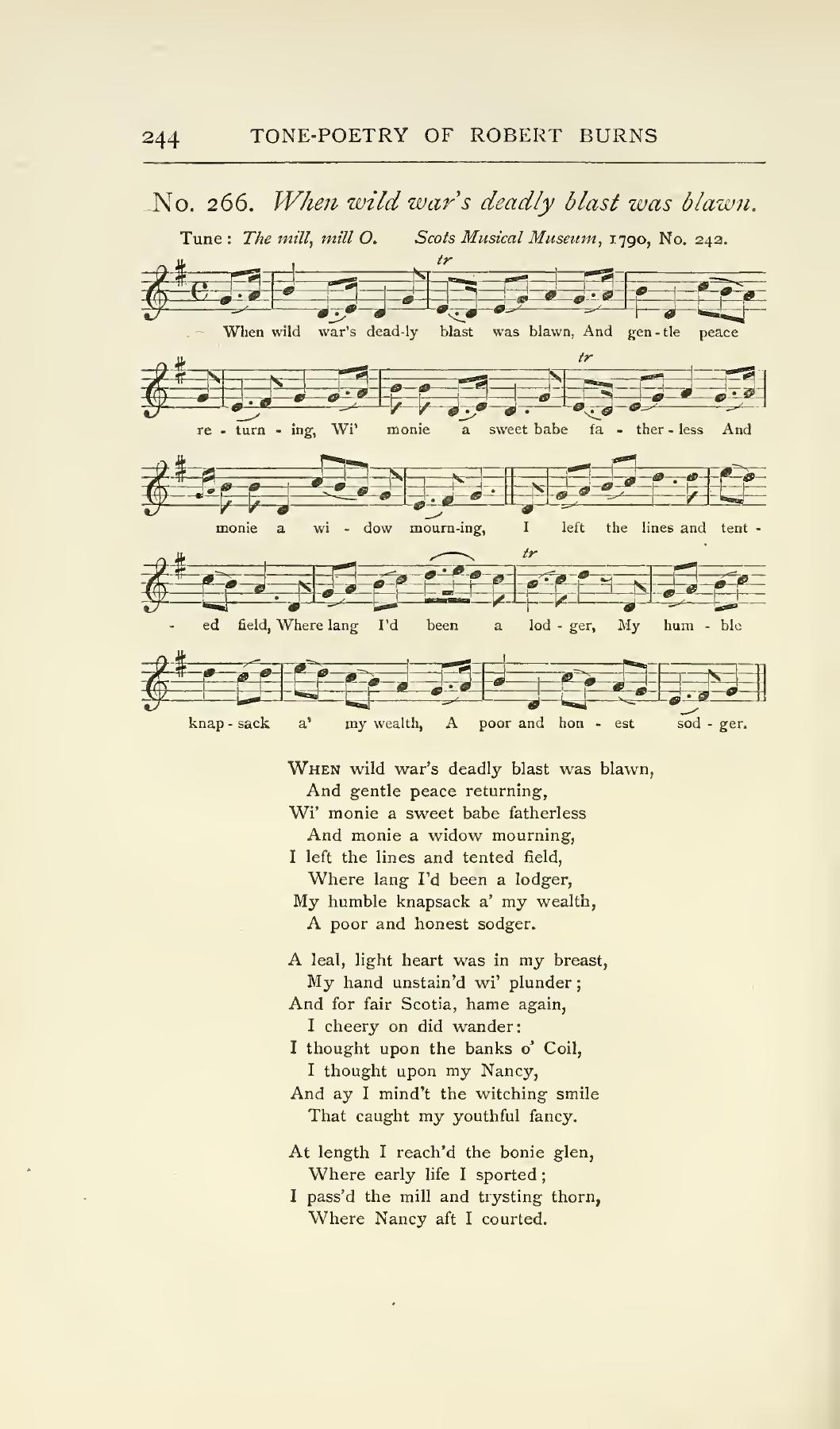 View score Dick’s Songs of Robert Burns (1903)
Lyrics
Choose an edition
Version notes
| Dick (1903) · no. 266 | Cunningham · 1855Ebook transcription |
|---|---|
| And ay I mind’t the witching smile | I thought upon the witching smile |
| honor | honour |
| reply left open across stanza boundary | closing punctuation without opening/closing speech quotation scheme |
Dick (1903) · no. 266
When wild war's deadly blast was blawn,
And gentle peace returning,
Wi' monie a sweet babe fatherless
And monie a widow mourning,
I left the lines and tented field,
Where lang I'd been a lodger,
My humble knapsack a' my wealth,
A poor and honest sodger.

A leal, light heart was in my breast,
My hand unstain'd wi' plunder;
And for fair Scotia, hame again,
I cheery on did wander:
I thought upon the banks o' Coil,
I thought upon my Nancy,
And ay I mind't the witching smile
That caught my youthful fancy.

At length I reach'd the bonie glen,
Where early life I sported;
I pass'd the mill and trysting thorn,
Where Nancy aft I courted.
Wha spied I but my ain dear maid,
Down by her mother's dwelling,
And turn'd me round to hide the flood
That in my een was swelling!

Wi' alter'd voice, quoth I:—'Sweet lass,
Sweet as yon hawthorn's blossom,
O, happy, happy may he be,
That's dearest to thy bosom!
My purse is light, I've far to gang,
And fain wad be thy lodger;
I've served my king and country lang—
Take pity on a sodger.'

Sae wistfully she gazed on me,
And lovelier was than ever:
Quo' she:—'A sodger ance I lo'ed,
Forget him shall I never:
Our humble cot, and hamely fare,
Ye freely shall partake it;
That gallant badge—the dear cockade—
Ye're welcome for the sake o't.'

She gaz'd, she redden'd like a rose,
Syne, pale like onie lily,
She sank within my arms, and cried:—
'Art thou my ain dear Willie?'
'By Him who made yon sun and sky,
By whom true love's regarded,
I am the man! and thus may still
True lovers be rewarded!

'The wars are o'er, and I'm come hame
And find thee still true-hearted;
Tho' poor in gear, we're rich in love,
And mair, we'se ne'er be parted.'
Quo' she:—'My grandsire left me gowd,
A mailen plenish'd fairly;
And come, my faithfu' sodger lad,
Thou'rt welcome to it dearly!'

For gold the merchant ploughs the main,
The farmer ploughs the manor;
But glory is the sodger's prize,
The sodger's wealth is honor:
The brave poor sodger ne'er despise,
Nor count him as a stranger;
Remember he's his country's stay
In day and hour of danger.
These are the words printed below the score.
View the source edition · no. 266; pp. 244–245
About this edition
Both print eight eight-line stanzas. Dick has “And ay I mind’t the witching smile”; Cunningham “I thought upon the witching smile”. Dick’s final stanza has “honor”; Cunningham “honour”. Dick’s sixth stanza leaves the soldier’s long reply open across the stanza boundary; that printed quotation layout is retained.
Cunningham (1855)
When wild war’s deadly blast was blawn
  And gentle peace returning,
Wi’ mony a sweet babe fatherless,
  And mony a widow mourning;
I left the lines and tented field,
  Where lang I’d been a lodger,
My humble knapsack a’ my wealth,
  A poor and honest sodger.

A leal, light heart was in my breast,
  My hand unstain’d wi’ plunder;
And for fair Scotia, hame again,
  I cheery on did wander.
I thought upon the banks o’ Coil,
  I thought upon my Nancy,
I thought upon the witching smile
  That caught my youthful fancy.

At length I reach’d the bonny glen,
  Where early life I sported;
I pass’d the mill, and trysting thorn,
  Where Nancy aft I courted:
Wha spied I but my ain dear maid,
  Down by her mother’s dwelling!
And turn’d me round to hide the flood
  That in my een was swelling.

Wi’ alter’d voice, quoth I, sweet lass,
  Sweet as yon hawthorn’s blossom,
O! happy, happy, may he be
  That’s dearest to thy bosom!
My purse is light, I’ve far to gang,
  And fain wud be thy lodger;
I’ve serv’d my king and country lang—
  Take pity on a sodger.

Sae wistfully she gaz’d on me,
  And lovelier was then ever;
Quo’ she, a sodger ance I lo’d,
  Forget him shall I never:
Our humble cot, and hamely fare,
  Ye freely shall partake it,
That gallant badge—the dear cockade—
  Ye’re welcome for the sake o’t.

She gaz’d—she redden’d like a rose—
  Syne pale like onie lily;
She sank within my arms, and cried,
  Art thou my ain dear Willie?
By him who made yon sun and sky—
  By whom true love’s regarded,
I am the man: and thus may still
  True lovers be rewarded!

The wars are o’er, and I’m come hame,
  And find thee still true-hearted;
Tho’ poor in gear, we’re rich in love,
  And mair we’se ne’er be parted.
Quo’ she, my grandsire left me gowd,
  A mailen plenish’d fairly;
And come, my faithful sodger lad,
  Thou’rt welcome to it dearly!

For gold the merchant ploughs the main,
  The farmer ploughs the manor;
But glory is the sodger’s prize,
  The sodger’s wealth is honour;
The brave poor sodger ne’er despise,
  Nor count him as a stranger;
Remember he’s his country’s stay,
  In day and hour of danger.
Digital text from Project Gutenberg.
View the source edition · p. 279
About this edition
Both print eight eight-line stanzas. Dick has “And ay I mind’t the witching smile”; Cunningham “I thought upon the witching smile”. Dick’s final stanza has “honor”; Cunningham “honour”. Dick’s sixth stanza leaves the soldier’s long reply open across the stanza boundary; that printed quotation layout is retained.
Music
View historical scores
Dick’s Songs of Robert Burns (1903)
no. 266; pp. 244–245