Oh, open the door to me, oh!
Behind the song
The request is simple: open the door and show some pity. Outside, a rejected lover measures the cold wind against the colder feeling of the person within. Each stanza moves towards the moment when she finally opens the door. By then he is dead, and she falls beside him. The speed of the ending makes the delay fatal. [1]
The third stanza gives the song its strongest image of passing time. The pale moon sets behind a white wave while the speaker’s own time runs out. A farewell to false friends and false love replaces the earlier request for entry. When the voice changes to report the opened door, the appeal has become a finished tragedy. [1]
Read the fuller story
Dick presents the words as Burns’s alteration of an older song and quotes the predecessor from Corri’s Scots Songs. In that quoted text the final action occupies two stanzas and the repeated line returns throughout. Burns’s version compresses the ending into one stanza and adds the moon and time image. Dick reports that Burns sent it to Thomson in March 1793 with an uncertain judgement of whether the song had been improved. [2]
Cunningham’s introduction describes Burns revising an unsatisfactory first version. His footnote preserves “If love it may na be” as an earlier second line, while his main text repeats the request to open the door. Dick chooses the pity-and-love line for his reading. That difference changes the opening from insistent repetition to an offer to accept compassion when love has gone. Dick’s printed tune is Open the door softly, marked With pathos. [3][1]
Story references
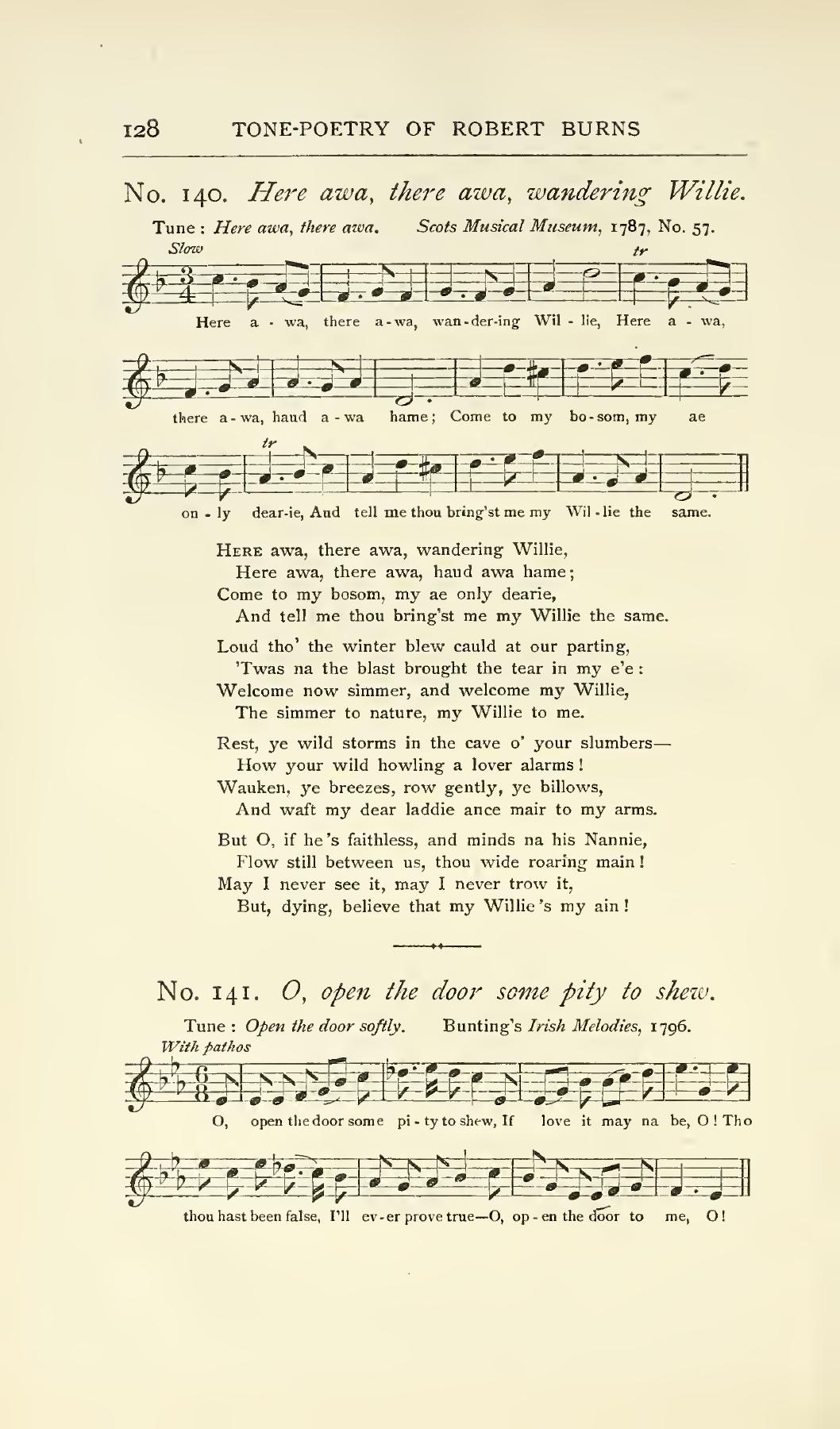 View score Dick’s Songs of Robert Burns (1903)
Lyrics
Choose an edition
Version notes
| Dick (1903) · no. 141 | Cunningham · 1855Ebook transcription |
|---|---|
| If love it may na be, O! | Oh, open the door to me, Oh! |
| thou hast | thou has |
| naught | nought |
| The wan moon sets / Time | The wan moon is setting / time |
More differences between these editions
| Dick (1903) · no. 141 | Cunningham · 1855Ebook transcription |
|---|---|
| the pale corse | his pale corse |
Dick (1903) · no. 141
O, open the door some pity to shew,
If love it may na be, O!
Tho' thou hast been false, I'll ever prove true—
O, open the door to me, O!

Cauld is the blast upon my pale cheek,
But caulder thy love for me, O:
The frost, that freezes the life at my heart,
Is naught to my pains frae thee, O!

The wan moon sets behind the white wave,
And Time is setting with me, O:
False friends, false love, farewell! for mair
I'll ne'er trouble them, nor thee, O!

She has open'd the door, she has open'd it wide,
She sees the pale corse on the plain, O!
'My true love,' she cried, and sank down by his side—
Never to rise again, O!
These are the words printed below the score.
View the source edition · no. 141; pp. 128–129
About this edition
Dick’s second line is “If love it may na be, O!”; Cunningham’s main text has “Oh, open the door to me, Oh!” and footnote 139 gives the Dick reading as an earlier line. Dick has “hast”, “naught”, “The wan moon sets”, “Time” and “the pale corse”; Cunningham has “has”, “nought”, “The wan moon is setting”, “time” and “his pale corse”. Dick’s note quotes the Corri predecessor separately, with a two-stanza ending and recurring refrain.
Cunningham (1855)
Oh, open the door, some pity to show,
  Oh, open the door to me, Oh!
Tho’ thou has been false, I’ll ever prove true,
  Oh, open the door to me, Oh!

Cauld is the blast upon my pale cheek,
  But caulder thy love for me, Oh!
The frost that freezes the life at my heart,
  Is nought to my pains frae thee, Oh!

The wan moon is setting behind the white wave,
  And time is setting with me, Oh!
False friends, false love, farewell! for mair
  I’ll ne’er trouble them, nor thee, Oh!

She has open’d the door, she has open’d it wide;
  She sees his pale corse on the plain, Oh!
My true love! she cried, and sank down by his side,
  Never to rise again, Oh!
Digital text from Project Gutenberg.
View the source edition · p. 279
About this edition
Dick’s second line is “If love it may na be, O!”; Cunningham’s main text has “Oh, open the door to me, Oh!” and footnote 139 gives the Dick reading as an earlier line. Dick has “hast”, “naught”, “The wan moon sets”, “Time” and “the pale corse”; Cunningham has “has”, “nought”, “The wan moon is setting”, “time” and “his pale corse”. Dick’s note quotes the Corri predecessor separately, with a two-stanza ending and recurring refrain.
Music
View historical scores
Dick’s Songs of Robert Burns (1903)
no. 141; pp. 128–129