Wandering Willie. Last Version
Behind the song
Willie can come home to Nannie’s arms, if he still wants her. She fears he has changed in his absence. In Allan Cunningham’s account, Erskine and George Thomson proposed changes to fit the words to the tune. Burns accepted some and turned down others. [1]
Read the fuller story
Cunningham labels this the ‘Last Version’. Across four quatrains, winter parting gives way to a summer welcome, while storms and gentle breezes become threats or helpers to the absent traveller. The final stanza holds to a painful condition: if Willie has become faithless, the singer would rather believe in him from across the sea than discover it. [1]
The headnote says that Erskine and Thomson altered this text and that Burns approved it after rejecting some of their proposed changes. Cunningham explains the revisions chiefly as attempts to fit the words to the music. His account describes a negotiated text, while leaving each person’s share in its wording unspecified. [1]
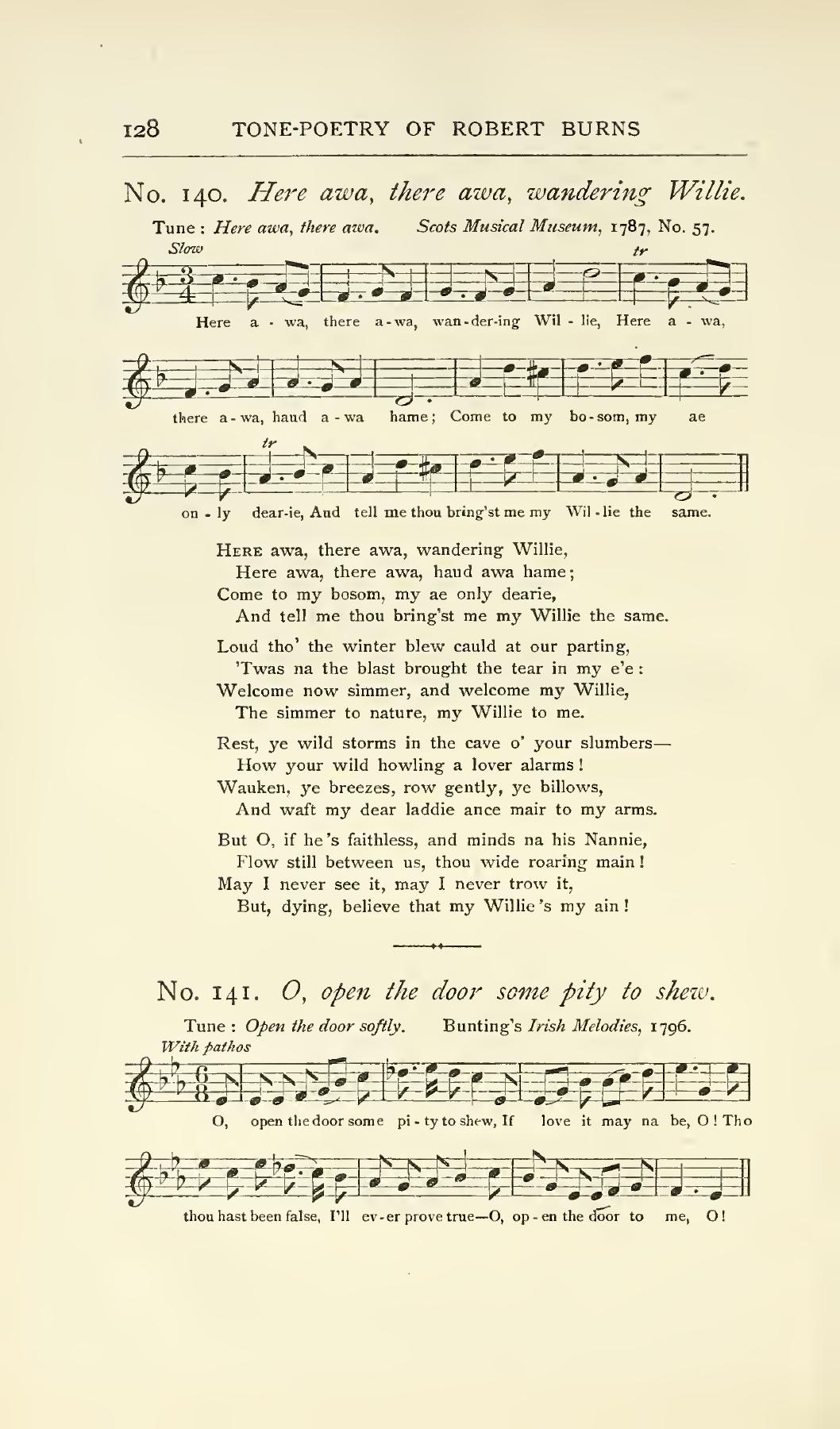 View score Dick’s Songs of Robert Burns (1903)
Lyrics
Choose an edition
Cunningham (1855)
Here awa, there awa, wandering Willie,
  Here awa, there awa, haud awa hame;
Come to my bosom, my ain only dearie,
  Tell me thou bring’st me my Willie the same.

Winter winds blew loud and cauld at our parting,
  Fears for my Willie brought tears in my e’e;
Welcome now simmer, and welcome my Willie,
  The simmer to nature, my Willie to me.

Rest, ye wild storms, in the cave of your slumbers,
  How your dread howling a lover alarms!
Wauken, ye breezes, row gently, ye billows,
  And waft my dear laddie ance mair to my arms.

But oh, if he’s faithless, and minds na his Nannie,
  Flow still between us, thou wide roaring main;
May I never see it, may I never trow it,
  But, dying, believe that my Willie’s my ain.
Digital text from Project Gutenberg.
View the source edition · p. 278
About this edition
Cunningham’s preface discusses several poems he left out of the collection.
Dick (1903) · no. 140
The words are on the score page.
View the source edition · no. 140; p. 128
Music
View historical scores
Dick’s Songs of Robert Burns (1903)
no. 140; p. 128
Revision involving Burns, Erskine and Thomson in Cunningham’s account
Cunningham says that Erskine and Thomson altered the text and that Burns approved it after rejecting several proposed changes. The headnote leaves their exact shares unspecified.
Words Robert Burns, with alterations by Erskine and Thomson, according to Cunningham
Burns’s role Revision involving Burns, Erskine and Thomson in Cunningham’s account