Lord Gregory
Behind the song
A woman stands outside Lord Gregory’s tower in a midnight storm. Driven from her father’s house for loving him, she asks for shelter and for pity if he will give her no love. Her appeal carries the story forward entirely through her own voice. The weather makes her exposure immediate while the closed door gives her lover’s failure a physical form. [1]
She recalls their first admission of love beside the Irvine and the vows she believed. By the final stanza she asks a flash of lightning to bring her rest. Even then she begs the thunder to spare and pardon the man who has wronged her. The song ends with that divided feeling: despair for herself and continuing tenderness towards the person responsible. [1]
Read the fuller story
Dick describes Burns’s shorter lyric as a reworking of the long tragic ballad Fair Annie of Lochryan. His note traces printed fragments through Herd and the Museum, and reports that Thomson had told Burns of a song on the same subject by Dr Wolcot. He dates Burns’s reply with his own verses to 26 January 1793. The familiar story was being reshaped for a new song collection. [2]
Cunningham makes rivalry with Wolcot central to his introduction and strongly prefers the older ballad. His six quatrains follow the woman’s appeal through the same sequence, while Dick groups the words into three octaves. Among the changes, Cunningham asks a “dart of heaven” to “give me rest”; Dick has a “bolt” and “bring me rest”. Dick heads his score Lord Gregory and marks it Slow. These small wording choices sharpen a scene whose emotional force depends on a voice meeting silence. [3][1]
Story references
- James C. Dick, The Songs of Robert Burns (1903), No. 138; printed pp. 126–127; PDF pp. 182–183
- James C. Dick, The Songs of Robert Burns (1903), Dick note 138; printed 398; PDF 454
- Allan Cunningham, The Complete Works of Robert Burns (1855), printed 277; HTML #CLXXXVII. Project Gutenberg transcription.
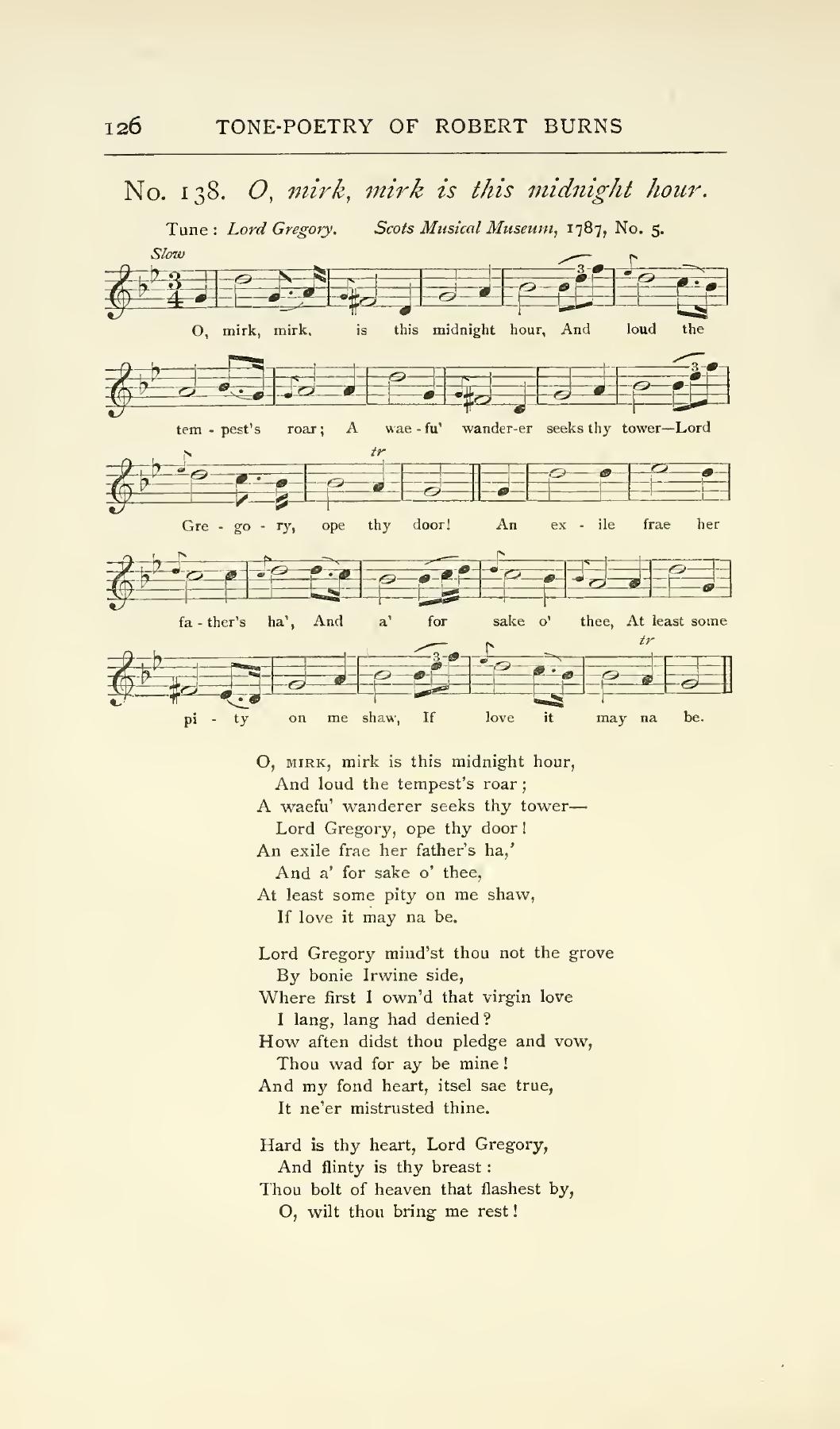 View score Dick’s Songs of Robert Burns (1903)
Lyrics
Choose an edition
Version notes
| Dick (1903) · no. 138 | Cunningham · 1855Ebook transcription |
|---|---|
| three octaves | six quatrains |
| for sake o’ thee | for loving thee |
| Irvine side | Irwin-side |
| How aften | How often |
More differences between these editions
| Dick (1903) · no. 138 | Cunningham · 1855Ebook transcription |
|---|---|
| bolt of heaven / bring me rest | dart of heaven / give me rest |
Dick (1903) · no. 138
O, mirk, mirk is this midnight hour,
And loud the tempest's roar;
A waefu' wanderer seeks thy tower—
Lord Gregory, ope thy door!
An exile frae her father's ha',
And a' for sake o' thee,
At least some pity on me shaw,
If love it may na be.

Lord Gregory mind'st thou not the grove
By bonie Irvine side,
Where first I own'd that virgin love
I lang, lang had denied?
How aften didst thou pledge and vow,
Thou wad for ay be mine!
And my fond heart, itsel sae true,
It ne'er mistrusted thine.

Hard is thy heart, Lord Gregory,
And flinty is thy breast:
Thou bolt of heaven that flashest by,
O, wilt thou bring me rest!
Ye mustering thunders from above,
Your willing victim see,
But spare and pardon my fause love
His wrangs to Heaven and me!
These are the words printed below the score.
View the source edition · no. 138; pp. 126–127
About this edition
Dick groups the lyric into three octaves; Cunningham prints six quatrains. Dick has “for sake o’ thee”, “Irvine side”, “How aften”, “bolt of heaven” and “bring me rest”; Cunningham has “for loving thee”, “Irwin-side”, “How often”, “dart of heaven” and “give me rest”. The final quatrain continues on Dick printed 127/PDF 183, beyond the inherited index range 126/PDF 182.
Cunningham (1855)
O mirk, mirk is this midnight hour,
  And loud the tempest’s roar;
A waefu’ wanderer seeks thy tow’r,
  Lord Gregory, ope thy door!

An exile frae her father’s ha’,
  And a’ for loving thee;
At least some pity on me shaw,
  If love it may na be.

Lord Gregory, mind’st thou not the grove
  By bonnie Irwin-side,
Where first I own’d that virgin-love
  I lang, lang had denied?

How often didst thou pledge and vow
  Thou wad for ay be mine;
And my fond heart, itsel’ sae true,
  It ne’er mistrusted thine.

Hard is thy heart, Lord Gregory,
  And flinty is thy breast—
Thou dart of heaven that flashest by,
  O wilt thou give me rest!

Ye mustering thunders from above,
  Your willing victim see!
But spare and pardon my fause love,
  His wrangs to heaven and me!
Digital text from Project Gutenberg.
View the source edition · p. 277
About this edition
Dick groups the lyric into three octaves; Cunningham prints six quatrains. Dick has “for sake o’ thee”, “Irvine side”, “How aften”, “bolt of heaven” and “bring me rest”; Cunningham has “for loving thee”, “Irwin-side”, “How often”, “dart of heaven” and “give me rest”. The final quatrain continues on Dick printed 127/PDF 183, beyond the inherited index range 126/PDF 182.
Music
View historical scores
Dick’s Songs of Robert Burns (1903)
no. 138; pp. 126–127