Galla Water
Behind the song
Handsome lads live beside the Yarrow, says the singer, but the lads beside Galla Water are handsomer still. Among them there is one she means to keep to herself. [1]
His father has no estate and her dowry is small. She can already see the two of them tending their flocks. If they have one another, she reckons they will be wealthy enough. [1]
Read the fuller story
Dick dates this version to January 1793 and connects it with Burns's correspondence with George Thomson. He prints a passage in which Burns asks what other songs Thomson proposes to publish with each tune and seeks a voice in the choice of poetry. The exchange shows the literary judgement involved in the collaboration, as reported in this later edition. [2]
Dick also prints three stanzas of an earlier anonymous Galla-water song from Herd. Its lover lifts her skirts to follow her sweetheart through the water. Burns's present version develops a different prospect: a shared household and work beside the stream. Cunningham describes the piece as an improvement of an earlier Burns song, with a debt to an older strain. [2][3]
The opening changes between these editions. Dick prints “They rove amang the blooming heather”; Cunningham has “That wander thro' the blooming heather”. Dick supplies a score headed The brave lads of Galla Water. Cunningham's section carries the title Galla Water and its editorial introduction, with the four verses beneath it. [1][3]
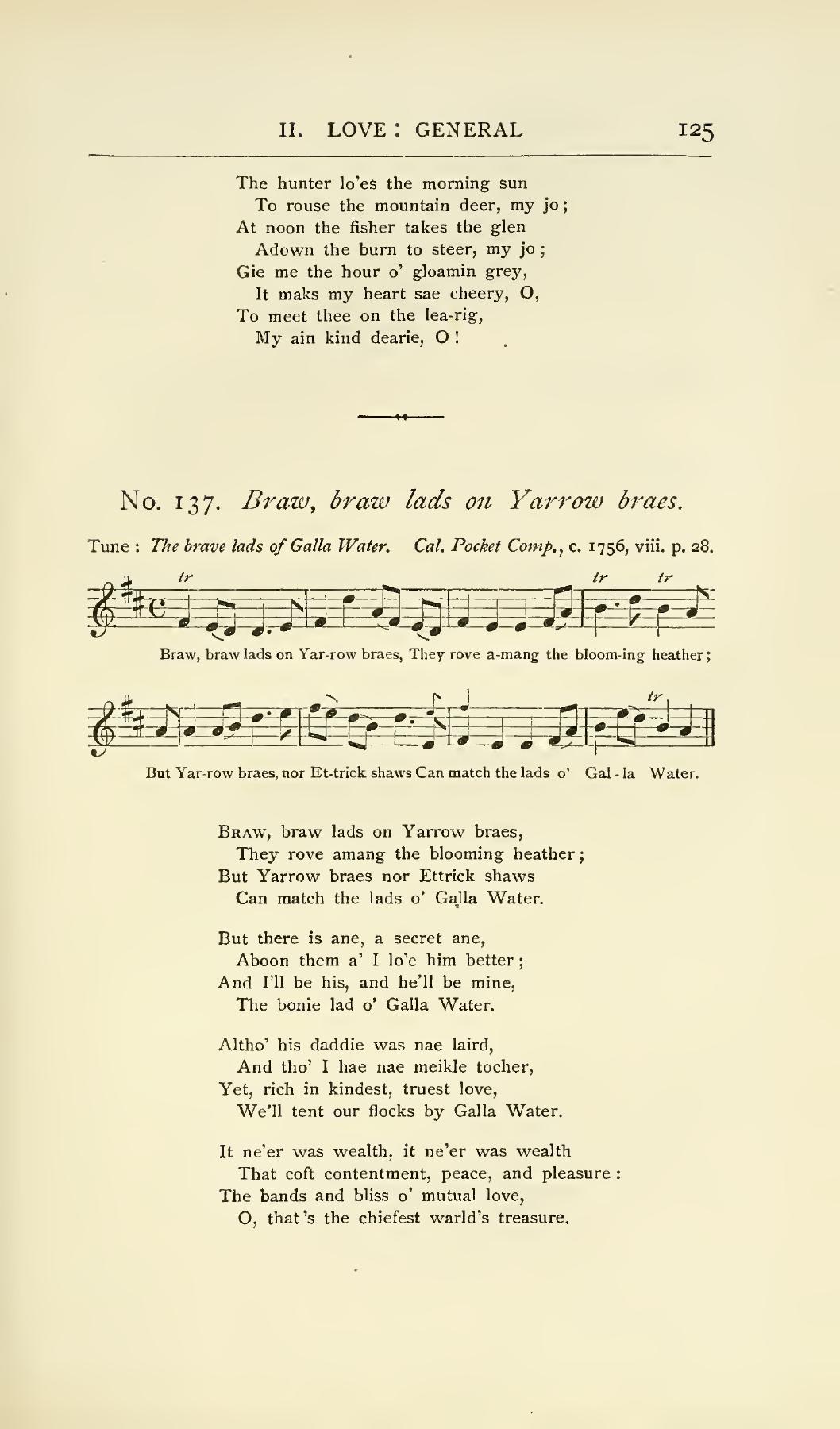 View score Dick’s Songs of Robert Burns (1903)
Lyrics
Choose an edition
Version notes
| Dick (1903) · no. 137 | Cunningham · 1855Ebook transcription |
|---|---|
| They rove amang the blooming heather | That wander thro’ the blooming heather |
| peace, and pleasure | peace, or pleasure |
Dick (1903) · no. 137
Braw, braw lads on Yarrow braes,
They rove amang the blooming heather;
But Yarrow braes nor Ettrick shaws
Can match the lads o' Galla Water.

But there is ane, a secret ane,
Aboon them a' I lo'e him better;
And I'll be his, and he'll be mine,
The bonie lad o' Galla Water.

Altho' his daddie was nae laird,
And tho' I hae nae meikle tocher,
Yet, rich in kindest, truest love,
We'll tent our flocks by Galla Water.

It ne'er was wealth, it ne'er was wealth
That coft contentment, peace, and pleasure;
The bands and bliss o' mutual love,
O, that's the chiefest warld's treasure.
These are the words printed below the score.
View the source edition · no. 137; p. 125
About this edition
Both print four quatrains. Dick opens “Braw, braw lads” and continues “They rove amang”; Cunningham begins “There’s braw, braw lads” and “That wander thro’”. Dick has “peace, and pleasure”; Cunningham “peace, or pleasure”.
Cunningham (1855)
There’s braw, braw lads on Yarrow braes,
  That wander thro’ the blooming heather;
But Yarrow braes nor Ettrick shaws
  Can match the lads o’ Galla Water.

But there is ane, a secret ane,
  Aboon them a’ I lo’e him better;
And I’ll be his, and he’ll be mine,
  The bonnie lad o’ Galla Water.

Altho’ his daddie was nae laird,
  And tho’ I hae nae meikle tocher;
Yet rich in kindest, truest love,
  We’ll tent our flocks by Galla Water.

It ne’er was wealth, it ne’er was wealth,
  That coft contentment, peace, or pleasure;
The bands and bliss o’ mutual love,
  O that’s the chiefest warld’s treasure!
Digital text from Project Gutenberg.
View the source edition · p. 277
About this edition
Both print four quatrains. Dick opens “Braw, braw lads” and continues “They rove amang”; Cunningham begins “There’s braw, braw lads” and “That wander thro’”. Dick has “peace, and pleasure”; Cunningham “peace, or pleasure”.
Music
View historical scores
Dick’s Songs of Robert Burns (1903)
no. 137; p. 125