Auld Rob Morris
Behind the song
Auld Rob Morris is a wealthy father with gold, cattle and a daughter whom the singer loves. The opening praise of Rob’s good fellowship gives way to the difficulty his wealth creates: the daughter is an heiress, while the singer’s father has only a cottage and yard. The young man sees his poverty standing between them. [1]
His description of the woman uses the morning, May, new hay and lambs on the grass. These bright images are followed by sleepless nights and solitary wandering. He imagines the happiness that might have been possible if she had belonged to a lower social rank. The song ends within his distress, with the hoped-for smile still conditional. [1]
Read the fuller story
Dick sets the song beside an older dialogue between a mother and daughter. In that song the mother recommends Rob’s wealth as a reason to marry him, while the daughter objects to the old man. Burns’s version gives the name and the fortune a different role: Rob becomes the father, and the concern passes to the poor lover of his daughter. Cunningham also identifies old opening material and describes the new treatment as tender. [2][3]
Dick quotes Burns writing to Thomson on 14 November 1792 that he was proceeding with Auld Rob Morris “on a new plan”, and reports it complete on 4 December. He identifies it in Thomson’s Scotish Airs of 1793. The older air remained the musical framework for the changed situation. [2]
The five quatrains in Dick carry Auld Rob Morris, marked “Slow”, with Orpheus Caledonius of 1725 named above the score. Cunningham has “his darling and mine” where Dick calls the daughter “his dautie and mine”. Their words keep the affection of father and lover in the same line. [1][3]
Story references
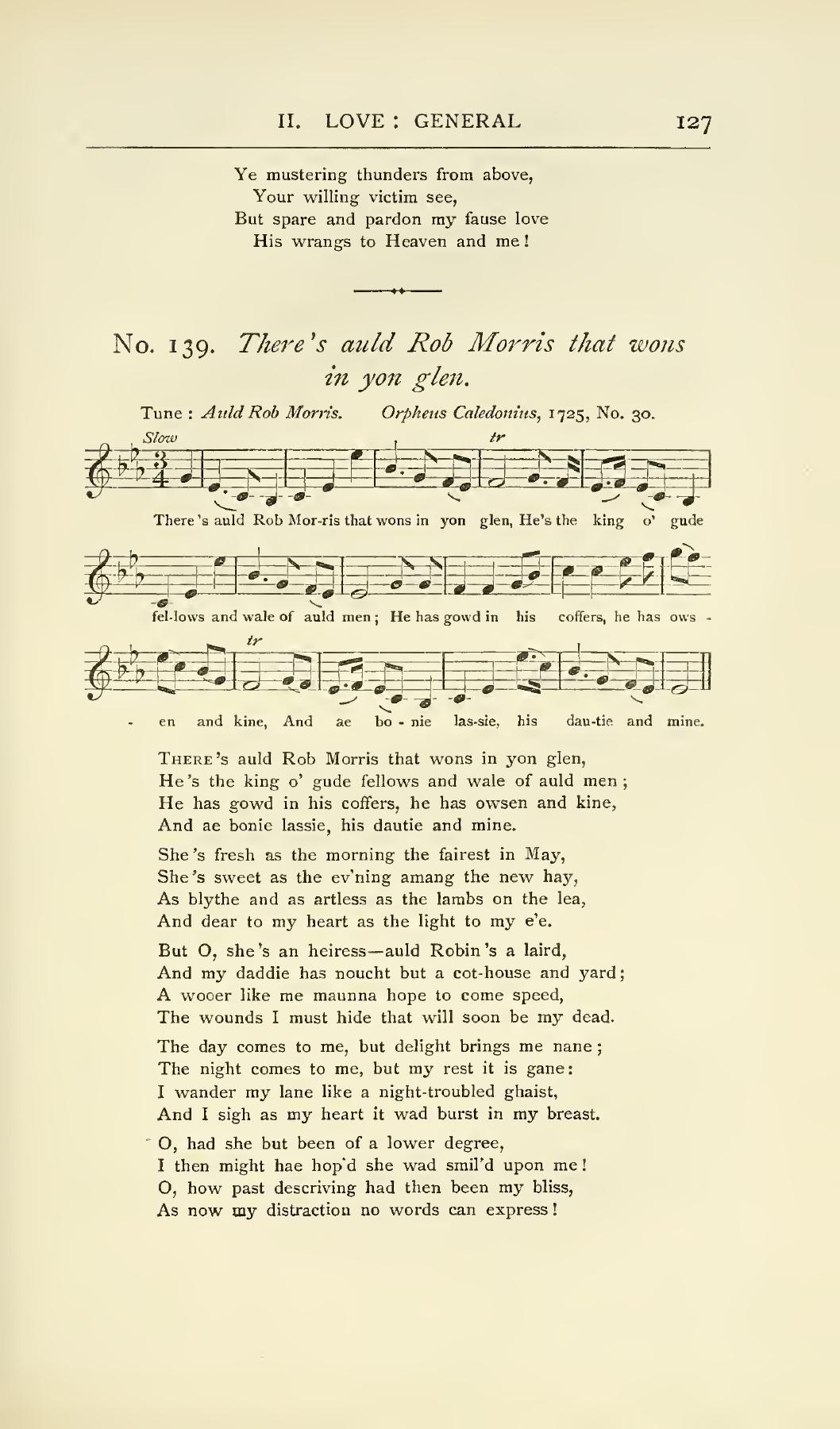 View score Dick’s Songs of Robert Burns (1903)
Lyrics
Choose an edition
Version notes
| Dick (1903) · no. 139 | Cunningham · 1855Ebook transcription |
|---|---|
| He’s the king o’ gude fellows and wale of auld men; | He’s the king o’ guid fellows and wale of auld men; |
| But O, she’s an heiress—auld Robin’s a laird, | But oh! she’s an heiress,—auld Robin’s a laird, |
| A wooer like me maunna hope to come speed, | A wooer like me mamma hope to come speed; |
| O, had she but been of a lower degree, | O had she but been of a lower degree, |
Dick (1903) · no. 139
There’s auld Rob Morris that wons in yon glen,
He’s the king o’ gude fellows and wale of auld men;
He has gowd in his coffers, he has owsen and kine,
And ae bonie lassie, his dautie and mine.

She’s fresh as the morning the fairest in May,
She’s sweet as the ev’ning amang the new hay,
As blythe and as artless as the lambs on the lea,
And dear to my heart as the light to my e’e.

But O, she’s an heiress—auld Robin’s a laird,
And my daddie has nought but a cot-house and yard;
A wooer like me maunna hope to come speed,
The wounds I must hide that will soon be my dead.

The day comes to me, but delight brings me nane;
The night comes to me, but my rest it is gane:
I wander my lane like a night-troubled ghaist,
And I sigh as my heart it wad burst in my breast.

O, had she but been of a lower degree,
I then might hae hop’d she wad smil’d upon me!
O, how past descriving had then been my bliss,
As now my distraction no words can express!
View the source edition · no. 139; p. 127
About this edition
Dick’s “his dautie and mine” becomes “his darling and mine” in Cunningham; Dick’s “lambs” is Cunningham’s “lamb”. The ebook has “mamma hope to come speed”, where Dick clearly prints “maunna hope to come speed”. That ebook anomaly remains a separately recorded reading awaiting printed-page proof.
Cunningham (1855)
There’s auld Rob Morris that wons in yon glen,
He’s the king o’ guid fellows and wale of auld men;
He has gowd in his coffers, he has owsen and kine,
And ae bonnie lassie, his darling and mine.

She’s fresh as the morning, the fairest in May;
She’s sweet as the ev’ning amang the new hay;
As blythe and as artless as the lamb on the lea,
And dear to my heart as the light to my e’e.

But oh! she’s an heiress,—auld Robin’s a laird,
And my daddie has nought but a cot-house and yard;
A wooer like me mamma hope to come speed;
The wounds I must hide that will soon be my dead.

The day comes to me, but delight brings me nane;
The night comes to me, but my rest it is gane:
I wander my lane like a night-troubled ghaist,
And I sigh as my heart it wad burst in my breast.

O had she but been of a lower degree,
I then might hae hop’d she wad smil’d upon me!
O, how past descriving had then been my bliss,
As now my distraction no words can express!
Digital text from Project Gutenberg.
View the source edition · p. 275
About this edition
Dick’s “his dautie and mine” becomes “his darling and mine” in Cunningham; Dick’s “lambs” is Cunningham’s “lamb”. The ebook has “mamma hope to come speed”, where Dick clearly prints “maunna hope to come speed”. That ebook anomaly remains a separately recorded reading awaiting printed-page proof.
Music
View historical scores
Dick’s Songs of Robert Burns (1903)
no. 139; p. 127