My ain kind dearie, O
Behind the song
The hunter can have the morning and the fisher the noon. The singer wants the grey twilight, when the day’s work is done and his sweetheart will meet him by the burn. Allan Cunningham identifies this as Burns’s first song for George Thomson’s collection. He dates the first two verses to October 1792 and the last to December. [1]
Read the fuller story
The first stanza begins with the rhythms of rural labour. A star above the hill announces the time for bringing in the sheep, and weary oxen return from the field. Dew hangs on the birches by the water, where the promised meeting brings the working day towards an intimate close.[1]
The second stanza tests the promise against darker conditions. Even a midnight glen or a wild night would hold no terror if the lover were travelling towards that meeting. The third assigns morning to the hunter and noon to the fisher, reserving grey twilight as the singer’s happiest hour.[1]
Cunningham dates the first two verses to October 1792 and says Burns added the last in December. He quotes Burns describing his attempt after reading “The Lea-rig”. A footnote records “birken buds” in some copies where this text prints “scented birks”. Those details give the printed song a history of composition and variation beside its steady return to the hoped-for meeting.[1]
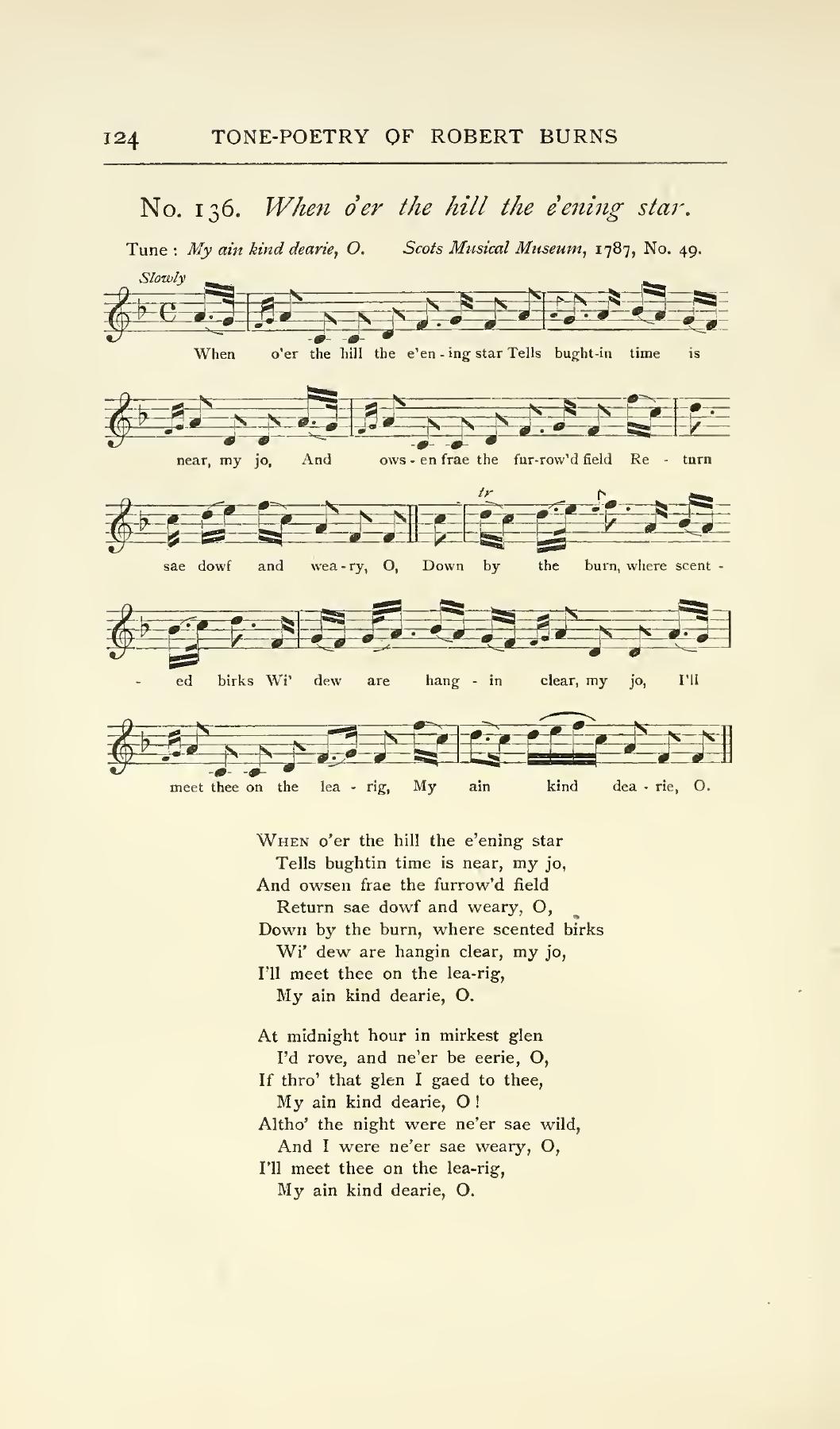 View score Dick’s Songs of Robert Burns (1903)
Lyrics
Choose an edition
Cunningham (1855)
When o’er the hill the eastern star
  Tells bughtin-time is near, my jo;
And owsen frae the furrow’d field
  Return sae dowf and weary, O!
Down by the burn, where scented birks
  Wi’ dew are hanging clear, my jo;
I’ll meet thee on the lea-rig,
  My ain kind dearie O!

In mirkest glen, at midnight hour,
  I’d rove, and ne’er be eerie, O;
If thro’ that glen I gaed to thee,
  My ain kind dearie O!
Altho’ the night were ne’er sae wild,
  And I were ne’er sae wearie, O,
I’d meet thee on the lea-rig,
  My ain kind dearie O!

The hunter lo’es the morning sun,
  To rouse the mountain deer, my jo;
At noon the fisher seeks the glen,
  Alang the burn to steer, my jo;
Gie me the hour o’ gloamin gray,
  It maks my heart sae cheery, O,
To meet thee on the lea-ring,
  My ain kind dearie O!
Digital text from Project Gutenberg.
View the source edition · p. 273
About this edition
Cunningham’s preface discusses several poems he left out of the collection.
Dick (1903) · no. 136
The words are on the score page.
View the source edition · no. 136; pp. 124–125
Music
View historical scores
Dick’s Songs of Robert Burns (1903)
no. 136; pp. 124–125