Wae is my heart, and the tear’s in my e’e
Behind the song
A stream and a castle green come back to the lonely singer. If her lover would meet her there, he might yet dry her tears. Allan Cunningham records a tradition that the musician Clarke wanted the song for Phillis M’Murdo of Nithsdale. [1]
Read the fuller story
Three quatrains move from forsakenness towards imagined reunion. The first finds no voice of pity; the second measures love’s pleasures against its painful cost. The third names Phillis and places a caring lover in the landscape where she has known happiness. That closing thought gives tenderness to a song which has spoken of approaching rest. [1]
Cunningham says that the song was reportedly composed at the musician Clarke’s request in connection with his feelings for Phillis M’Murdo of Nithsdale. His wording, ‘it is said’, qualifies the account. The heading names ‘Wae is my heart’ as the tune. [1]
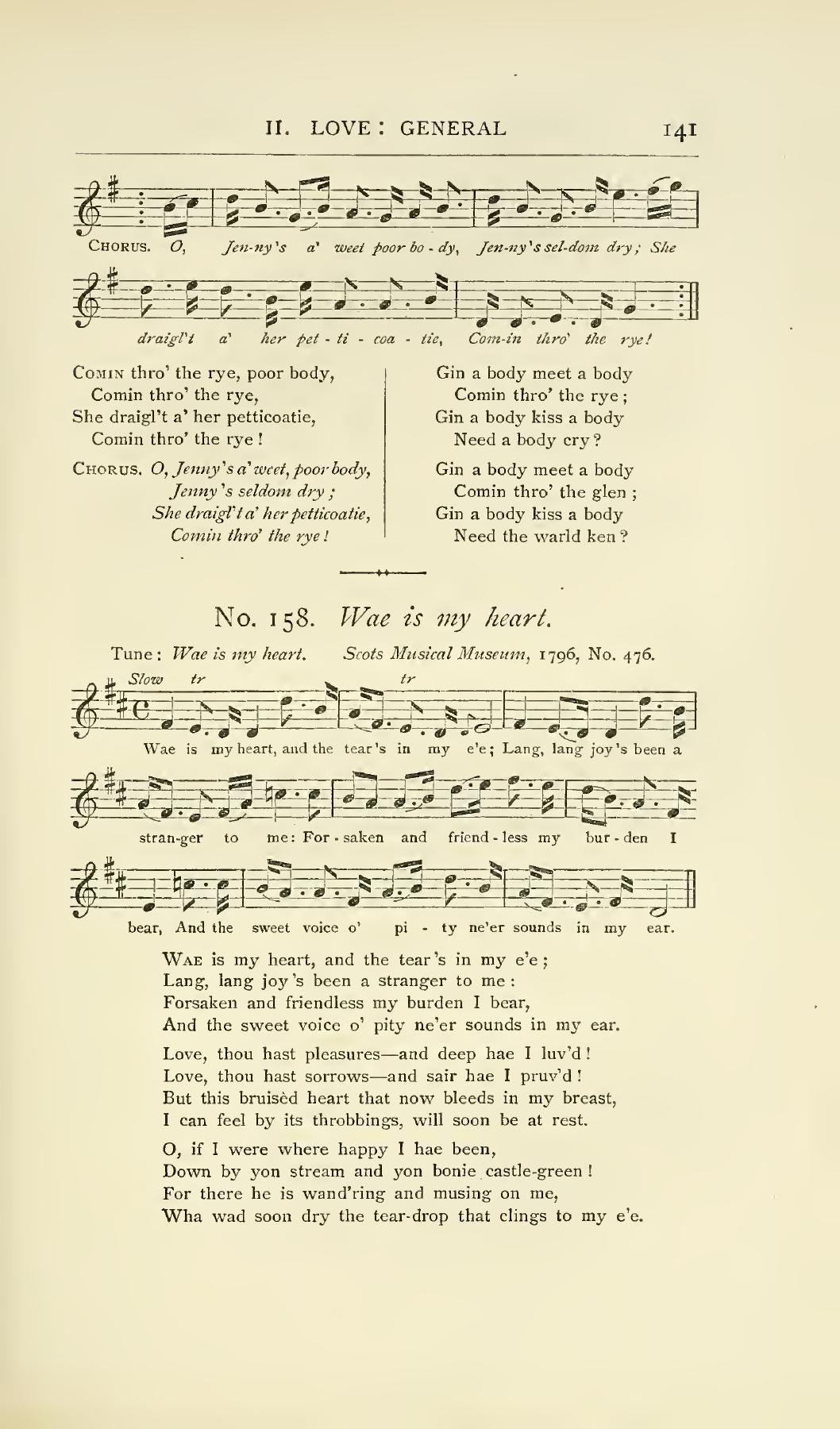 View score Dick’s Songs of Robert Burns (1903)
Lyrics
Choose an edition
Cunningham (1855)
Wae is my heart, and the tear’s in my e’e;
Lang, lang, joy’s been a stranger to me;
Forsaken and friendless, my burden I bear,
And the sweet voice of pity ne’er sounds in my ear.

Love, thou hast pleasures, and deep hae I loved;
Love, thou hast sorrows, and sair hae I proved;
But this bruised heart that now bleeds in my breast,
I can feel by its throbbings will soon be at rest.

O, if I were happy, where happy I hae been,
Down by yon stream, and yon bonnie castle green;
For there he is wand’ring, and musing on me,
Wha wad soon dry the tear frae his Phillis’s e’e.
Digital text from Project Gutenberg.
View the source edition · p. 271
About this edition
Cunningham’s preface discusses several poems he left out of the collection.
Dick (1903) · no. 158
The words are on the score page.
View the source edition · no. 158; p. 141
Scots Musical Museum, vol. V (catalogued 1796) · no. 476
View the source edition · Volume 5, no. 476; p. 490
Music
View historical scores
Dick’s Songs of Robert Burns (1903)
no. 158; p. 141