The lass that made the bed for me
Behind the song
Travelling north in January darkness, the narrator finds shelter through a young woman’s kindness. She makes his bed and brings another pillow when called back. His embrace meets a demand to keep his hands away, but his account continues into a sexual encounter and her tearful fear the next morning that he has ruined her.
Read the fuller story
The narrator repeatedly thanks her courtesy while telling the story entirely from his own side. After her objection, his attention turns to an elaborate portrait of her body, using gold, ivory, lilies, wine, snow and marble. In the morning he answers her distress with a promise that she will always make his bed. The ending moves to shirts made from her mother’s sheets and a vow never to forget her.
Cunningham describes the song as Burns’s reworking of an older indecorous strain. He associates that earlier song with a supposed adventure of Charles II and a young woman of Port Letham, then says Burns produced the present version for the Museum. The selected narrator remains unnamed.[1]
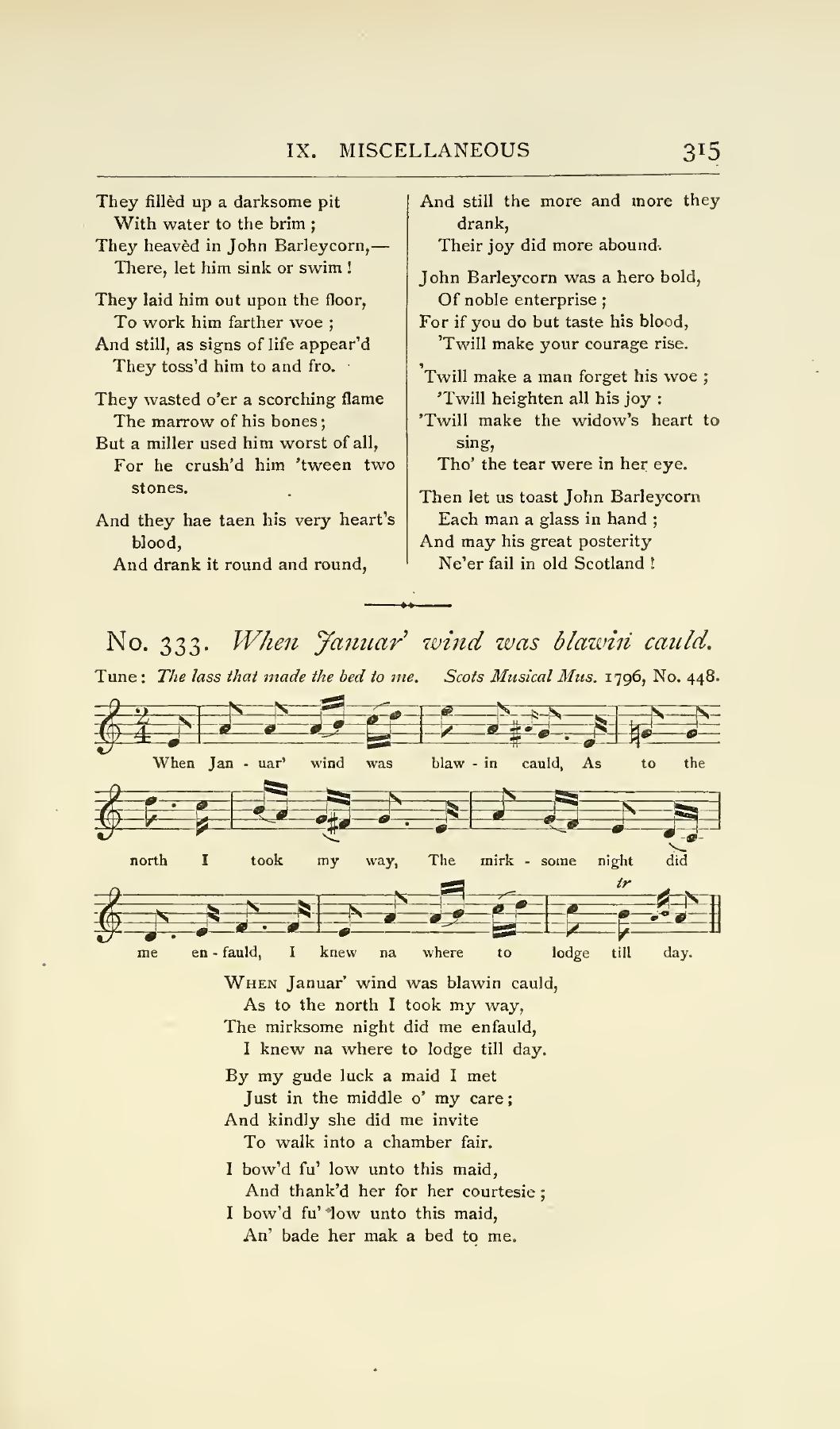 View score Dick’s Songs of Robert Burns (1903)
Lyrics
Choose an edition
Cunningham (1855)
When Januar’ wind was blawing cauld,
  As to the north I took my way,
The mirksome night did me enfauld,
  I knew na where to lodge till day.

By my good luck a maid I met,
  Just in the middle o’ my care;
And kindly she did me invite
  To walk into a chamber fair.

I bow’d fu’ low unto this maid,
  And thank’d her for her courtesie;
I bow’d fu’ low unto this maid,
  And bade her mak a bed to me.

She made the bed baith large and wide,
  Wi’ twa white hands she spread it down;
She put the cup to her rosy lips,
  And drank, “Young man, now sleep ye soun’.”

She snatch’d the candle in her hand,
  And frae my chamber went wi’ speed;
But I call’d her quickly back again
  To lay some mair below my head.

A cod she laid below my head,
  And served me wi’ due respect;
And to salute her wi’ a kiss,
  I put my arms about her neck.

“Haud aff your hands, young man,” she says,
  “And dinna sae uncivil be:
If ye hae onto love for me,
  O wrang na my virginitie!”

Her hair was like the links o’ gowd,
  Her teeth were like the ivorie;
Her cheeks like lilies dipt in wine,
  The lass that made the bed to me.

Her bosom was the driven snaw,
  Twa drifted heaps sae fair to see;
Her limbs the polish’d marble stane,
  The lass that made the bed to me.

I kiss’d her owre and owre again,
  And ay she wist na what to say;
I laid her between me and the wa’—
  The lassie thought na lang till day.

Upon the morrow when we rose,
  I thank’d her for her courtesie;
But aye she blush’d, and aye she sigh’d,
  And said, “Alas! ye’ve ruin’d me.”

I clasp’d her waist, and kiss’d her syne,
  While the tear stood twinklin’ in her e’e;
I said, “My lassie, dinna cry,
  For ye ay shall mak the bed to me.”

She took her mither’s Holland sheets,
  And made them a’ in sarks to me:
Blythe and merry may she be,
  The lass that made the bed to me.

The bonnie lass made the bed to me,
  The braw lass made the bed to me:
I’ll ne’er forget till the day I die,
  The lass that made the bed to me!
Digital text from Project Gutenberg.
View the source edition · p. 267
About this edition
Cunningham’s preface discusses several poems he left out of the collection.
Dick (1903) · no. 333
The words are on the score page.
View the source edition · no. 333; pp. 315–316
Scots Musical Museum, vol. V (catalogued 1796) · no. 448
View the source edition · Volume 5, no. 448; p. 460
Music
View historical scores
Dick’s Songs of Robert Burns (1903)
no. 333; pp. 315–316
Reworking attributed to Burns
Cunningham describes Burns working on an older indecorous song to produce this Museum version.
Words Robert Burns, revising an earlier song
Burns’s role Reworking attributed to Burns