The Lass of Ecclefechan
Behind the song
What did Luckie Laing bring to the marriage? She can count spinning gear, a basin and houses in the family, quite apart from her own charms. Her partner counts what has gone missing since they met, including song, pleasure and peace. Allan Cunningham says Burns heard an earlier form on a work visit to Ecclefechan. [1]
Read the fuller story
The two inventories measure different things. Household goods and family property supply the first speaker’s account of value. The second counts what the relationship has cost, moving from a lost whistle and song to the loss of happiness. Its final turn is bitter: Luckie Laing’s green grave would point the way back to the speaker’s treasure.
Cunningham says Burns heard a rough local song during a professional visit to Ecclefechan, softened its language and sentiments, and sent it to the Museum. That editorial story credits revision of a district song; the sharp exchange survives within the version printed here.[1]
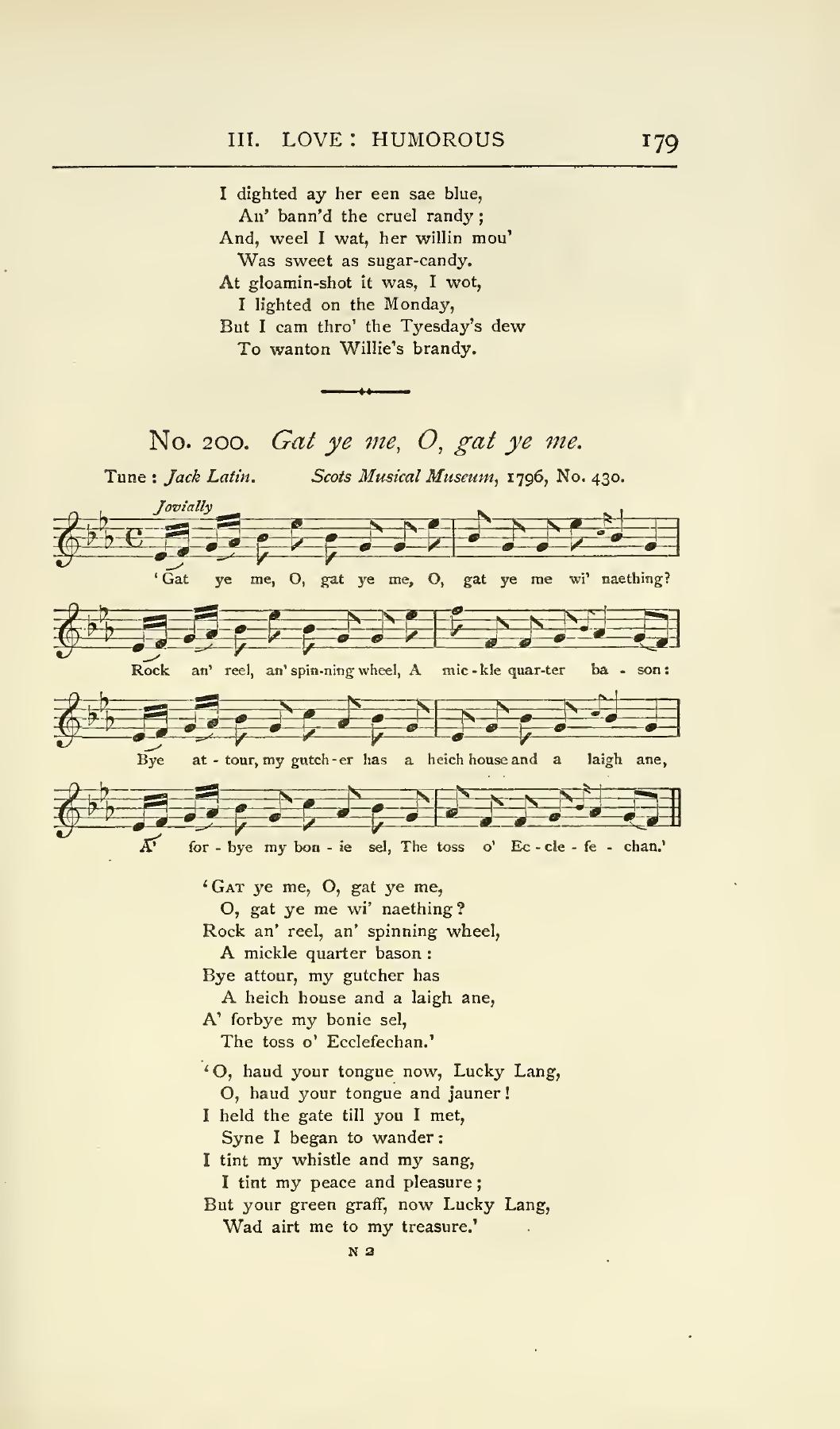 View score Dick’s Songs of Robert Burns (1903)
Lyrics
Choose an edition
Cunningham (1855)
Gat ye me, O gat ye me,
  O gat ye me wi’ naething?
Rock and reel, and spinnin’ wheel,
  A mickle quarter basin.
Bye attour, my gutcher has
  A hich house and a laigh ane,
A’ for bye, my bonnie sel’,
  The toss of Ecclefechan.

O haud your tongue now, Luckie Laing,
  O hand your tongue and jauner;
I held the gate till you I met,
  Syne I began to wander:
I tint my whistle and my sang,
  I tint my peace and pleasure:
But your green graff, now, Luckie Laing,
  Wad airt me to my treasure.
Digital text from Project Gutenberg.
View the source edition · p. 265
About this edition
Cunningham’s preface discusses several poems he left out of the collection.
Dick (1903) · no. 200
The words are on the score page.
View the source edition · no. 200; p. 179
Scots Musical Museum, vol. V (catalogued 1796) · no. 430
View the source edition · Volume 5, no. 430; p. 442
Music
View historical scores
Dick’s Songs of Robert Burns (1903)
no. 200; p. 179
Reworking attributed to Burns
Cunningham describes Burns softening an older Ecclefechan song’s language and sentiments.
Words Robert Burns, revising an earlier district song
Burns’s role Reworking attributed to Burns