Young Jamie, pride of a’ the plain
Behind the song
Jamie once ranged among the lassies as a resistless king of love. Now he wanders through woods, glens and rocky caves in tears. The women he slighted laugh at his suffering, while the woman he desires forbids him to see her again.
Read the fuller story
The first stanza presents the reversal from outside; the second gives Jamie the complaint in his own voice. He remembers changing his love with every moon and admits that he never expected repentance to cost so much. His description of the beloved as cruel and scornful sits beside his acknowledgement of the women he has hurt.
Cunningham reports that Burns sent the song to the Museum in his own handwriting, but says only part is thought to be his. That uncertain partial credit accompanies a complete song whose individual contributions are left unallocated.[1]
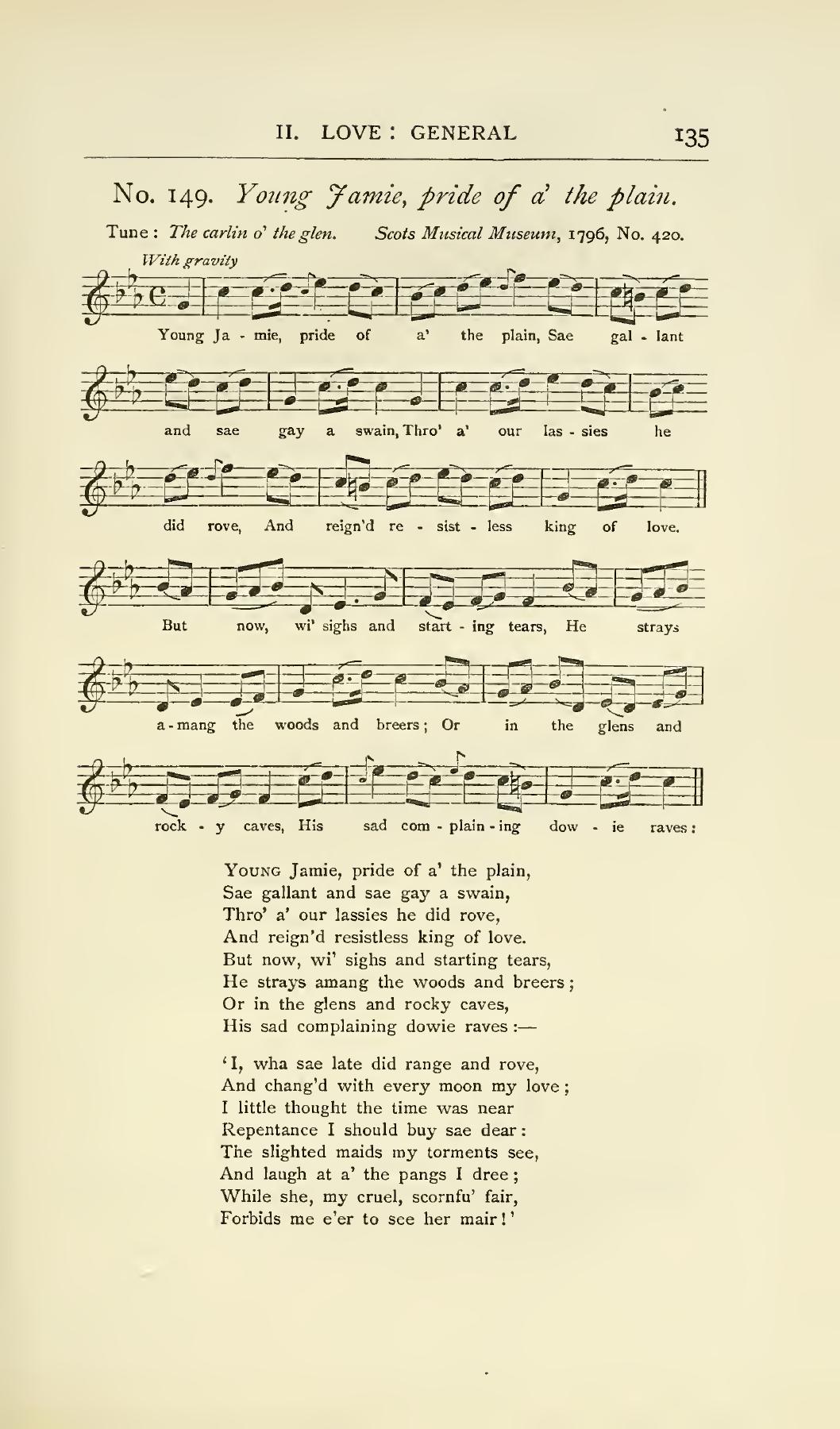 View score Dick’s Songs of Robert Burns (1903)
Lyrics
Choose an edition
Cunningham (1855)
Young Jamie, pride of a’ the plain,
Sae gallant and sae gay a swain;
Thro’ a’ our lasses he did rove,
And reign’d resistless king of love:
But now wi’ sighs and starting tears,
He strays amang the woods and briers;
Or in the glens and rocky caves
His sad complaining dowie raves.

I wha sae late did range and rove,
And chang’d with every moon my love,
I little thought the time was near,
Repentance I should buy sae dear:
The slighted maids my torment see,
And laugh at a’ the pangs I dree;
While she, my cruel, scornfu’ fair,
Forbids me e’er to see her mair!
Digital text from Project Gutenberg.
View the source edition · p. 265
About this edition
Cunningham’s preface discusses several poems he left out of the collection.
Dick (1903) · no. 149
The words are on the score page.
View the source edition · no. 149; p. 135
Scots Musical Museum, vol. V (catalogued 1796) · no. 420
View the source edition · Volume 5, no. 420; p. 433
Music
View historical scores
Dick’s Songs of Robert Burns (1903)
no. 149; p. 135
Burns’s possible partial contribution — qualified attribution
Cunningham says part only is thought to be Burns’s and reports his handwritten transmission.
Words Part thought to be by Robert Burns; extent uncertain
Burns’s role Burns’s possible partial contribution — qualified attribution