Coming through the rye
Behind the song
Jenny comes through the rye with her petticoat draggled and wet. The refrain returns to her condition with a repeated “poor body”, a phrase that can sound sympathetic or teasing. The opening gives the song a person and a small mishap before it widens into questions about meeting, kissing and what other people need to know. [1]
The two following verses use almost the same shape. If one person meets another and kisses them, must somebody cry out? If the meeting happens in the glen, must the world know? Repetition makes the questions easy to remember, while the shift from rye to glen carries the same encounter into another setting. The words leave room for a playful exchange about affection and privacy. [1]
Read the fuller story
Cunningham describes Burns removing coarse material from an older chant for the Museum. Dick records an inherited refrain and a private Merry Muses version, alongside later statements crediting the song to Burns. He also recounts an argument over a pantomime song registered in 1796. His account preserves these competing claims about the song’s authorship. [2][3]
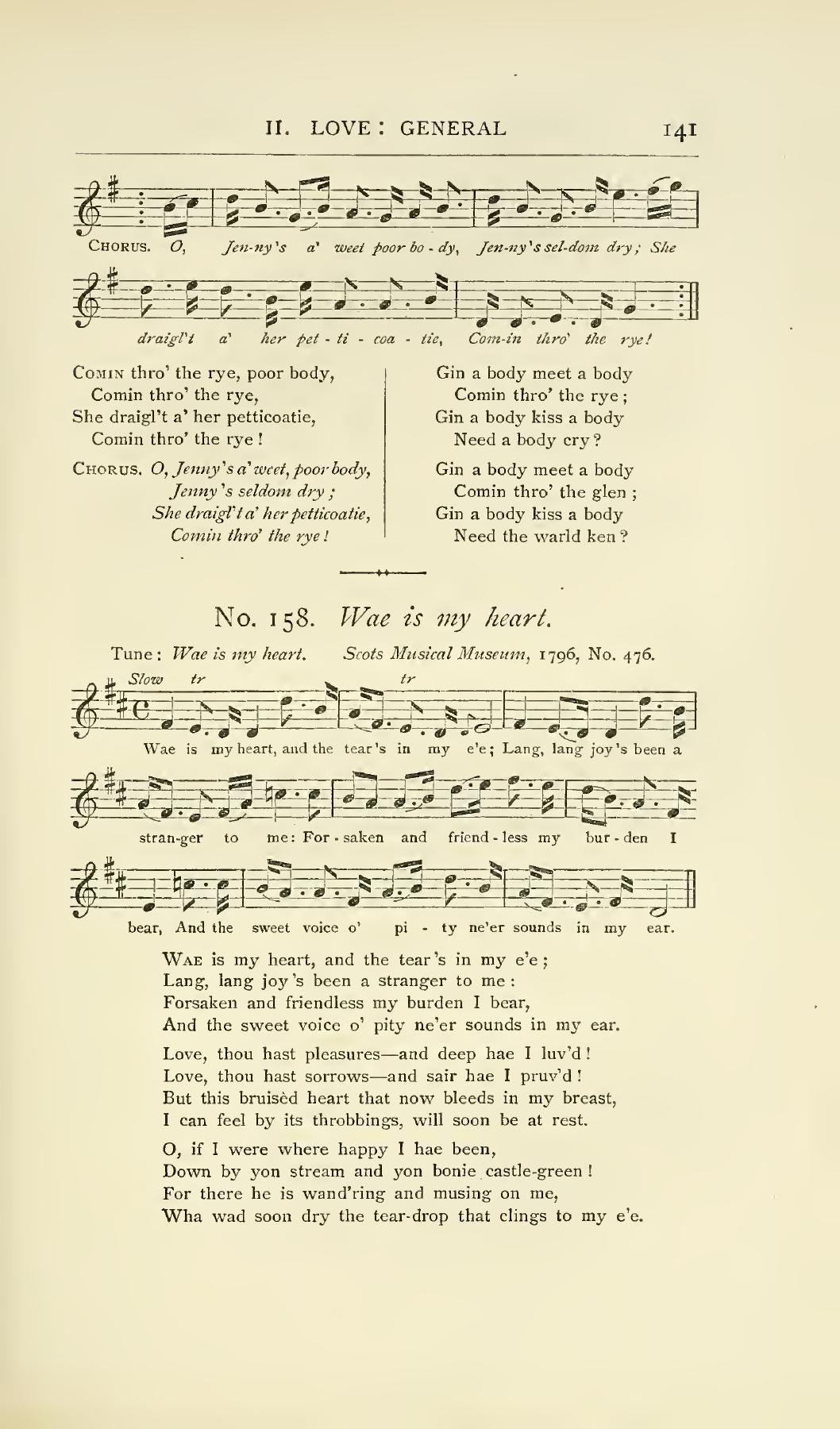
Dick’s heading calls the tune Miller’s wedding and marks it Slow. His note quotes a manuscript list attributed to Burns naming Miller’s Wedding as a strathspey and directs readers to entries 144 and 234 for musical variants. Cunningham instead heads his text Coming through the rye. In the words, Cunningham’s “wat” and “world” become “weet” and “warld” in Dick, who also adds the opening O to Jenny’s refrain. The familiar questions remain at the centre of both readings. [1][3][2]
Story references
- James C. Dick, The Songs of Robert Burns (1903), No. 157; printed pp. 140–141; PDF pp. 196–197
- Allan Cunningham, The Complete Works of Robert Burns (1855), printed 265; HTML #songsCLII. Project Gutenberg transcription.
- James C. Dick, The Songs of Robert Burns (1903), Dick note 157; printed 406; PDF 462
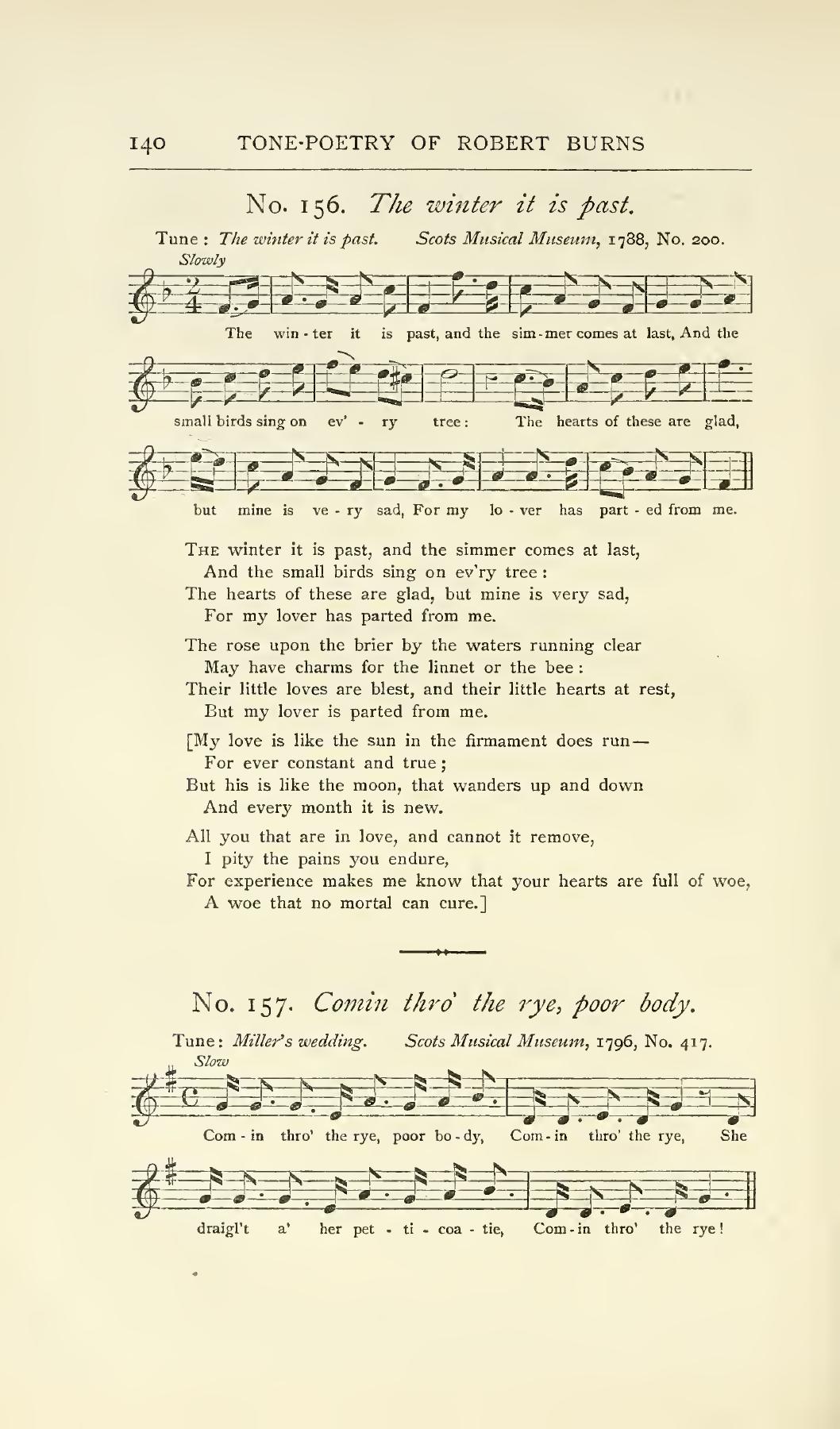 View score Dick’s Songs of Robert Burns (1903)
Lyrics
Choose an edition
Version notes
| Dick (1903) · no. 157 | Cunningham · 1855Ebook transcription |
|---|---|
| Comin / draigl’t | Coming / draiglet |
| O, Jenny’s a’ weet | Jenny’s a’ wat |
| warld | world |
| after opening quatrain | after opening and at close |
More differences between these editions
| Dick (1903) · no. 157 | Cunningham · 1855Ebook transcription |
|---|---|
| Miller’s wedding | Coming through the rye |
Dick (1903) · no. 157
Comin thro' the rye, poor body,
Comin thro' the rye,
She draigl't a' her petticoatie,
Comin thro' the rye!

Chorus. O, Jenny's a' weet, poor body,
Jenny's seldom dry;
She draigl't a' her petticoatie,
Comin thro' the rye!

Gin a body meet a body
Comin thro' the rye;
Gin a body kiss a body
Need a body cry?

Gin a body meet a body
Comin thro' the glen;
Gin a body kiss a body
Need the warld ken?
These are the words printed below the score.
View the source edition · no. 157; pp. 140–141
About this edition
Both texts have an opening quatrain and two question quatrains, with Jenny’s refrain. Dick prints “Comin”, “draigl’t”, “O, Jenny’s a’ weet” and “Need the warld ken”; Cunningham has “Coming”, “draiglet”, “Jenny’s a’ wat” and “Need the world ken”. Cunningham repeats the full refrain at the end; Dick prints it after the first quatrain. Dick’s notation spans both indexed pages.
Cunningham (1855)
Coming through the rye, poor body,
  Coming through the rye,
She draiglet a’ her petticoatie,
  Coming through the rye.
Jenny’s a’ wat, poor body,
  Jenny’s seldom dry;
She draiglet a’ her petticoatie,
  Coming through the rye.

Gin a body meet a body—
  Coming through the rye,
Gin a body kiss a body—
  Need a body cry?

Gin a body meet a body
  Coming through the glen,
Gin a body kiss a body—
  Need the world ken?
Jenny’s a’ wat, poor body;
  Jenny’s seldom dry;
She draiglet a’ her petticoatie,
  Coming through the rye.
Digital text from Project Gutenberg.
View the source edition · p. 265
About this edition
Both texts have an opening quatrain and two question quatrains, with Jenny’s refrain. Dick prints “Comin”, “draigl’t”, “O, Jenny’s a’ weet” and “Need the warld ken”; Cunningham has “Coming”, “draiglet”, “Jenny’s a’ wat” and “Need the world ken”. Cunningham repeats the full refrain at the end; Dick prints it after the first quatrain. Dick’s notation spans both indexed pages.
Scots Musical Museum, vol. V (catalogued 1796) · no. 417
View the source edition · Volume 5, no. 417; p. 430
Music
View historical scores
Dick’s Songs of Robert Burns (1903)
no. 157; pp. 140–141
View source · Download citation