A Red, Red Rose
Behind the song
When the singer of A Red, Red Rose promises to come back from “ten thousand mile”, the words have travelled too. James C. Dick quotes much the same promise from The Turtle Dove and describes Burns drawing on material he learned when young. Allan Cunningham also heard echoes of street ballads. [1][2][3]
First comes a rose newly opened in June, then a melody played in tune. By the time the lovers must part, the singer has promised a love that will outlast the seas and the rocks. Only in the farewell does the measure come back to something a traveller could face, the miles between here and home. [1]
Read the fuller story
The song travelled with different music. Dick names an original melody in Urbani’s Scots Songs of 1794, Major Graham in the Scots Musical Museum of 1796, and a Thomson printing of 1799. His own score uses Major Graham, also named in a manuscript note that he quotes. Cunningham’s tune heading is Graham’s Strathspey. [1][2][3]
Dick’s page begins “My luve is like”, while Cunningham opens “O, my luve’s like”. Dick groups the words into two eight-line stanzas, marking the final four lines of each for repetition with “bis”. Cunningham prints four quatrains. The repetitions allow a singer to dwell on the promise and then on the farewell. [1][3]
The last line measures the distance of return in “ten thousand mile”. It follows the sands of life and the melting rocks with a journey that can at least be imagined. The song leaves the lover’s circumstances open and gives the whole force of its ending to the assurance that he will come again. [1]
Story references
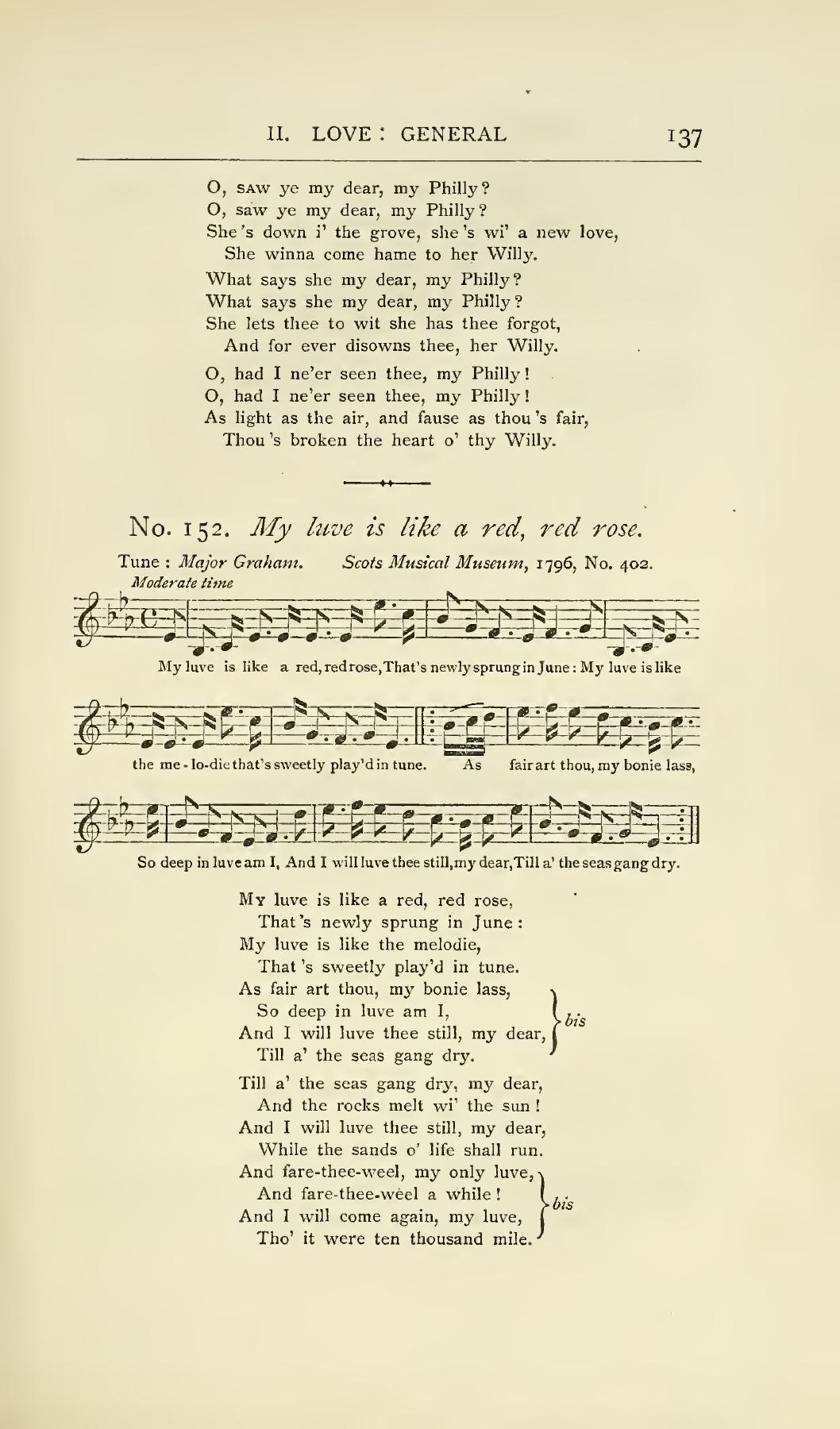 View score Dick’s Songs of Robert Burns (1903)
Lyrics
Choose an edition
Version notes
| Dick (1903) · no. 152 | Cunningham · 1855Ebook transcription |
|---|---|
| My luve is like a red, red rose, | O, my luve’s like a red, red rose, |
| My luve is like the melodie, | O, my luve’s like the melodie, |
Dick (1903) · no. 152
My luve is like a red, red rose,
    That’s newly sprung in June:
My luve is like the melodie,
    That’s sweetly play’d in tune.
As fair art thou, my bonie lass,
    So deep in luve am I,
And I will luve thee still, my dear,
    Till a’ the seas gang dry.

Till a’ the seas gang dry, my dear,
    And the rocks melt wi’ the sun!
And I will luve thee still, my dear,
    While the sands o’ life shall run.
And fare-thee-weel, my only luve,
    And fare-thee-weel a while!
And I will come again, my luve,
    Tho’ it were ten thousand mile.
View the source edition · no. 152; p. 137
About this edition
Dick begins “My luve is like”; Cunningham has “O, my luve’s like”. Cunningham prints four quatrains and names Graham’s Strathspey. Dick groups the lyric into two eight-line stanzas and brackets the second half of each for repetition. The reading prints those lines once and records the repeat direction here.
Cunningham (1855)
O, my luve’s like a red, red rose,
  That’s newly sprung in June:
O, my luve’s like the melodie,
  That’s sweetly play’d in tune.

As fair art thou, my bonnie lass,
  So deep in luve am I:
And I will luve thee still, my dear,
  ’Till a’ the seas gang dry.

’Till a’ the seas gang dry, my dear,
  And the rocks melt wi’ the sun:
I will luve thee still, my dear,
  While the sands o’ life shall run.

And fare thee weel, my only luve!
  And fare thee weel a-while!
And I will come again, my luve,
  Tho’ it were ten thousand mile.
Digital text from Project Gutenberg.
View the source edition · p. 264
About this edition
Dick begins “My luve is like”; Cunningham has “O, my luve’s like”. Cunningham prints four quatrains and names Graham’s Strathspey. Dick groups the lyric into two eight-line stanzas and brackets the second half of each for repetition. The reading prints those lines once and records the repeat direction here.
Scots Musical Museum, vol. V (catalogued 1796) · no. 402
View the source edition · Volume 5, no. 402; pp. 415–416
Scots Musical Museum, vol. V (catalogued 1796) · no. 403
View the source edition · Volume 5, no. 403; p. 416
About this edition
The Old Set is a separate printed setting of Red, red Rose, following no.402.
Music
View historical scores
Dick’s Songs of Robert Burns (1903)
no. 152; p. 137