The Gallant weaver
Behind the song
Eight or nine suitors have sent her rings and ribbons. Her father has a marriage settlement in mind with a man who owns land. She has already chosen a weaver by the river Cart and intends to give him both her heart and her hand. [1]
The flowers, trees, birds, bees and green corn by the Cart will all bear witness to her promise. One publisher made a striking change to the man she chose. James C. Dick records that George Thomson turned her weaver into a sailor and gave the song a different tune. [1][2][3]
Read the fuller story
Dick quotes Burns's description of the chorus as old and the rest as his own. The quoted note opens into Burns's frank explanation of the practical work behind the Museum: beautiful airs needed words, and other duties often left him little time. That admission gives this compact song a place in the labour of supplying a national music collection. [2]
Cunningham reports the song's popularity among the looms in the west of Scotland. His short introduction connects its audience with the occupation of the chosen lover. That is a later editor's account of reception; the woman's own declaration supplies the song's most direct statement about the weaver's worth. [1][3]
Dick reports that Thomson changed the weaver into a sailor and set the words to The auld wife ayont the fire. Such a change alters the occupation around which the lyric's choice is organised. Dick's own musical heading retains The gallant weaver, while Cunningham heads his edition with The Weavers' March. [1][2][3]
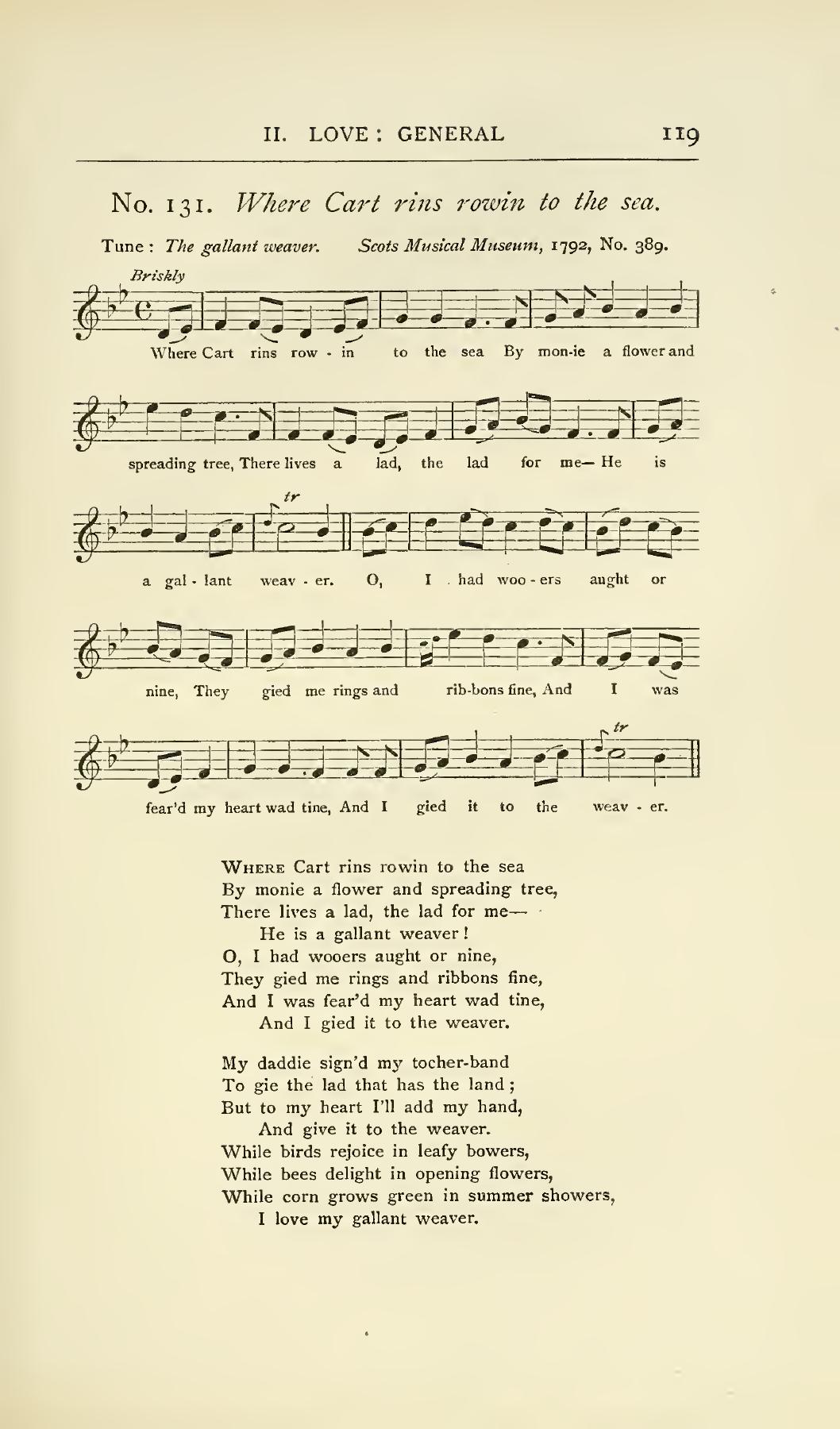 View score Dick’s Songs of Robert Burns (1903)
Lyrics
Choose an edition
Version notes
| Dick (1903) · no. 131 | Cunningham · 1855Ebook transcription |
|---|---|
| I love my gallant weaver | I’ll love my gallant weaver |
| summer showers | simmer showers |
| The gallant weaver | The Weavers’ March |
Dick (1903) · no. 131
Where Cart rins rowin to the sea
By monie a flower and spreading tree,
There lives a lad, the lad for me—
He is a gallant weaver!
O, I had wooers aught or nine,
They gied me rings and ribbons fine,
And I was fear'd my heart wad tine,
And I gied it to the weaver.

My daddie sign'd my tocher-band
To gie the lad that has the land;
But to my heart I'll add my hand,
And give it to the weaver.
While birds rejoice in leafy bowers,
While bees delight in opening flowers,
While corn grows green in summer showers,
I love my gallant weaver.
These are the words printed below the score.
View the source edition · no. 131; p. 119
About this edition
Both print two eight-line stanzas. Dick ends “I love my gallant weaver”; Cunningham has “I’ll love my gallant weaver”. Dick’s “summer showers” appears as “simmer showers” in Cunningham.
Cunningham (1855)
Where Cart rins rowin to the sea,
By mony a flow’r and spreading tree,
There lives a lad, the lad for me,
    He is a gallant weaver.
Oh, I had wooers aught or nine,
They gied me rings and ribbons fine;
And I was fear’d my heart would tine,
    And I gied it to the weaver.

My daddie sign’d my tocher-band,
To gie the lad that has the land;
But to my heart I’ll add my hand,
    And gie it to the weaver.
While birds rejoice in leafy bowers;
While bees delight in op’ning flowers;
While corn grows green in simmer showers,
    I’ll love my gallant weaver.
Digital text from Project Gutenberg.
View the source edition · p. 262
About this edition
Both print two eight-line stanzas. Dick ends “I love my gallant weaver”; Cunningham has “I’ll love my gallant weaver”. Dick’s “summer showers” appears as “simmer showers” in Cunningham.
Scots Musical Museum, vol. IV (1792) · no. 389
View the source edition · Volume 4, no. 389; p. 403
Music
View historical scores
Dick’s Songs of Robert Burns (1903)
no. 131; p. 119