Hey ca’ thro’, ca’ thro’
Behind the song
The song calls up the people of Dysart, Buckhaven, Largo and Leven for a shared good time. There are tales to tell, songs to sing, pennies to spend and pints to bring. Its last advice is to live fully and leave those who follow to do the same with what they earn.
Read the fuller story
The repeated “Hey, ca’ thro’” gives urgency to the gathering: there is much to do. The opening roll-call spreads the invitation across four places, while the following verses make enjoyment practical through speech, singing, money and drink. The final return of the chorus keeps the song moving after its advice to the next generation.
Cunningham says Burns sent the song to the Museum in his own handwriting. He attributes part of it to Burns and adds that some believed the whole was his. The headnote therefore preserves a broader authorship belief alongside its more limited statement of part-composition.[1]
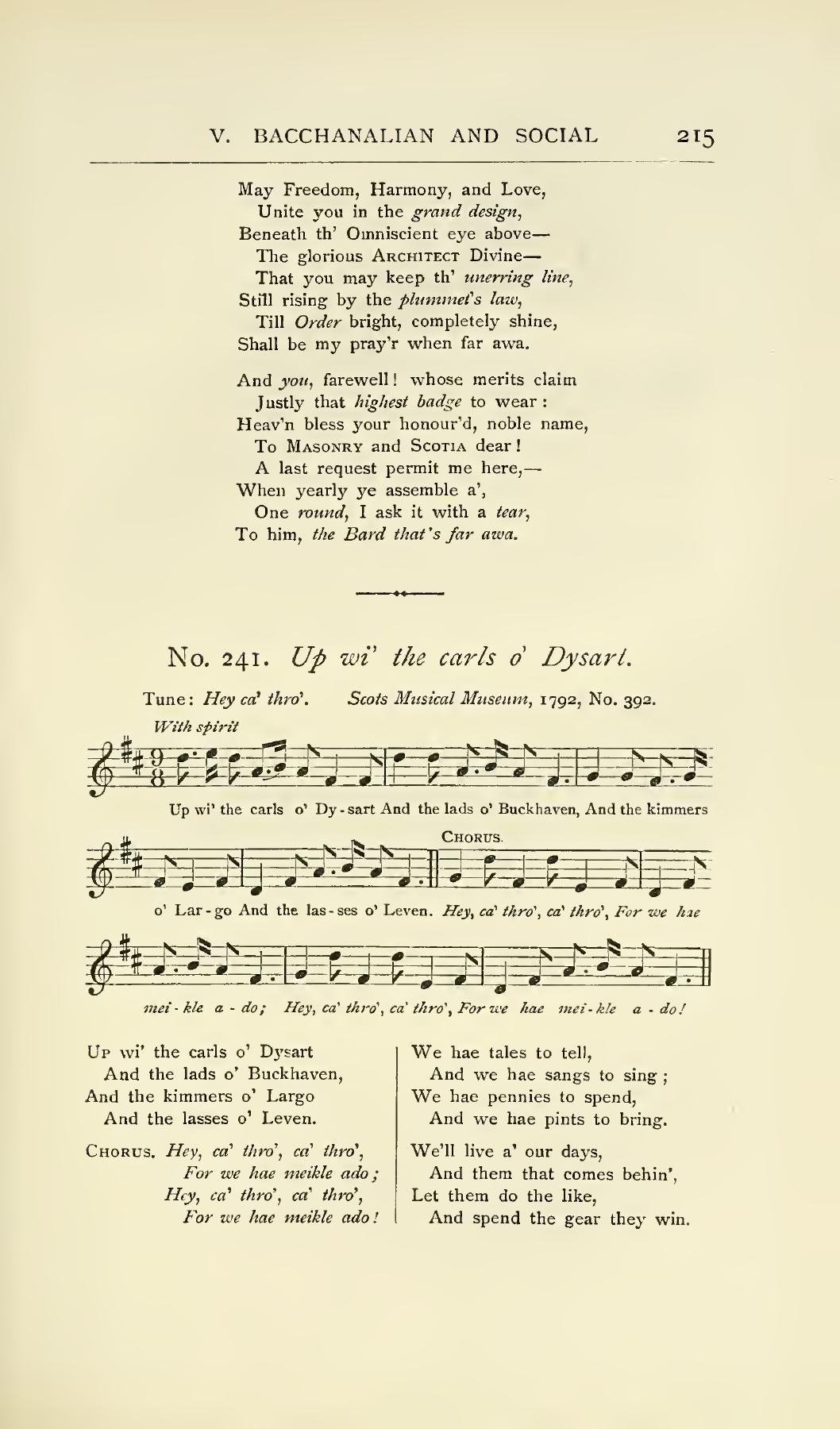 View score Dick’s Songs of Robert Burns (1903)
Lyrics
Choose an edition
Cunningham (1855)
Up wi’ the carles o’ Dysart,
  And the lads o’ Buckhaven,
And the kimmers o’ Largo,
  And the lasses o’ Leven.
    Hey, ca’ thro’, ca’ thro’,
      For we hae mickle ado;
    Hey, ca’ thro’, ca’ thro’,
      For we hae mickle ado.

We hae tales to tell,
  And we hae sangs to sing;
We hae pennies to spend,
  And we hae pints to bring.

We’ll live a’ our days,
  And them that come behin’,
Let them do the like,
  And spend the gear they win.
    Hey, ca’ thro’, ca’ thro’,
      For we hae mickle ado,
    Hey, ca’ thro’, ca’ thro’,
      For we hae mickle ado.
Digital text from Project Gutenberg.
View the source edition · p. 262
About this edition
Cunningham’s preface discusses several poems he left out of the collection.
Dick (1903) · no. 241
The words are on the score page.
View the source edition · no. 241; p. 215
Scots Musical Museum, vol. IV (1792) · no. 392
View the source edition · Volume 4, no. 392; p. 405
Music
View historical scores
Dick’s Songs of Robert Burns (1903)
no. 241; p. 215
Part of the text attributed to Burns
Cunningham attributes part to Burns and records that some believed the whole was his.
Words Part attributed to Robert Burns; full extent uncertain
Burns’s role Part of the text attributed to Burns