Song of Death
Behind the song
Burns recalled looking through a book of Highland airs with a musical friend. A Skye tune called Oran an Aoig, The Song of Death, suggested words to fit its measure. In the song, men who still have swords in their hands take leave of the earth, the evening sky, love and friendship. [1][2]
They see daylight shining on the very world they must leave. Then they challenge the King of Terrors to frighten cowards and slaves. A peasant may die forgotten, they sing, while a hero dies in a blaze of fame. They mean to meet death in company, fighting for king and country. [1]
Read the fuller story
Dick quotes a letter to Mrs Dunlop in which Burns describes looking through McDonald’s Highland Airs with a musical friend. An Isle of Skye tune called Oran an Aoig, or The Song of Death, prompted words fitted to its measure. Dick gives May 1791 as a proposed date for this undated letter. The musical title thus supplies a route into the poem’s subject through the transmitted account of its making. [2]
Cunningham prints an introductory scene in which wounded and dying soldiers of a victorious army sing together at evening. Dick calls the customary preface an interpolation without authority. The lyric itself supplies a plural voice, swords, country and victory; Cunningham’s added scene fixes those elements into a particular imagined performance. Keeping the preface distinct lets readers see how an editor could shape the setting before the first line was sung. Both editions name Oran an Aoig as the air. [3][2][1]
Story references
- James C. Dick, The Songs of Robert Burns (1903), No. 272; printed pp. 254–254; PDF pp. 310–310
- James C. Dick, The Songs of Robert Burns (1903), Dick note 272; printed 458,459; PDF 514,515
- Allan Cunningham, The Complete Works of Robert Burns (1855), printed 261; HTML #songsCXL. Project Gutenberg transcription.
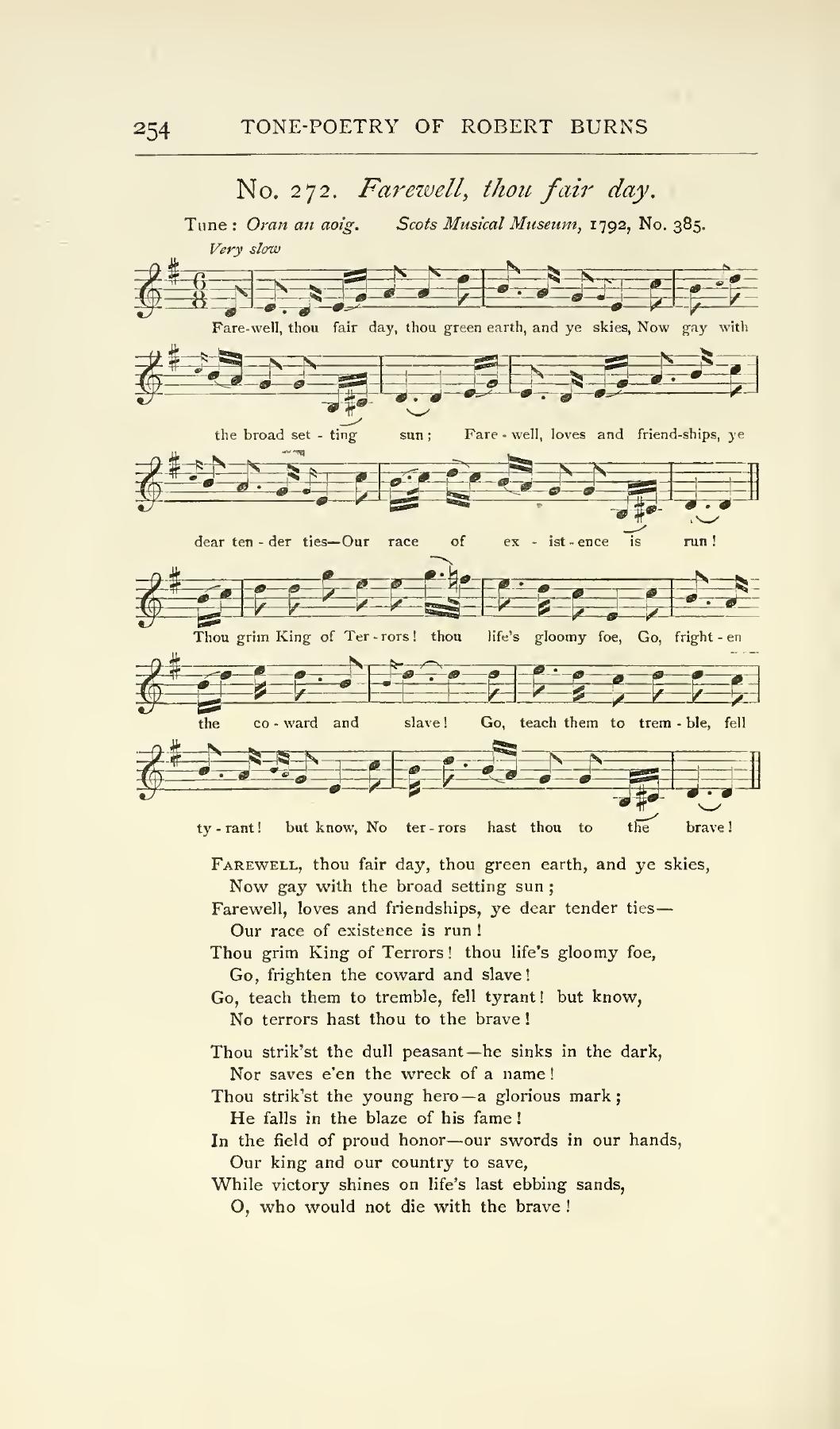 View score Dick’s Songs of Robert Burns (1903)
Lyrics
Choose an edition
Version notes
| Dick (1903) · no. 272 | Cunningham · 1855Ebook transcription |
|---|---|
| broad setting sun | bright setting sun |
| two octaves | four quatrains |
| honor | honour |
| a glorious mark; | a glorious mark! |
More differences between these editions
| Dick (1903) · no. 272 | Cunningham · 1855Ebook transcription |
|---|---|
| O | Oh |
| no scene before song; Dick note272 challenges customary preface | Scene—field of battle; evening; wounded/dying of victorious army supposed to sing |
Dick (1903) · no. 272
Farewell, thou fair day, thou green earth, and ye skies,
Now gay with the broad setting sun;
Farewell, loves and friendships, ye dear tender ties—
Our race of existence is run!
Thou grim King of Terrors! thou life's gloomy foe,
Go, frighten the coward and slave!
Go, teach them to tremble, fell tyrant! but know,
No terrors hast thou to the brave!

Thou strik'st the dull peasant—he sinks in the dark,
Nor saves e'en the wreck of a name!
Thou strik'st the young hero—a glorious mark;
He falls in the blaze of his fame!
In the field of proud honor—our swords in our hands,
Our king and our country to save,
While victory shines on life's last ebbing sands,
O, who would not die with the brave!
These are the words printed below the score.
View the source edition · no. 272; p. 254
About this edition
Dick prints two octaves; Cunningham divides the same sixteen lines into four quatrains. Dick has “broad setting sun”, “honor”, “Thou strik’st the young hero—a glorious mark;” and “O”; Cunningham has “bright setting sun”, “honour”, “a glorious mark!” and “Oh”. Cunningham’s battlefield/evening/victorious-army preface is absent from Dick’s song; Dick expressly challenges its authority in note 272.
Cunningham (1855)
Farewell, thou fair day, thou green earth, and ye skies,
  Now gay with the bright setting sun;
Farewell loves and friendships, ye dear tender ties—
  Our race of existence is run!

Thou grim king of terrors, thou life’s gloomy foe!
  Go frighten the coward and slave;
Go, teach them to tremble, fell tyrant! but know,
  No terrors hast thou to the brave!

Thou strik’st the dull peasant—he sinks in the dark,
  Nor saves e’en the wreck of a name;
Thou strik’st the young hero—a glorious mark!
  He falls in the blaze of his fame!

In the field of proud honour—our swords in our hands,
  Our king and our country to save—
While victory shines on life’s last ebbing sands,
  Oh! who would not die with the brave!
Digital text from Project Gutenberg.
View the source edition · p. 261
About this edition
Dick prints two octaves; Cunningham divides the same sixteen lines into four quatrains. Dick has “broad setting sun”, “honor”, “Thou strik’st the young hero—a glorious mark;” and “O”; Cunningham has “bright setting sun”, “honour”, “a glorious mark!” and “Oh”. Cunningham’s battlefield/evening/victorious-army preface is absent from Dick’s song; Dick expressly challenges its authority in note 272.
Scots Musical Museum, vol. IV (1792) · no. 385
View the source edition · Volume 4, no. 385; p. 399
Music
View historical scores
Dick’s Songs of Robert Burns (1903)
no. 272; p. 254